Owner’s manual


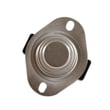
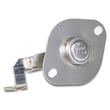
How do I know if my Kenmore dryer thermal fuse is blown?
If your Kenmore electric dryer model 11067832791 runs but won’t heat, or won’t run at all, a blown thermal fuse is a common cause. We confirm it by unplugging the dryer and testing the fuse for continuity with a multimeter; a blown fuse reads “open” (no continuity). See the 11067832791 owner's manual for safety steps and access guidance.
Quick symptoms that point to a blown thermal fuse
- Dryer will not start even though the door is closed and you press Start
- Motor runs but there is no heat (some models show this when one house fuse is blown)
- Dryer stops mid-cycle and won’t restart until it cools
- Burning smell or repeated overheating symptoms (often caused by restricted venting)
How we test the thermal fuse (continuity check)
- Unplug the dryer (or switch off the breaker).
- Access the fuse area (commonly on the blower housing or exhaust duct).
- Pull one wire off the fuse terminal so you don’t backfeed the circuit.
- Set your multimeter to continuity (or lowest ohms).
- Touch a probe to each terminal:
- Good fuse: continuity (near 0 ohms or meter beeps)
- Blown fuse: no continuity (OL or no beep)
What to do if the fuse is blown
A thermal fuse usually blows because the dryer overheated, so we fix the airflow problem at the same time.
| What we do | Why it matters |
|---|---|
| Clean lint screen and housing | Restores airflow and drying performance |
| Inspect and clean the vent run to the outside | Prevents repeat overheating |
| Check blower wheel for damage or looseness | Weak airflow can overheat the heater |
| Replace the failed safety part(s) | Restores safe operation |
Helpful model-matched parts to consider when airflow or overheating is involved:
- Dryer blower wheel WP694089 (moves air through the drum and vent)
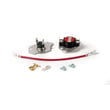
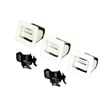
- Cut-off kit 279816 (thermal safety components often serviced together)
- Dryer operating thermostat WP3387134 (helps regulate temperature)
Why it matters
The thermal fuse is a one-time safety device designed to shut the dryer down if temperatures get unsafe. Replacing the fuse without correcting a crushed, kinked, or lint-clogged vent often leads to another failure and poor drying results.
Last updated: February 2026
How do I know what model my Kenmore dryer is?
Your Kenmore dryer’s model number is printed on the model and serial number plate; on model 11067832791, it’s the same plate you use to record the model and serial numbers for service and parts matching. Check the plate first, then write the number down exactly as shown.
Where to find the model number plate
Most Kenmore dryers place the model and serial number plate in one of these common spots:
- Inside the dryer door opening on the cabinet frame
- On the back of the dryer cabinet near the top
- Along the door opening edge where the door closes
- Occasionally behind the lower access panel (if equipped)
For the exact location and what the plate looks like for your dryer, use the 11067832791 owner's manual.
How to read it correctly (so parts match)
Model numbers must be copied exactly; one wrong digit can pull the wrong diagrams and parts.
- Copy the full model number (all digits)
- Copy the serial number too (helpful for production changes)
- Take a clear photo of the plate for reference
- Use the model number when ordering common wear items like a belt, thermostat, or heating element
Quick check table
| What you see on the plate | What it’s used for |
|---|---|
| Model number (example: 11067832791) | Finds the correct parts diagrams and compatible parts |
| Serial number | Helps confirm version changes and service history |
| Electrical ratings | Confirms power requirements for an electric dryer |
Why it matters
We use the model number to match parts to your exact Kenmore electric dryer configuration. That prevents ordering a similar-looking part that will not fit, especially for heating and drive components.
Last updated: February 2026
What is the average lifespan of 11067832791?
The average lifespan of the Kenmore 11067832791 electric dryer is 13 years. You can often reach or exceed that with steady airflow maintenance, routine lint removal, and prompt replacement of wear items like the belt, idler pulley, and thermostats.
Typical lifespan and what affects it
A dryer’s service life is mostly driven by heat stress and airflow restriction. The 11067832791 owner's manual also emphasizes lint and vent cleaning as key maintenance.
- Heavy weekly loads shorten life faster than light use
- Restricted venting overheats the heater and thermostats
- Worn drum support parts increase strain on the motor
- Electrical issues (loose connections, heat damage) accelerate failures
- Regular cleaning reduces heat buildup and component wear
Maintenance schedule we recommend
The manual notes lint can build up in the exhaust vent and inside the dryer; vent sections should be cleaned as needed, and internal lint removal is typically done periodically by a qualified service person.
| Task | How often | Why it matters |
|---|---|---|
| Clean lint screen | Every load | Keeps airflow strong, improves drying time |
| Clean exhaust duct to hood | At least yearly | Prevents overheating and long dry times |
| Check drum support noise (rollers, idler) | Every 6 months | Prevents belt and motor strain |
| Deep clean lint inside cabinet | Every 2 to 3 years | Reduces fire risk and heat damage |
Parts that commonly determine “end of life”
If your dryer still heats and tumbles, replacing a few parts often restores reliable operation.
- Drum belt 341241 if the drum will not turn or belt is cracked
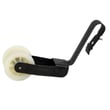
- Dryer idler pulley WP691366 if you hear squealing or the belt keeps slipping
- Dryer operating thermostat WP3387134 if temperatures are erratic
- Cut-off kit 279816 if the dryer overheats or stops heating after a vent restriction
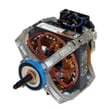
- Drive motor 279827 if the motor hums, stalls, or trips the breaker
Why it matters
Knowing the 13-year average helps you decide between maintenance, a targeted repair, or a larger rebuild. On model 11067832791, airflow care and timely replacement of wear parts are the biggest factors in getting full life from the heating system and motor.
Last updated: March 2026