 Installation guide
 Owner’s manual




What is the life expectancy of a GE washing machine?
A GE washing machine like model GLWN2800D1WS typically lasts 10 to 14 years with normal household use. Consistent maintenance, correct loading, and quick attention to leaks or unusual noise are the biggest factors that help this washer reach the high end of that range.
- Load size and balance: Overloading strains the drive system and suspension.
- Water quality: Hard water can speed up valve and hose wear.
- Drain health: Slow draining makes the pump work harder.
- Vibration control: An unlevel washer increases wear on tub and suspension parts.
- Routine cleaning: Reduces odor, residue, and corrosion.
- Keep the washer level and stable; re-check after moving it.
- Use the right amount of detergent (too much causes buildup).
- Inspect fill hoses for bulges or cracking; replace as needed.
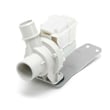
- If draining slows or you hear grinding, inspect the pump area and consider the washer drain pump WH23X10043.
- Follow setup and clearance guidance in the GLWN2800D1WS installation guide.
| Symptom | Often fixable? | Parts commonly involved on this model |
|---|---|---|
| Won’t drain or drains slowly | Yes | Drain pump, drain hose |
| Won’t start or stops mid-cycle | Often | Lid switch, timer |
| Loud rumbling during spin | Sometimes | Tub bearing, tub seal |
| Excessive vibration | Often | Suspension components, leveling |
Knowing the typical lifespan helps you decide whether to invest in a repair (for example, a drain pump or lid switch) or plan for replacement if multiple major systems are wearing out at the same time.
Last updated: January 2026
What is the most common problem with GE washers?
For the GE GLWN2800D1WS washer, the most common service issues we see are “won’t drain” and “won’t spin” complaints. These problems are often tied to a drain restriction, a failing lid switch system, or a worn drive component; all are common wear items on many GE top-load washers. See the GLWN2800D1WS installation guide for setup details that can prevent drain and vibration issues.
- Washer won’t drain: clogged drain hose, blocked pump, or a failing drain pump
- Washer won’t spin: lid switch not sensing closed lid, out-of-balance load, or drive system wear
- Loud noise during spin: tub bearing or tub seal wear, or a loose pulley
- Won’t fill or fills slowly: inlet screens clogged, water inlet valve issue, or pressure system problem
- Stops mid-cycle: timer or wiring/connection issue
If your symptoms match, these model-compatible parts are often involved:
| Symptom | Common part to check | What it does |
|---|---|---|
| Won’t drain / water left in tub | Washer drain pump WH23X10043 | Pumps water out through the drain hose |
| Won’t spin / acts like lid is open | Washer lid switch assembly WH12X10334 | Confirms the lid is closed so spin can run |
| Slow/no spin or burning rubber smell | Washer drive belt WH01X10302 | Transfers motor power to the drive pulley |
| Overfilling or wrong water level | Washer water-level pressure switch WH12X10479 | Senses tub water level to stop filling |
- Unplug the washer; turn off water.
- Confirm the drain hose is not kinked and the standpipe height is at least 30 inches.
- Redistribute the load; try a spin cycle with a small, balanced load.
- Listen for the drain pump running; a hum with no draining often points to a blockage.
- If the lid must be pressed or jiggled to spin, suspect the lid switch system.
Drain and spin problems can look like a “bad washer,” but they are often caused by a single service part (pump, lid switch, or belt). Catching the issue early helps prevent water leaks, repeated out-of-balance events, and extra wear on the tub and drive system.
Last updated: January 2026
How to force GE washer to drain and spin?
On the GE GLWN2800D1WS washer, you can usually force a drain and spin by selecting the spin portion of the cycle with the timer knob and starting the cycle with the lid closed. Exact knob labels vary, so we use the cycle chart in the GLWN2800D1WS owner’s manual.
- Turn the cycle knob to OFF for 30 seconds.
- Set the knob to a Spin or Drain/Spin portion of the dial (wording varies).
- Set water level to the lowest practical setting.
- Close the lid firmly (the washer typically will not spin with the lid open).
- Pull the knob out or press Start (depending on your control style).
- Listen for draining; you should hear water moving through the drain hose within 1 to 2 minutes.
- Check the drain hose for kinks and make sure it is not shoved too far into the standpipe.
- Confirm the home drain is open and not backing up.
- Verify the drain discharge height meets typical GE requirements (the installation guide calls out a 30-inch minimum).
- If you hear a hum but no water moves, suspect a clog at the pump or a weak pump.
- If it drains but will not spin, suspect the lid safety circuit.
| What you observe | What to inspect | Why it matters |
|---|---|---|
| No draining, or humming with no flow | Washer drain pump WH23X10043 | Moves water out so spin can start |
| Drains but won’t spin | Washer lid switch assembly WH12X10334 | Confirms lid is closed for safe spinning |
Draining first prevents overflow and lets the washer reach spin speed; it also helps you narrow the issue to the drain system (pump, hose, clogs) versus the lid switch safety circuit.
Last updated: January 2026


