Owner’s manual
 Error Codes



How do you level a Kenmore refrigerator?
To level your Kenmore side-by-side refrigerator model 1069552611, we set the cabinet level side-to-side and front-to-back using a level, shims (if needed), and the front leveling screws behind the base grille. Proper leveling helps the doors align and seal so cooling stays consistent.
Step-by-step leveling for model 1069552611
- Move the refrigerator into its final position.
- Place a level on top of the cabinet and check side-to-side, then front-to-back.
- If the floor is uneven at the back, roll the refrigerator out and use shims to level the floor near the wall.
- Roll the refrigerator back so the rear rollers sit on the shim(s).
- Open the refrigerator door and remove the base grille to access the two front leveling screws.
- Use a screwdriver to adjust the leveling screws:
- Turn clockwise to raise the low side (or raise the lower door).
- Turn counterclockwise to lower the high side (or lower the higher door).
- Open and close both doors after each adjustment; repeat until the doors are even and seal well.
What the front leveling screws control
On this style of Kenmore side-by-side, each front leveling screw affects door height on its side.
| Leveling screw location | What it raises/lowers | What you will notice |
|---|---|---|
| Freezer side | Freezer door side | Door alignment and sealing on freezer side |
| Refrigerator side | Refrigerator door side | Door alignment and sealing on fresh food side |
Why it matters
If the refrigerator is not level during installation, the doors can look uneven and may not close or seal properly. That can lead to temperature swings, frost buildup, or moisture around the doors.
Helpful tips
- Having someone gently push against the top of the refrigerator reduces weight on the rollers and makes the screws easier to turn.
- If your unit has an ice maker, level the refrigerator before finalizing the water hookup so you do not stress the water line.
- After leveling, reinstall the base grille and recheck the cabinet with the level.
For the exact diagrams and the leveling screw locations, follow the instructions in the 1069552611 owner's manual.
Last updated: February 2026
Where is the model number on a Kenmore side by side refrigerator?
On Kenmore side-by-side refrigerator model 1069552611, the model number is printed on the model and serial number label located inside the fresh food (refrigerator) compartment on a side wall. Use that label to record both the complete model and serial number for parts and service.
Where to look (fast checklist)
- Open the refrigerator (fresh food) door
- Look along the inside side walls near the front
- Check around the control panel area and light switch zone
- Look for a white or silver sticker/plate that lists both model and serial
- Wipe condensation or smudges off the label so the numbers are readable
What you should see on the label
The label typically includes both identifiers. Use the model number when ordering parts; use the serial number to identify production details.
| Item on label | What it’s used for | Example format |
|---|---|---|
| Model number | Matching the correct parts list | 1069552611 |
| Serial number | Manufacturing and service reference | Letters plus numbers |
Why it matters
Using the exact model number ensures we match your Kenmore refrigerator to the correct parts diagrams and compatible replacement parts (for example, an ice maker assembly, thermostat, or inlet valve). The wrong model number can lead to ordering a part that does not fit.
Helpful tip for parts lookup
Once you find the label, write the model and serial number down and keep it with your paperwork; the owner's manual also recommends recording this information for future reference.
Last updated: February 2026
Why is the ice maker not working on my Kenmore side by side refrigerator?
On Kenmore model 1069552611, the ice maker usually stops working because the freezer is not cold enough yet, the wire shutoff arm is in the OFF (up) position, or the refrigerator is not getting water. Use the checks below, then follow the owner's manual steps for your exact setup.
Quick checks that fix most “no ice” problems
- Make sure the freezer is cold enough to make ice; after changes, allow up to 24 hours for ice production.
- Confirm the ice maker wire signal arm is down (ON).
- Verify the household water shut-off valve to the refrigerator is fully open.
- Check that the water line is connected and not kinked behind the refrigerator.
- Look for a cube jammed in the ejector area; clear it with a plastic utensil.
- If the mold is dry (no water filling), focus on the water supply and inlet valve checks.
What to check based on what you see
| Symptom | Most likely cause | What to do next |
|---|---|---|
| Ice maker is on but no ice after a day | Freezer not cold enough | Set controls colder and wait 24 hours |
| Arm is up | Ice maker turned off | Lower the arm to ON |
| Ice mold is empty and dry | Water not reaching ice maker | Confirm shut-off valve is on; inspect line for kinks |
| Ice is stuck at ejector | Jam | Remove jam with plastic utensil |
Parts that commonly solve ice maker “no ice” issues
If your checks point to a failed component, these parts are commonly involved:
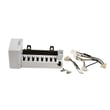
- Ice maker assembly - refrigerator ice maker by whirlpool 4317943 (complete ice maker assembly)
- Refrigerator inlet valve W10853654 (controls water flow into the refrigerator)
- Refrigerator door chute WP2180353 (more related to dispensing issues than ice production)
Why it matters
An ice maker needs two things to run: cold enough freezer temperatures and a steady water supply. If either one is missing, the ice maker can sit “on” but never fill, freeze, or harvest cubes.
Last updated: February 2026
How to replace an ice maker in a side by side refrigerator?
To replace the ice maker in your Kenmore 1069552611 side-by-side refrigerator, we unplug the refrigerator first, shut off the water supply, swap the ice maker assembly and any matching mounting/drive pieces, then restore water and power; ice production can take up to 24 hours.
Before you start (safety and prep)
- Unplug the refrigerator before working on the ice maker (shock hazard).
- Turn off the household water supply to the refrigerator.
- Empty the ice bin and clear any jammed cubes from the chute.
- Protect the floor; you may need to pull the refrigerator out for access.
- Keep a towel handy for small water drips at the rear water connection.
Replacement steps (typical for this model)
- Unplug the refrigerator.
- Turn the ice maker OFF (lift the shutoff arm if your unit uses one).
- Remove the ice bin/ice container.
- Remove the mounting screws and disconnect the ice maker wiring harness.
- Transfer any parts that must match the old unit (for example, the stripper or mounting bracket pieces) if your replacement does not include them.
- Install the new ice maker, reconnect the harness, and secure mounting screws.
- Turn the water supply back on and check for leaks.
- Plug the refrigerator back in and turn the ice maker ON.
What to expect after installation
It is normal for a newly installed ice maker to need time to cycle and fill. Use this quick guide:
| What you see | What it usually means | What we do |
|---|---|---|
| No ice right away | Normal startup | Wait up to 24 hours |
| Small or hollow cubes | Low water flow or air in line | Flush dispenser, verify shutoff valve fully open |
| Water leaking at back | Loose compression fitting | Tighten connection and recheck |
Parts and documents that help
- Use the owner's manual for model-specific diagrams, shutoff arm details, and water connection guidance.
- If you need the replacement assembly for this model, use the ice maker assembly - refrigerator ice maker by whirlpool 4317943.
Why it matters
A correct ice maker replacement prevents leaks, protects the wiring harness, and ensures proper water flow. Following the unplug and leak-check steps also helps avoid electrical shock and water damage.
Last updated: February 2026
How to tell if a Kenmore refrigerator compressor is bad?
A bad compressor on your Kenmore 1069552611 side-by-side refrigerator usually shows up as poor cooling even though the unit has power, along with unusual compressor behavior (repeated clicking, overheating, or not running). Before condemning the compressor, we confirm airflow, defrost, and temperature control issues that can mimic a sealed-system failure.
Quick checks before blaming the compressor
These items commonly cause “warm fridge” symptoms even when the compressor is OK:
- Make sure the doors seal and close fully; poor sealing can cause cooling and moisture problems.
- Listen for normal operating sounds; many new or different sounds are expected during cycles.
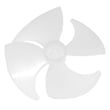
- Verify the evaporator fan is running (freezer airflow is critical for both sections).
- Check for heavy frost on the freezer back panel (points to a defrost problem).
- Confirm the temperature control is actually cycling the system on and off.
For model-specific operating notes and sound descriptions, use the owner's manual.
Signs that point more directly to a bad compressor
If the basics above check out, these symptoms are stronger compressor clues:
- Compressor won’t start and you hear repeated clicking every few minutes (start device overload cycling).
- Compressor runs constantly but temperatures stay unsafe (little to no heat at the condenser area, weak cooling).
- Compressor is extremely hot to the touch and shuts off on overload.
- No “refrigerant equalizing” gurgle when it stops and cooling performance is consistently poor.
What to test and what it means
Here is a practical way we separate compressor problems from control or defrost problems.
| What you observe | More likely cause | What we do next |
|---|---|---|
| Freezer has heavy frost, airflow weak | Defrost system issue | Check defrost components such as refrigerator defrost bi-metal WPW10225581 and refrigerator defrost timer W10822278 |
| Fan not running, warm temps | Airflow problem | Inspect evaporator fan area and blade for obstruction |
| Clicking at compressor, no cooling | Start device or compressor | Have a technician test start components and compressor windings |
| Runs but won’t cool | Sealed system (compressor/restriction/leak) | Sealed-system diagnosis by a technician |
Why it matters
Replacing a compressor is a major repair; confirming door sealing, airflow, and defrost operation first prevents unnecessary parts replacement and gets cooling restored faster.
Last updated: February 2026