Owner’s manual
 Error Codes



How to tell cubic feet of Kenmore refrigerator by model number?
For Kenmore model 25361832104, the model number alone usually does not state the exact cubic-foot capacity. The most reliable way is to look up the capacity in the 25361832104 owner's manual or estimate it by measuring the usable interior space and converting cubic inches to cubic feet.
Fast ways to find the cubic feet
- Check the specifications section in the 25361832104 owner's manual.
- Search the model tag information: the serial plate is located inside the refrigerator compartment (per the manual), and it confirms you have the full model number.
- Measure the interior (best for an estimate): measure the main fresh-food compartment and freezer compartment separately.
- Ignore exterior dimensions for capacity: insulation and liner thickness make outside measurements misleading.
How to estimate cubic feet by measuring
- Empty the compartment enough to measure.
- Measure width x depth x height (in inches) of the usable space.
- Multiply to get cubic inches.
- Divide by 1,728 to convert to cubic feet.
Quick conversion table
| What you have | What to do | Result |
|---|---|---|
| Inches (W x D x H) | Multiply | Cubic inches |
| Cubic inches | Divide by 1,728 | Cubic feet |
Why the model number is not a dependable “capacity code”
Kenmore model numbers (including the 253 prefix family) are primarily used to identify the product line and parts system; capacity can vary by configuration even within similar-looking models. Using the manual specs or a measurement-based estimate prevents ordering the wrong shelves, bins, or storage components.
Related parts sizing tip
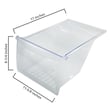
If you are replacing interior storage parts, match by model number and the exact part listing, not by cubic feet. For example, a drawer such as the crisper drawer - refrigerator storage component by frigidaire 240337103 is selected by fit for 25361832104, not by the refrigerator’s advertised capacity.
Last updated: January 2026
What are the most common issues with 25361832104?
The most common problems we see on the Kenmore 25361832104 top-mount refrigerator are warm temperatures (especially in the fresh-food section), frost buildup in the freezer, water leaking or puddling, and door sealing issues that cause longer run times. Use the 25361832104 owner's manual to confirm control settings and normal operation.
Common symptoms and what they usually point to
- Fridge warm, freezer OK: restricted airflow, iced-over evaporator area, or an evaporator fan issue
- Frost on freezer back wall: defrost system problem (often the defrost thermostat)
- Water under crisper or on floor: clogged/iced defrost drain or door left ajar
- Door not closing or sweating around the gasket: torn/warped gasket or door alignment issue
- Noisy operation: fan blade rubbing ice or a failing fan motor
Quick checks we recommend first
- Set controls to mid-range and give the unit 24 hours to stabilize.
- Make sure vents inside the refrigerator and freezer are not blocked by food packages.
- Check the door seal with the paper test; resistance should be consistent all around.
- Look for heavy frost on the freezer rear panel (a strong defrost clue).
- Clean dust from the condenser area to improve cooling efficiency.
Parts that commonly solve these issues
| Symptom | Likely area | Example part for this model |
|---|---|---|
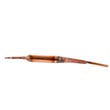
| Frost buildup, warming | Defrost system | Refrigerator defrost bi-metal thermostat 5303918202 |
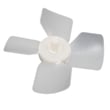
| Warm temps, noise | Evaporator airflow | Refrigerator evaporator fan blade 5308000010 or evaporator motor 5303918549 |
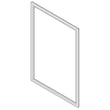
| Door not sealing | Door gasket | Refrigerator gasket 241872503 |
Why it matters
Cooling and defrost problems can quickly lead to food spoilage and higher energy use. Catching a weak door seal or early frost buildup also helps prevent fan damage and recurring leaks.
Last updated: March 2026
What is the erff code on a Kenmore Elite?
On many Kenmore Elite refrigerators, an ER FF (or Er FF) code points to an evaporator fan problem. The evaporator fan moves cold air from the freezer into the fresh food section, so when it fails you can see warm refrigerator temps, poor airflow, or unusual fan noise.
What you’ll notice when ER FF is active
- Refrigerator section warming up while the freezer is closer to normal
- Little or no airflow from the refrigerator vents
- Louder-than-normal fan noise, rattling, or intermittent fan operation
- Frost buildup on the freezer back wall (airflow restriction)
- Temperature swings after door openings
Quick checks we recommend (before replacing parts)
- Power reset: Unplug the refrigerator for 5 minutes, then restore power.
- Check for ice blockage: Look for frost or ice around the freezer rear panel and air vents.
- Door seal and loading: Make sure the freezer door closes fully and packages are not blocking vents.
- Listen for the fan: With the freezer door switch held closed, you should typically hear the evaporator fan running when cooling is called.
Parts that commonly relate to an evaporator fan issue
If the fan is noisy, damaged, or not moving air, these are common repair paths:
| Symptom | Most likely cause | Typical fix |
|---|---|---|
| Fan runs but rattles | Damaged blade or ice contact | Clear ice; replace fan blade if cracked |
| Fan not running | Failed fan motor, wiring, or control issue | Diagnose power to fan; repair wiring or replace failed component |
| Heavy frost, weak airflow | Defrost system problem | Check defrost thermostat and defrost components |
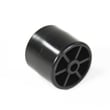
For this model’s parts catalog, a common related item is the refrigerator evaporator fan blade 5308000010. Another frequent cause of frost-related airflow problems is the refrigerator defrost bi-metal thermostat 5303918202.
Why it matters
The evaporator fan is what distributes cold air. When airflow stops, the refrigerator compartment warms quickly even if the compressor is running, and food can spoil.
For model-specific operating and troubleshooting guidance, use the 25361832104 owner’s manual.
Last updated: January 2026