Installation guide
 Owner’s manual


How to find a Kenmore dishwasher model number?
On Kenmore dishwasher model 66513473N410, the model number is printed on the rating label located just inside the door opening, typically along the left side of the tub opening. Open the door fully and read the label for both the model and serial numbers.
Check these common label locations first:
- Inside the door opening on the tub frame (most common)
- Left side of the tub opening near the front edge
- Along the inner door edge near the latch area
- On the side wall just behind the front gasket
If you need a picture of the exact label location and what the label looks like, use the 66513473N410 owner's manual.
- Turn on a kitchen light or use a flashlight; the print can be small
- Open the door and look for a white or silver “model and serial number” label
- Wipe the label gently with a damp cloth if it is dusty or spotted
- Write down the full model number exactly as shown (including letters and numbers)
- Record the serial number too; it helps match production changes when ordering parts
| Label item | What it’s used for |
|---|---|
| Model number (example: 66513473N410) | Matching the correct parts diagrams and parts |
| Serial number | Identifying production series and compatible revisions |
| Electrical ratings | Verifying power requirements for service |
We use the full model number to match the correct Kenmore parts and diagrams for your dishwasher, especially for components like the heating element, drain pump, water inlet valve, and control parts that can vary by production run.
Last updated: February 2026
What is the code E25 on a Kenmore dishwasher?
On a Kenmore dishwasher, an E25 code means the dishwasher is not draining correctly, most often because the drain pump area is blocked or the pump cover is loose or missing. On model 66513473N410, start by checking the drain path and pump for debris.
- Cancel the cycle and let the unit stop completely.
- Remove standing water (cup or wet/dry vac) so you can see into the sump.
- Check the filter area for food, labels, glass, or bone fragments.
- Inspect the drain hose routing for kinks or a crushed section under the sink.
- If you have a sink air gap, check it for clogs and clean it.
- Verify the drain hose has a proper high loop or is connected correctly to an air gap (routing details are shown in the 66513473N410 installation guide).
If the drain path is clear but E25 returns, the drain pump can be jammed or failing.
| Symptom | Most likely cause | What we do next |
|---|---|---|
| Hums but won’t drain | Debris in pump impeller | Clear obstruction; re-test drain |
| Drains slowly | Partial clog in hose/air gap | Clean hose/air gap; confirm routing |
| No pump sound | Pump not running | Check wiring, then replace pump if needed |
Relevant model parts:
- Dishwasher drain pump WPW10348269 (drives water out through the drain hose)
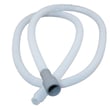
- Dishwasher drain hose 8269144A (can kink, clog, or collapse and restrict flow)
When the dishwasher cannot drain, dirty water can recirculate, cycles can stop mid-program, and you can end up with odors and poor cleaning. Fixing the drain restriction quickly also helps protect the pump and sump seals.
- Scrape heavy food off dishes before loading.
- Clean the filter area regularly (care steps are outlined in the 66513473N410 owner’s manual).
- Avoid running with labels or small items that can break loose and enter the sump.
Last updated: February 2026
How to install lower spray arm Kenmore dishwasher?
To install the lower spray arm on your Kenmore 66513473N410 dishwasher, we remove the lower rack, lift the old arm off its mount, then seat the new arm fully and confirm it spins freely without rubbing the heating element or sump area. Use the 66513473N410 installation guide for the exact access and safety steps.
- Turn off power at the breaker (dishwashers are hard-wired or plugged in under the sink).
- Shut off the water supply if you will be working near the inlet or moving the dishwasher.
- Open the door and pull out the bottom rack; set it aside.
- Place a towel over the pump area so small parts do not drop into the sump (this is a key tip in the install instructions).
- Work with the dishwasher level and stable; do not tip it forward.
- Remove the bottom rack to fully expose the lower spray arm.
- Remove the old spray arm:
- If it is a lift-off style, pull straight up.
- If it uses a center retainer/nut, turn the retainer counterclockwise and lift the arm off.
- Clean the mounting area (food debris around the hub can prevent a good seal and cause poor wash performance).
- Install the new lower spray arm by pressing it down onto the hub until it seats.
- Spin-test by hand; it must rotate smoothly and not contact the heating element.
- Reinstall the bottom rack and run a quick rinse cycle to confirm strong spray and no unusual noise.
For Kenmore 66513473N410, the listed lower spray arm is dishwasher spray arm, lower W10849471.
| Check | What you want to see | What it means if not OK |
|---|---|---|
| Arm spins freely | No rubbing or binding | Arm not seated, debris at hub, or interference |
| Spray holes clear | No mineral or food blockage | Weak cleaning, redepositing soil |
| No leaks at sump area | Dry under the unit after a cycle | Misfit, cracked arm, or disturbed seal |
A properly seated lower spray arm is what distributes wash water across the bottom rack. If it is loose, clogged, or rubbing, you can get poor cleaning, noise, and water circulation problems.
Last updated: February 2026
Why is my Kenmore dishwasher leaking from the bottom?
A bottom leak on your Kenmore dishwasher model 66513473N410 is usually caused by excess suds (overflow), the dishwasher not being level, or a leak at the sump, pump, or hoses under the tub. Start by checking for suds and confirming the unit is level per the 66513473N410 installation guide.
- Suds overflow from using the wrong detergent (or too much detergent), especially with soft water
- Dishwasher not level front-to-back or side-to-side, letting water spill past normal containment areas
- Loose or leaking drain connection at the drain hose or drain pump outlet
- Worn seals or grommets around the pump and sump area
- Cracked or leaking inlet valve body or a loose fill hose connection
- Open the door and look for foam. If you see suds, stop the cycle and let suds dissipate; then run a rinse/drain with no detergent.
- Confirm you are using dishwasher detergent only (never dish soap) and measure accurately.
- Verify the dishwasher is level in the cabinet opening (front-to-back and side-to-side).
- Inspect underneath for drips during fill and drain: look at the inlet valve, drain hose, and pump area.
- Check the filter and sump area for debris that can redirect water and cause leaks.
| Leak location | What you may notice | Related part for this model |
|---|---|---|
| Drain area | Water appears near the front after draining | Dishwasher drain hose 8269144A or dishwasher drain pump WPW10348269 |
| Pump/sump seals | Slow drip during wash circulation | Dishwasher pump grommet WPW10538166 or dishwasher sump and seal assembly WPW10455268 |
| Fill area | Drip during fill, then stops | Dishwasher water inlet valve W11175771 |
A bottom leak can damage flooring and cabinets quickly, and suds-related overflow can also cause poor washing and draining. Leveling and correct detergent use fix a large share of “mystery leaks” without parts.
For model-specific care and troubleshooting steps (including leak and suds guidance), follow the 66513473N410 owner’s manual.
Last updated: February 2026