 Installation guide
 Owner’s manual
 Error Codes




Can a clogged drain cause an FTD error?
Yes. On the GE GDF640HGM2WW dishwasher, an FTD (fail to drain) condition is commonly caused by a clog in the drain path, such as a blocked air gap, disposer connection, filter area, or drain hose, which prevents the drain pump from pushing water out.
What to check first (fast, no parts)
- Turn the dishwasher off, then check for standing water in the tub.
- Clean the air gap (if your installation has one); the manual notes to check it any time the dishwasher isn’t draining well.
- If the dishwasher drains into a garbage disposer, run the disposer to clear the inlet.
- Confirm the kitchen sink drains normally; a slow sink often points to a household drain restriction.
- Inspect the drain hose routing for kinks or a sag; a proper high drain loop helps prevent backflow.
Cleaning the filter and air gap
The manual describes removing the bottom rack and twisting the Ultra-Fine Filter assembly counterclockwise to lift it out for cleaning. Rinse with warm soapy water and remove debris carefully. For air gaps, remove the cover and cap, then clean the opening.
- Reference steps and diagrams in the GDF640HGM2WW owner’s manual.
- Verify the drain line routing and high loop requirements in the GDF640HGM2WW installation guide.
When a clog turns into a part problem
If the drain path is clear but the unit still won’t pump out, the issue often shifts to the drain pump or a restriction inside the hose.
| Symptom | Most likely cause | What we recommend |
|---|---|---|
| Water remains after cycle | Air gap/disposer/drain clog | Clean air gap, clear disposer, check sink drain |
| Hums but drains slowly | Partial blockage or weak pump | Check hose for debris; test drain pump |
| Drains sometimes, not always | Intermittent obstruction | Recheck filter area and hose routing |
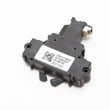
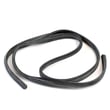
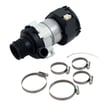
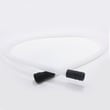
If you suspect a failed pump or damaged hose, common model-matched parts include the drain pump asm WD19X24829 and the dishwasher drain hose WD24X10062.
Why it matters
FTD conditions leave dirty water in the tub, can cause odors, and can reduce cleaning performance because the dishwasher cannot properly exchange wash water during the cycle.
Last updated: January 2026
What are the most common issues with GDF640HGM2WW?
The most common issues we see on the GE GDF640HGM2WW dishwasher are poor cleaning, not draining, leaking, not drying, and not starting. These problems usually trace back to spray-arm clogs, drain restrictions, door-latch issues, or a heating or pump problem; use the owner's manual for model-specific checks.
Common symptoms and what they usually mean
- Not cleaning well: clogged spray arms, low water fill, or circulation problem
- Not draining: blocked filter/sump area, kinked drain hose, or weak drain pump
- Leaking: door seal wear, loose hose connections, or tub gasket issues
- Not drying: heater issue, rinse aid setting, or door not venting properly
- Won’t start: door not latching, control lock/settings, or control power issue
Quick checks we recommend first
- Reset power at the breaker for 1 minute, then retry a cycle.
- Confirm the door closes firmly; a misaligned latch can stop the cycle.
- Clean the sump area and check for debris under the lower spray arm.
- Inspect the drain path for kinks or clogs.
- Run hot water at the sink before starting to improve wash performance.
Parts that commonly relate to these issues
| Symptom | Likely area | Example part on this model |
|---|---|---|
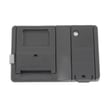
| Won’t start or stops mid-cycle | Door latch system | GE dishwasher door latch lock WD21X10490 |
| Not draining | Drain system | Dishwasher drain hose WD24X10062 or drain pump asm WD19X24829 |
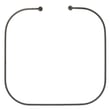
| Not drying | Heating circuit | Dishwasher heating element WD05X35098 |
| Poor cleaning | Wash system | Dishwasher spray arm, lower WD22X33499 or dishwasher circulation pump WD26X23258 |
| Leaking at the door | Door sealing | Dishwasher tub gasket WD08X23476 |
Why it matters
Catching the root cause early prevents repeat wash failures and helps avoid secondary damage, such as water leaks affecting the toe-kick area or a restricted drain overworking the pump.
For code-related problems, use GE electronic dishwasher error codes to match the display or blink pattern to the most likely fix.
Last updated: March 2026
What is the average life expectancy of a GE dishwasher?
A GE dishwasher typically lasts 10 to 12 years. With consistent care and normal household use, many units reach the low teens; heavy daily use and poor cleaning habits shorten lifespan. For your GE GDF640HGM2WW, following the care steps in the GDF640HGM2WW owner's manual helps you get the full expected service life.
What affects how long a GE dishwasher lasts
- Maintenance frequency: cleaning and periodic de-scaling reduce wear on the sump and pump.
- Water quality: hard water can cause mineral buildup that hurts wash performance and stresses components.
- Loading and detergent use: overloading and incorrect detergent amounts can lead to repeat washing and extra run time.
- Drying heat and cycle choices: frequent high-heat cycles add thermal stress over time.
- Installation quality: a stable, correctly installed dishwasher is less likely to leak or vibrate (see the GDF640HGM2WW installation guide).
Typical lifespan by use pattern
| Use pattern | Typical life expectancy | What to do to maximize life |
|---|---|---|
| Light (a few loads/week) | 12 to 15 years | Run a monthly cleaning cycle; keep seals clean |
| Average (1 load/day) | 10 to 12 years | Clean filters and spray arms; use rinse aid |
| Heavy (2+ loads/day) | 8 to 10 years | Reduce overloading; address draining and heating issues fast |
Maintenance habits that extend life
- Clean the interior and control panel with a damp cloth and dry thoroughly.
- Remove film and mineral buildup periodically (vinegar cleaning is commonly used when needed).
- Use the right detergent amount for your water hardness.
- Keep spray paths clear; if wash performance drops, inspect the dishwasher spray arm, lower WD22X33499 for clogs or damage.
Why it matters
Dishwashers usually fail early from buildup, leaks, or repeated strain on the circulation and drain system. Simple care reduces re-washes, improves drying, and helps protect high-cost parts like the circulation pump and heating element.
Last updated: January 2026





