Owner’s manual



What is the capacity of dle5977w?
The LG DLE5977W dryer has an IEC capacity of 7.3 cu. ft. (about 22.5 lb of laundry). You can confirm the published specifications and load guidance in the DLE5977W owner’s manual.
What “7.3 cu. ft.” means for real loads
A 7.3 cu. ft. drum is considered a large-capacity 27-inch dryer. For best drying performance, we recommend leaving enough space for clothes to tumble freely.
- Dry by volume, not weight; don’t pack the drum tight
- Mix similar fabrics (towels with towels, not towels with lightweight tees)
- Use Sensor Dry for most everyday loads
- Clean the lint screen before or after every load
- Keep the exhaust vent run short and clear to maintain airflow
Example load sizes (typical for this model)
The manual includes sample “super capacity” loads; here’s a quick reference:
| Load type | Example items |
|---|---|
| Heavy work clothes | 4 jeans, 2 sweatpants, 4 workpants, 2 sweatshirts, 4 work shirts |
| Cotton/towels | 10 bath towels, 14 wash cloths, 10 hand towels |
| Mixed load | 3 sheets (1 king, 2 twin), 4 pillowcases, 3 shirts, 3 blouses, 9 T-shirts, 9 shorts, 10 handkerchiefs |
Why it matters
Using the correct load size helps the moisture sensor read accurately, reduces dry time, and helps prevent wrinkles and overheating from restricted airflow.
Last updated: January 2026
How do I reset my LG dryer?
To reset your LG DLE5977W dryer, we recommend a simple power reset: turn the dryer off, unplug it (or switch the breaker off), wait 1 minute, then restore power and start a cycle again. This clears many control glitches without disassembly.
Quick reset steps (safe for most situations)
- Press Power to turn the dryer off.
- Unplug the dryer (or turn the dryer breaker off).
- Wait 60 seconds.
- Plug back in (or turn the breaker on).
- Press Power, select a cycle, and press Start/Pause.
For control-panel features like Child Lock (CL), use the button sequence shown in the DLE5977W user manual.
If the dryer still will not start or heat
A “reset” will not fix a hard failure such as a tripped house breaker, poor airflow, or a failed heating component. On the LG DLE5977W, these checks are the most common next steps:
- No start: confirm the door fully closes and the door switch clicks; a failed switch can stop operation.
- No heat (electric): confirm both sides of the 240V supply are present (electric dryers often use 2 breakers/fuses).
- Long dry times: clean the lint screen and make sure the vent run is not crushed or clogged.
Parts that commonly relate to “no heat” or control issues
| Symptom | Part to consider | What it does |
|---|---|---|
| No heat / weak heat | Dryer heating element 5301EL1001J | Heats air for electric drying cycles |
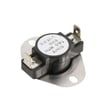
| Overheating / shuts down | Dryer high-limit thermostat 6931EL3003D | Opens if temperature gets too high |
| Temperature errors / poor sensing | Dryer thermistor AGM30045804 | Helps the control measure temperature |
Why it matters
Resetting is a fast way to clear a temporary electronic glitch, but repeated overheating or “no heat” symptoms usually point to airflow restrictions or a failed heating or temperature-sensing part.
Last updated: January 2026
What is the most common problem with LG dryers?
On the LG DLE5977W dryer, the issue we see most often in troubleshooting is “clothes take too long to dry” or “dryer doesn’t heat.” On this model, the first place to focus is airflow (lint screen and venting) because restricted exhaust is a leading cause of poor drying and overheating symptoms.
What to check first on DLE5977W (no parts)
Use the operating and maintenance steps in the DLE5977W dryer manual and start with these quick checks:
- Clean the lint screen before every load and make sure it seats fully.
- Check the vent hose behind the dryer for kinks, crushing, or loose connections.
- Confirm strong airflow at the outside vent hood while the dryer runs.
- Avoid overloading; bulky loads can dry unevenly and extend cycle time.
- Try a timed cycle to compare results versus Sensor Dry.
When it’s airflow vs. a heating/control problem
Here’s a practical way to separate the two common causes.
| What you notice | More likely cause | What to do next |
|---|---|---|
| Long dry times, cabinet feels hot | Restricted venting or lint buildup | Clean/shorten vent run; verify outside damper opens freely |
| Drum tumbles but clothes stay cool | Heating circuit or temperature sensing | Check power supply (electric), then test heating components |
| Heat starts then stops repeatedly | Overheating protection opening | Fix airflow first; then check thermostats if needed |
Parts that commonly relate to “no heat” or “poor drying” on DLE5977W
If airflow is confirmed good and the dryer still won’t heat or dries poorly, these model-compatible parts are typical suspects:
- Dryer heating element 5301EL1001J (electric heat source)
- Dryer high-limit thermostat 6931EL3003D (safety cutoff for overheating)
- Dryer thermistor AGM30045804 (temperature sensing for heat control)
- Dryer blower wheel 5835EL1002A (moves air through the drum and vent)
What about noise issues?
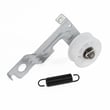
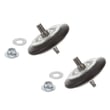
Noise and vibration are also common dryer complaints, but they are not necessarily the single most frequent issue for every LG dryer. On DLE5977W, thumping or rumbling often points to wear items such as the dryer drum support roller 4581EL2002L or the LG dryer idler pulley 4561EL3002A.
Why it matters
Airflow problems can make drying slow, trigger overheating protection, and shorten the life of heating parts. Fixing venting and lint buildup first often restores normal drying without replacing components.
Last updated: January 2026
What does d mean on a LG dryer?
On the LG DLE5977W dryer, a single “d” on the display isn’t defined as a standalone code in the model’s documentation we have; it’s usually part of a longer message or a partial character on the status display. Use the DLE5977W user manual to match the full display behavior before troubleshooting.
What to check first on DLE5977W
Capture the complete display and the exact moment it appears.
- Look for additional letters (for example, “CL” for Child Lock) or a second character that appears after a few seconds
- Note whether it shows during a cycle, at the end of a cycle, or when you press Start/Pause
- Power the dryer off, wait 10 seconds, then power it back on to see if the same display returns
- Try a different cycle (Sensor Dry vs. Time Dry) to see if the display changes
- If the dryer isn’t drying well, check airflow and lint buildup at the same time
If “d” appears with long dry times or overheating symptoms
The DLE5977W manual emphasizes venting and lint maintenance; restricted airflow is a common cause of poor drying and can trigger unusual display behavior on many LG dryers.
- Clean the lint screen before every load
- Check the lint screen housing for lint buildup and vacuum it out
- Inspect the vent hose for kinks, crushing, or sagging
- Make sure the outside vent hood damper opens freely
- Clean the full vent run if dry times suddenly increase
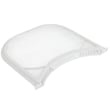
If the lint screen is damaged or doesn’t fit tightly, replace it to help maintain proper airflow: LG dryer lint screen 5231EL1003B.
Quick guide: what “d” might mean based on symptoms
| What you notice | Most likely category | What we recommend first |
|---|---|---|
| “d” only, dryer works normally | Display/status behavior | Recheck for additional characters and indicators |
| “d” plus long dry times | Airflow restriction | Clean lint screen and inspect venting |
| “d” plus no heat or weak heat | Heating/temperature control issue | Verify airflow, then move to heat diagnostics |
Why it matters
On DLE5977W, confirming the full display prevents unnecessary part replacement. Most dryer problems trace back to settings, airflow, or lint buildup, and those checks are fast and low-cost.
Last updated: January 2026