Owner’s manual
 Error Codes



How to lower wheels on Kenmore refrigerator?
To lower the front of your Kenmore 59673502202 bottom-mount refrigerator, turn the front roller adjustment screws counterclockwise; they do not back out, they simply change the wheel height. For proper stability, lower the front rollers after the stabilizing legs are firmly on the floor (see the owner's manual).
Steps to lower the wheels (front rollers)
- Unplug the refrigerator or switch off power at the breaker for safety.
- Remove the toe grille and the bottom bracket covers.
- Locate the front roller adjustment screws (A).
- Turn both front adjustment screws counterclockwise to lower the front.
- Turn the stabilizing legs (C) clockwise until they are firmly against the floor.
- Turn the front roller adjustment screws 2 to 3 turns counterclockwise so the refrigerator’s weight rests on the stabilizing legs.
Leveling targets we use for this model
The manual’s goal is a slight “tilt back” so the doors close and seal correctly.
| What to check | Target | Why it helps |
|---|---|---|
| Front-to-back level | Front about 1/4 inch (6 mm) higher than back | Improves door closing and sealing |
| Left-to-right level | Level side-to-side | Prevents door swing and uneven gasket contact |
| Stability | Stabilizing legs firmly on floor | Reduces vibration and movement |
Why it matters
If the front rollers are too low (or the stabilizing legs are not set), the refrigerator can rock, doors may not self-close, and you can get air leaks that cause temperature swings, frost, or moisture.
Quick tips if the screws seem “stuck”
- Use the correct driver (the manual calls for a 5/16-inch hex head driver).
- Turn both sides the same number of turns to keep the cabinet square.
- Reinstall the toe grille when finished so airflow and appearance stay normal.
Last updated: February 2026
What are the most common problems with Kenmore refrigerators?
The most common Kenmore refrigerator problems are warm temperatures, frequent running, water leaks, odors, condensation (water droplets), and unusual noises. For Kenmore model 59673502202, our troubleshooting starts with door sealing, control settings, and cleaning the condenser coils as outlined in the owner's manual.
Most common symptoms and what usually causes them
- Food temperature too warm: door not closing properly, controls need adjustment, dirty condenser coils, blocked rear air grille, frequent door openings
- Refrigerator runs too frequently: warm room conditions, frequent door openings, dirty condenser coils, controls set too cold, door not sealing
- Water leaking: water line connection issues (plastic tubing and poor valve choices are common contributors)
- Odors: spills, uncovered foods, dirty interior, or gaskets not sealing well
- Condensation inside or outside: high humidity, frequent door openings, gasket sealing issues
- Unfamiliar sounds: normal ice maker fill buzz, compressor hum, and defrost heater sizzling or popping
Quick checks we recommend first (in order)
- Confirm the doors close and seal: check for bins, drawers, or containers preventing closure.
- Check gasket contact: wipe the gasket and mating surface clean so it seals consistently.
- Verify temperature controls: adjust in small steps and allow time to stabilize.
- Clean condenser coils: dirty coils are a top cause of warm temps and long run times.
- Listen for “normal” sounds: ice maker fill and defrost sounds can be expected during operation.
Symptom-to-fix guide
| Symptom | Most likely cause | Best first action |
|---|---|---|
| Too warm | Dirty coils, door not sealing, controls | Clean coils; check door seal; adjust controls |
| Runs a lot | Heat/humidity, dirty coils, door openings | Improve airflow; clean coils; reduce door-open time |
| Water on floor | Water connection/valve issue | Inspect tubing/valve; correct connection |
| Loud or new noises | Ice maker fill, compressor, defrost heater | Compare to normal operating sounds |
Why it matters
These issues often stack together. For example, a door that does not seal well raises humidity and temperature, which makes the compressor run longer and can increase condensation and odors.
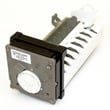
If you are troubleshooting ice maker-related noise or performance, checking the refrigerator ice maker D7824706Q can also help when the ice maker is not cycling or filling correctly.
Last updated: February 2026
What is a bottom mount fridge freezer?
A bottom-mount (bottom freezer) refrigerator puts the freezer compartment on the bottom and the fresh-food section on top, so everyday refrigerated items sit at eye level. Your Kenmore 59673502202 is a bottom freezer design, which reduces bending for fresh-food access.
How a bottom-mount refrigerator is laid out
- Fresh-food compartment is on top (most-used items are easier to reach)
- Freezer is a lower drawer or door (bulk frozen storage below)
- Controls are typically inside at the top front of each compartment
- Many models use dual fresh-food doors with a center sealing flap (mullion)
For model-specific features and control locations, use the owner's manual.
Bottom-mount vs. top-freezer: quick comparison
| Feature | Bottom-mount (bottom freezer) | Top-freezer |
|---|---|---|
| Fresh-food access | Higher, easier reach | Lower, more bending |
| Freezer access | Lower drawer/door | Upper door |
| Best for | Frequent fresh-food use | Frequent freezer use |
Why it matters
This layout affects daily ergonomics and also impacts common service areas. For example, door sealing between two fresh-food doors often relies on a vertical mullion (flipper) to prevent warm air leaks and frost.
Related parts you might see on this model
If you are identifying components while troubleshooting, these are common bottom-mount items listed for Kenmore 59673502202:
- Vert mullion WP12722803W (helps seal between fresh-food doors)
- Toe grille WP67002224 (covers the lower front area)
- Refrigerator ice maker D7824706Q (automatic ice production, if equipped)
Last updated: February 2026
What's the average lifespan of a Kenmore refrigerator?
Most Kenmore refrigerators last 12 to 15 years with normal household use. For your Kenmore 59673502202 bottom-mount refrigerator, keeping the condenser area clean, maintaining good airflow, and fixing cooling or water issues early helps you reach (and often exceed) that typical lifespan; see the owner's manual.
Typical lifespan and what affects it
A refrigerator’s life is mainly driven by compressor run time, heat buildup, and how well the doors seal.
- Ventilation and heat: blocked airflow makes the compressor work harder
- Dirty condenser coils: raises operating temperature and wear
- Door gasket leaks: causes long run times and frost issues
- Defrost system health: prevents ice buildup that restricts airflow
- Water and ice maker upkeep: reduces leaks and clogs that can damage components
Quick maintenance checklist (high impact)
Use this as a simple routine to protect the sealed system and cooling performance.
- Vacuum dust from the front toe-kick area and around the unit regularly
- Keep a small gap behind the refrigerator for airflow
- Confirm doors close fully and shelves are not blocking closure
- Replace the water filter about every 6 months (more often with heavy use or poor water quality)
- Address unusual noises, warm temperatures, or frost buildup promptly
Common “wear items” vs. long-life components
| Component area | Typical pattern | Why it matters |
|---|---|---|
| Ice maker and water system | More frequent service needs | Leaks and restrictions can create bigger problems |
| Fans and controls | Mid-life repairs are common | Poor airflow or defrost issues reduce cooling efficiency |
| Sealed system (compressor, refrigerant loop) | Designed for long service life | Overheating and long run times shorten lifespan |
Why it matters
A refrigerator that runs hotter or longer than normal uses more energy and puts extra stress on the compressor. Simple airflow and cleaning habits are the easiest way to protect the most expensive cooling components.
Last updated: February 2026