Owner’s manual
 Error Codes



How to reset a LG fridge freezer?
To reset your LG LFC22770SW refrigerator and freezer, disconnect power for about 5 minutes (unplug the cord or turn off the circuit breaker), then restore power and allow up to 24 hours for temperatures to stabilize. Use the control panel to turn off any special modes that stay enabled.
Quick reset steps (power cycle)
- Unplug the refrigerator, or switch the dedicated circuit breaker OFF.
- Wait 5 minutes (this clears many control-board glitches).
- Restore power.
- Confirm the control panel lights up and cooling starts.
- Monitor temperatures for the next 24 hours (normal recovery time after a reset).
If cooling is still off: check for Display Mode (store mode)
On some LG models, Display Mode disables cooling and can look like a “failed” fridge. To toggle it:
- Open either refrigerator door.
- Press and hold Refrigerator and Ice Plus together until the control panel beeps.
- Verify cooling resumes (Display Mode should be off).
Details and button locations are shown in the owner's manual.
What a reset does (and does not) do
| Action | What it affects | What to expect |
|---|---|---|
| Power reset (5 minutes off) | Control board reboot | Temps may take hours to normalize |
| Turning off Display Mode | Restores cooling | Cooling should start shortly |
| Ice Plus on/off | Boosts ice making and freezing | Runs up to 24 hours unless stopped |
Why it matters
A reset is the fastest way to clear a temporary control-board lockup after a power flicker, cleaning, or a door-left-open event. If the freezer still will not cool after you confirm Display Mode is off, the issue is usually airflow, a sensor, or a sealed-system problem.
Last updated: February 2026
Why is my LG refrigerator not making ice on the lower part?
If your LG LFC22770SW isn’t making ice in the lower freezer area, the most common causes are the icemaker being switched OFF, the freezer temperature being too warm (target 0°F), or a water supply issue (valve closed, kinked line, or low pressure). See the LFC22770SW owner's manual for icemaker switch and operating requirements.
Quick checks we recommend first
- Wait 12 to 24 hours after a new install or after reconnecting water; ice production ramps up after temperatures stabilize.
- Confirm the icemaker power switch is set to ON (I).
- Set the freezer to 0°F (-18°C) for normal ice production.
- Make sure the freezer drawer closes fully; frequent openings slow ice production.
- Check the ice-detecting sensor area for frost or debris; clean it so it can “see” ice properly.
- Verify the house water valve is fully open and the supply line behind the refrigerator is not kinked.
Water supply and pressure (very common on bottom-mount units)
Your LFC22770SW needs adequate water flow to fill the ice mold. The manual calls for 20 to 120 psi water pressure for normal ice production.
| What you see | Likely cause | What to do |
|---|---|---|
| No ice at all | Icemaker OFF or no water supply | Turn icemaker ON; confirm valve open and line not kinked |
| Small cubes or slow output | Low water pressure or restricted flow | Check pressure, straighten line, replace restricted components |
| Stops after some ice | Sensor blocked by frost/debris | Clear frost and clean sensor area |
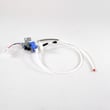
If you suspect the valve is not opening consistently, the model-specific replacement is the LG refrigerator water inlet valve AJU73753101.
Why it matters
Ice production depends on three things working together: freezer temperature, water supply pressure/flow, and the icemaker’s ability to detect and harvest ice. Fixing the root cause prevents repeated thawing, clumping, and inconsistent cube size.
Helpful DIY guidance
- How to diagnose a faulty refrigerator water inlet valve
- Common refrigerator ice maker problems and solutions
- How to prevent water dispenser and ice maker problems
Last updated: February 2026
What are common LG freezer problems?
Common freezer problems on the LG LFC22770SW usually come down to temperature control issues, airflow restrictions, door sealing problems, or a defrost-related ice buildup that blocks cooling. We start by confirming the freezer is set to 0°F (-18°C) and giving the unit time to stabilize after changes (see the owner's manual).
Most common freezer symptoms and what they point to
- Freezer not cold enough: doors opened often, doors not fully closed, or airflow blocked by packages
- Freezer too cold or food freezer-burned: temperature set too low or frequent door openings causing frost
- Frost or ice crystals on food: warm, humid air entering from frequent openings or a door that is not sealing
- Ice maker not keeping up (if equipped): freezer warmer than 0°F, water supply issue, or sensor obstruction
- Intermittent cooling: normal defrost cycle can temporarily raise compartment temperature
Quick checks we recommend (in order)
- Verify settings: set freezer to 0°F (-18°C); adjust one step at a time and wait for temperatures to stabilize.
- Give it time: after installation or moving, allow up to 24 hours to reach target temps; if it was on its side, let it stand upright 24 hours before powering on.
- Reduce warm-air intrusion: limit door-open time and confirm doors close completely.
- Check for airflow blockage: keep vents clear; avoid packing food tightly against the back wall.
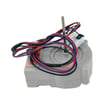
- Look for fan-related clues: if you hear unusual fan noise or have weak airflow, the LG refrigerator evaporator fan motor 4681JB1027C is a common cooling component to inspect.
Symptom-to-cause guide
| What you notice | Likely cause | What to do first |
|---|---|---|
| Fridge cold, freezer warm | Airflow/defrost issue or sealed-system problem | Check vents, door closure, and allow 30 minutes if in defrost |
| Heavy frost buildup | Door not sealing or frequent openings | Inspect gasket, reduce openings, reorganize food |
| Ice maker slow | Freezer above 0°F or water supply issue | Confirm 0°F setting; check water valve fully open |
| Food freezing in fresh-food section | Room too cold for operation | Avoid operating below recommended ambient temps |
Why it matters
Freezer performance depends on stable temperature, good airflow, and tight door sealing. Small issues like frequent door openings or blocked vents can mimic bigger failures and lead to thawing, frost buildup, and ice maker complaints.
For model-specific control settings and troubleshooting steps, follow the temperature and troubleshooting sections in the owner's manual.
Last updated: February 2026