Owner’s manual
 Error Codes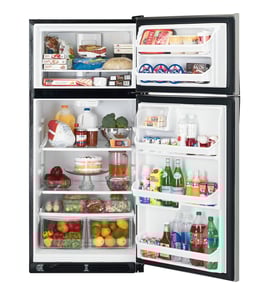


How to read Kenmore model numbers?
Kenmore model numbers are read left to right: the first 3 digits identify the manufacturing source, and the remaining digits identify the specific product design and feature set. For your Kenmore top-mount refrigerator model 10678229801, the 106 prefix points to the manufacturer family used for many Kenmore refrigerators; use the full number to match the correct parts and manual.
Where to find the model number (and why the full number matters)
We use the complete model number to ensure parts like a water filter, ice maker, or control board fit correctly.
- Check the model and serial label inside the fresh food compartment (commonly on a side wall or near the crisper area)
- Write down the full model number and serial number exactly as shown
- Keep it with your purchase date for service and parts lookup
- Use the full model number when ordering parts (not just the 3-digit prefix)
- If a label is hard to read, take a clear photo and zoom in
For label locations and recording details, use the owner's manual.
How to interpret the digits
Kenmore model numbers typically break down like this:
| Section | Example from your model | What it tells us |
|---|---|---|
| Prefix (first 3 digits) | 106 | Manufacturing source family |
| Remaining digits | 78229801 | Series, configuration, and revision details |
Why it matters
- The prefix helps identify the build platform
- The remaining digits prevent ordering the wrong version of a part
- Small revisions can change fit for items like door gaskets, shelves, and ice maker components
Parts lookup tip for this model
When you search parts for 10678229801, match by model first, then confirm by part ID. For example, this model uses a water filter listed as refrigerator filter EDR6D1.
Last updated: February 2026
How do I find the cubic feet of my Kenmore freezer?
To find the cubic feet of the freezer in your Kenmore 10678229801 top-mount refrigerator, we measure the usable inside space (height, width, depth in inches) and divide by 1,728. This gives freezer volume in cubic feet, which is useful for storage planning and outage prep.
Steps to measure freezer cubic feet
- Empty the freezer enough to measure the main compartment.
- Measure the inside dimensions in inches:
- Height (top to bottom)
- Width (side to side)
- Depth (front to back)
- Multiply:
height x width x depth = cubic inches. - Convert to cubic feet:
cubic inches ÷ 1,728 = cubic feet. - If your freezer has a pull-out floor or baskets, measure the main cavity; then subtract any permanently blocked areas (like an air tower) for a more realistic “usable” number.
Quick tips for accurate measuring
- Measure to the nearest 1/8 inch if possible.
- Measure the largest open rectangle of the compartment, not the door bins.
- Keep airflow areas clear; don’t pack items tight against vents.
- If shelves/floors are removable, reinstall them before measuring so you’re measuring “real-world” space.
Example calculation
If the inside measures 24 in (H) x 18 in (W) x 16 in (D):
- Cubic inches: 24 x 18 x 16 = 6,912
- Cubic feet: 6,912 ÷ 1,728 = 4.0 cu ft
| What you measure | Units | What you do |
|---|---|---|
| Height x width x depth | inches | Multiply to get cubic inches |
| Cubic inches | in³ | Divide by 1,728 |
| Result | ft³ | Freezer volume |
Why it matters
Freezer cubic feet helps you plan safe loading and storage. For example, our manual guidance uses freezer volume to estimate how much unfrozen food you can add at once (about 2 to 3 lb per cubic foot in 24 hours) and how much dry ice to use during longer power outages (about 2 lb per cubic foot). See the owner's manual for model-specific storage and care guidance.
Last updated: February 2026
How to unclog a Kenmore refrigerator drain line?
To unclog the drain line on your Kenmore 10678229801 top-mount refrigerator, we clear ice and debris from the freezer drain opening and then flush the drain tube with hot water until it flows freely into the drain pan underneath. This stops water leaks, ice buildup, and musty odors.
Before you start (safety and access)
- Unplug the refrigerator or disconnect power.
- Remove food from the freezer floor and take out the ice bin (if equipped).
- Lay towels down; drain clogs often release a lot of water at once.
- Use hot (not boiling) water to avoid cracking plastic liners.
- If you have an ice maker, switch it off while you work.
Step-by-step: clear the freezer drain
- Find the drain hole: It’s typically at the back of the freezer floor, under or behind the rear panel.
- Melt any ice plug: Warm the area with a hair dryer on low or place a cup of hot water near the drain opening for a few minutes.
- Flush the drain: Use a turkey baster or squeeze bottle to force hot water into the drain hole.
- Break up the clog: Feed a flexible plastic tube, zip tie, or pipe cleaner a short distance into the drain to loosen sludge.
- Confirm it’s open: Keep flushing until water runs quickly down the tube.
Verify the drain pan is draining correctly
A clogged drain line can also back up if the drain pan area is dirty.
| What you see | What it usually means | What we do |
|---|---|---|
| Water/ice on freezer floor | Drain hole or tube blocked | Melt ice, flush drain tube |
| Water under fridge | Drain overflowed or pan shifted | Clear drain, check pan position |
| Musty smell | Standing water and debris | Clean drain and pan area |
Why it matters
When the defrost system runs, meltwater must travel through the drain tube to the drain pan. If that path is restricted, water refreezes in the freezer, leaks into the fresh food section, or puddles on the floor.
Helpful related guidance
- For model-specific panel removal and drain location details, follow the steps in the owner's manual.
- If you’re also dealing with water dispenser or ice maker issues, use how to prevent water dispenser and ice maker problems to reduce repeat clogs and freezing.
Last updated: February 2026
What is the ER if code on a Kenmore 10678229801?
On Kenmore top-mount refrigerator model 10678229801, the ER IF (or Er IF) code points to an ice fan problem in the freezer area. That fan moves cold air through the ducting that helps keep the ice maker compartment cold, so ice production can slow down or stop.
What you’ll usually notice
- Ice maker stops making ice or makes very little ice
- Ice cubes look wet, clumped, or partially melted
- Freezer temperature seems OK, but the ice bin area is warm
- You hear unusual fan noise (rattling, grinding) or no fan sound at all
- The code returns after you clear it or after a power reset
Quick checks we recommend first
- Power reset: Unplug the refrigerator for 2 minutes, then plug it back in.
- Check for airflow blockage: Make sure packages are not blocking vents in the freezer.
- Look for frost buildup: Heavy frost near the rear freezer panel can restrict airflow and stress the fan.
- Inspect the ice room/duct area (if equipped): Ice or frost in the duct can reduce airflow.
- Confirm the freezer is cold enough: Target about 0°F in the freezer for reliable ice making.
Parts that commonly relate to ER IF symptoms
If the fan is not running or airflow is weak, these parts are often involved in the repair path:
| What it affects | What to check | Example part for this model |
|---|---|---|
| Cold air movement in freezer | Evaporator fan motor operation and noise | Evaporator motor WPW10189703 |
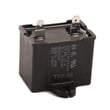
| Heat removal at back/bottom | Condenser fan motor running when compressor runs | Condenser motor W10124096 |
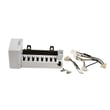
| Ice maker output (secondary symptom) | Ice maker cycling and filling | Refrigerator ice maker 4317943 |
Why it matters
The ice fan is what delivers cold air where the ice maker needs it. When airflow drops, the ice maker compartment warms up even if the freezer still feels cold, and the refrigerator may post ER IF to flag that cooling-air problem.
Helpful DIY reference
For model-family troubleshooting steps and code meanings, use our Kenmore 106 model refrigerator error codes guide alongside your owner's manual.
Last updated: February 2026