Owner’s manual
 Error Codes



How to lower wheels on Kenmore refrigerator?
On Kenmore refrigerator model 59673504201, you lower the front rollers by turning the front roller adjustment screws counterclockwise. The screw is designed to adjust height and typically will not back out. For exact access points and leveling targets, use the 59673504201 owner's manual.
- Remove the toe grille and the bottom bracket covers.
- Find the front roller adjustment screws (often labeled “A” in the manual).
- Turn both front adjustment screws counterclockwise to lower the front.
- After lowering, set the stabilizing legs so the refrigerator sits solidly.
- Unplug the refrigerator if you will be working near wiring or moving the unit.
- Turn both front adjustment screws the same amount to keep doors aligned.
- Lower the front only a little at a time; re-check door swing and sealing.
- Set stabilizing legs down to the floor so the cabinet does not rock.
- Reinstall the toe grille when finished.
For this style of bottom-mount refrigerator, we level it so the front is slightly higher than the back. That helps the doors close on their own and improves gasket sealing.
| What to check | What you want | Why |
|---|---|---|
| Front-to-back level | Front slightly higher than back (about 1/4 inch or a small bubble) | Helps doors close and seal |
| Side-to-side level | Even left to right | Prevents twisting and uneven door gaps |
| Stability | No rocking | Reduces noise and door misalignment |
If the front rollers are too high, the doors may not close consistently, warm air can leak in, and you can see frost, temperature swings, or moisture around the door seals.
Last updated: January 2026
How to find model number on Kenmore?
For Kenmore model 59673504201, we find the model number on the model and serial number sticker inside the fresh food (refrigerator) section, typically on the left wall. Write down both the model and serial numbers before ordering parts or scheduling service.
Check these common label locations first:
- Inside the refrigerator compartment on the left interior wall (most common for this model)
- On the side wall near the crisper drawers
- On the ceiling of the fresh food compartment near the light
- On the door frame (hinge side) when the door is open
For the exact location and what the label looks like, use the 59673504201 owner's manual.
When you find the sticker, record:
- Model number (example format in the manual: 596.)
- Serial number
- Purchase date (helpful for warranty and service)
Kenmore model numbers can look similar across different refrigerator designs. Using the exact model number ensures the parts list matches your unit, so items like an ice maker, door hardware, or control parts fit correctly.
- Confirm the model number matches exactly (all digits)
- Match the part by description and ID when available
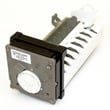
- If you are troubleshooting ice production, confirm your model first, then consider the refrigerator ice maker D7824706Q as the correct ice maker listing for this model
| What you need | Where you use it | Example |
|---|---|---|
| Model number | Parts lookup, manuals | 59673504201 |
| Serial number | Service history, warranty | From the sticker |
Last updated: January 2026
Why is my Kenmore refrigerator leaking underneath?
On Kenmore refrigerator model 59673504201, leaking underneath is usually caused by a water supply connection leak, a problem in the ice maker or water inlet valve circuit, or defrost water not draining correctly and overflowing into the base. Use the 59673504201 owner's manual to match symptoms to the right check.
- Water line connection leak behind the refrigerator (especially if plastic tubing was used).
- Water inlet valve leak or seeping fittings; inspect the valve body and outlet lines.
- Ice maker fill leak or a cracked fill tube; water can run down and pool under the cabinet.
- Defrost drain issue (ice or debris blockage) causing meltwater to overflow and drip into the bottom.
- Door not closing well leading to excess frost and extra defrost water (gasket or leveling issue).
- Confirm it is water, not compressor condensation: wipe the puddle and check if it returns after ice maker cycles or after a defrost period.
- Pull the refrigerator out and inspect the supply line: look for wet fittings and kinks. The manual guidance for this style of refrigerator recommends copper tubing because plastic is less durable and can leak.
- Check the valve area: look for drips at the valve and along the outlet tubes; if the valve seeps, replacement is common. For this model, the matching part is the refrigerator valve WP12544002.
- Inspect the ice maker area: look for ice buildup or water trails near the fill tube and ice maker. If the ice maker is leaking or not filling correctly, the refrigerator ice maker D7824706Q is the model-matched assembly.
- Check for a defrost drain overflow: remove the freezer lower bin and look for a sheet of ice on the freezer floor; that often points to a drain restriction.
| What you notice | Most likely cause | Where to look |
|---|---|---|
| Puddle appears near back | Supply line or valve leak | Behind unit, valve area |
| Puddle appears after ice production | Ice maker fill leak | Ice maker, fill tube |
| Ice on freezer floor plus leaking | Defrost drain issue | Freezer bottom, drain trough |
Leaks under the refrigerator can damage flooring and also lead to ice buildup that reduces cooling performance. Fixing the source early prevents repeat puddles and protects the sealed system area.
Last updated: January 2026