Installation guide
 Owner’s manual


How to figure out dryer model number?
For Kenmore dryer model 11068002010, the model number is typically printed on the appliance’s serial/rating label. The most reliable first check is the door opening area: open the dryer door and look along the door frame or inner rim; confirm the full number exactly as shown in the 11068002010 installation guide.
Where to look on this Kenmore dryer
Check these common label locations in this order:
- Inside the door opening on the cabinet frame (most common)
- On the inner rim just behind the door opening
- On the back panel of the dryer cabinet
- Behind the lower toe panel or front access panel (some designs)
- Near the control console area (less common)
What to write down (and why)
Record the information exactly as it appears on the label:
- Model number (example format: 110.68002010, sometimes shown without the dot)
- Serial number (helps confirm production run and correct parts match)
- Electrical rating (useful for cord/terminal block questions)
Quick ID checklist
| Item on label | What it’s used for | Example |
|---|---|---|
| Model number | Matching diagrams and parts | 11068002010 |
| Serial number | Verifying correct version/run | Varies |
| Type (electric/gas) | Safety and troubleshooting steps | Electric dryer |
Why it matters
We use the model number to match the correct Kenmore parts and diagrams because small changes between similar-looking dryers can affect fit and wiring. Using the exact model number helps avoid ordering the wrong switch, belt, or control component.
Last updated: January 2026
What is the average life of a Kenmore dryer?
A Kenmore electric dryer like model 11068002010 typically lasts 10 to 13 years with normal household use. Keeping airflow clear and the dryer installed correctly helps it reach the high end of that range and reduces heat-related wear.
What affects lifespan most on model 11068002010
Your dryer’s installation and venting setup has a direct impact on heat, cycle time, and component stress. We recommend following the venting and electrical requirements in the 11068002010 installation guide.
- Restricted exhaust venting can cause overheating and longer run times
- Heavy daily use increases mechanical wear on moving parts
- Overloading strains the drive system and motor
- Poor leveling increases vibration and noise
- Skipping lint removal reduces airflow and efficiency
Common service items (general guidance)
The manufacturer doesn’t publish a model-specific replacement schedule for wear parts on the 11068002010. In general, these are the components that most often need attention on many electric dryers when symptoms show up.
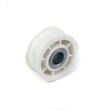
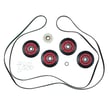
- Drum support rollers and idler pulley (noise, thumping, squealing)
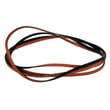
- Drive belt (drum won’t turn)
- Thermal fuse or thermal cut-off (dryer won’t heat or won’t run after overheating)
- Door switch (dryer won’t start when door is closed)
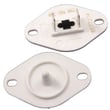
If you’re chasing a “won’t start” symptom, a common check is the dryer door switch WP3406107.
Quick “repair vs. replace” guide
| Symptom on 11068002010 | Most likely category | Best first step |
|---|---|---|
| Long dry times | Airflow/venting | Clean vent path and confirm proper ducting |
| Loud rumble/squeal | Mechanical wear | Inspect rollers/idler and belt condition |
| Drum turns, no heat | Heating circuit or safety device | Verify power supply, then test heating components |
| Won’t start | Door switch, start circuit, power | Check door switch and power at outlet |
Why it matters
Dryers usually fail early from heat and airflow problems, not age alone. Proper venting helps your Kenmore 11068002010 dry faster, run cooler, and avoid repeated overheating that can shorten component life.
Last updated: January 2026
How to hard reset a Kenmore dryer?
For the Kenmore 11068002010 electric dryer, a “hard reset” is a simple power reset: turn the dryer off, disconnect power for about 1 to 5 minutes, then restore power and try a Timed Dry cycle. This clears minor control glitches but won’t bypass safety shutoffs; see the 11068002010 installation guide.
Hard reset steps (safe, no tools)
- Turn the dryer OFF.
- Unplug the power cord (or switch the dryer circuit OFF at the electrical panel).
- Wait 1 to 5 minutes.
- Restore power.
- Close the door firmly.
- Start a Timed Dry cycle to test operation.
If it still won’t start after a reset
On the 11068002010, a no-start condition is usually caused by a door switch problem, an open overheat safety device, or a power supply issue.
- Make sure the door closes and latches normally.
- Verify the outlet has power and the dryer circuit is on.
- If the dryer is completely dead, check the door switch circuit first.
- If the dryer ran hot or airflow was restricted, an overheat safety device may have opened and will need replacement.
Common no-start related parts for this model
| Symptom after reset | What to check | Example compatible part |
|---|---|---|
| Won’t start unless you hold the door or slam it | Door switch not closing | Dryer door switch WP3406107 |
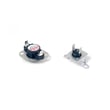
| Runs briefly then stops, or won’t run after overheating | Thermal cut-off opened (often from poor venting) | Dryer thermal cut-off fuse kit 279973 |
| Control seems erratic or unresponsive | Electronic control issue (after power is confirmed) | Electronic control WPW10351987 |
Why it matters
A reset can restore normal operation after a temporary control lockup. If the dryer overheated because the lint screen or vent system was restricted, a safety device can open to prevent a fire; the dryer won’t run again until the failed part is replaced and airflow is corrected.
Last updated: January 2026
How do I know if my Kenmore dryer thermal fuse is blown?
On Kenmore electric dryer model 11068002010, a blown thermal fuse typically causes the dryer to not run at all (no motor) or to run but not heat. The only sure confirmation is a continuity test with a multimeter after disconnecting power.
Common signs on model 11068002010
Look for these symptoms, especially if drying times have been getting longer:
- Dryer will not start (no tumbling, no sound)
- Dryer tumbles but produces no heat
- Dryer stops mid-cycle (overheat protection may be opening)
- Clothes take much longer to dry than normal
- Outside vent hood has weak airflow
How we test the thermal fuse (continuity)
Use the cabinet access and safety steps in the 11068002010 installation guide before testing.
- Unplug the dryer or shut off the breaker
- Access the thermal fuse (commonly on the blower housing area)
- Pull at least one wire off the fuse terminal (so you do not read the whole circuit)
- Set the meter to continuity or lowest ohms
- Probe the two fuse terminals
Reading the meter
| Meter result | What it means | What to do next |
|---|---|---|
| Continuity tone or ~0 ohms | Fuse is good | Check other causes (door switch, start switch, motor circuit, heating circuit) |
| OL, no tone, or no change | Fuse is blown | Replace the fuse and correct the airflow restriction |
Replacement part guidance for this model
For model 11068002010, a compatible option listed for thermal protection is the dryer thermal cut-off fuse kit 279973.
- Replace the failed thermal device(s) as directed in the kit instructions
- Do not bypass a thermal fuse or thermal cut-off
- After replacement, fix the overheating cause (usually venting)
Why it matters
A thermal fuse or thermal cut-off opens to prevent overheating. If you replace it without improving airflow, the new part can fail again quickly.
Last updated: January 2026