


What are the most common issues with LSG7800AAW?
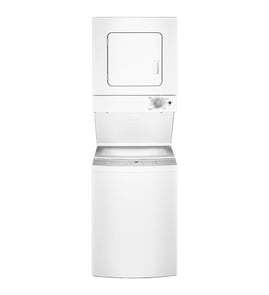
For the Maytag LSG7800AAW stacked laundry center, the most common problems are washer no-start/no-spin conditions, poor draining, excessive vibration, and dryer heat or noise issues. These symptoms usually trace to a small set of wear parts and airflow or load-balance problems.
Common washer problems (and what usually causes them)
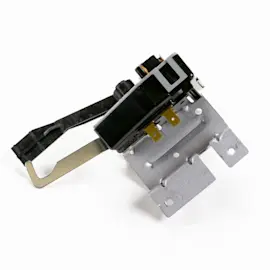
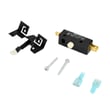
- Washer will not start or agitate: a failed lid safety circuit; check the lid switch W10820036.
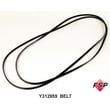
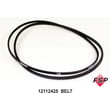
- Washer will not spin or spins weakly: a worn or stretched belt; inspect the washer drive belt 12112425.
- Washer will not drain or drains slowly: kinked drain hose, clogged standpipe, or a restriction at the tub outlet; inspect the washer drain hose WP213045 for kinks and internal blockage.
- Washer overfills or fills incorrectly: inlet valve issues or debris in the screens; check the washer water inlet valve 205613.
- Loud rumbling or grinding: bearing wear; this often shows up as increasing noise during spin.
Common dryer problems (and what usually causes them)
- No heat or intermittent heat (gas dryer section): ignition system faults; common suspects include the gas igniter 4391996 and the gas sensor WP338906.
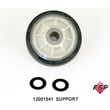
- Thumping, squealing, or scraping: drum support wear; inspect drum support components such as the dryer drum bearing kit 306508 and the dryer drum felt seal WP314820.
- Long dry times: restricted venting or lint buildup; confirm strong airflow at the exterior vent.
Quick symptom-to-part checklist
| Symptom | Most likely area | Part to check (if applicable) |
|---|---|---|
| Won’t start | Washer lid safety | Lid switch |
| Won’t spin | Washer drive system | Drive belt |
| Won’t drain | Drain path | Drain hose |
| No heat | Gas ignition | Igniter, gas sensor |
| Loud drum noise | Dryer drum support | Bearing kit, felt seal |
Why it matters
Catching these issues early prevents secondary damage, such as a slipping belt wearing pulleys, a restricted dryer vent overheating components, or a failing bearing damaging the tub or drum supports.
Before you order parts
- Unplug the unit and shut off gas (if equipped) and water.
- Note whether the problem is washer, dryer, or both.
- Check for simple causes first: unbalanced loads, clogged lint screen, kinked hoses, blocked vent.
- Match parts by model number LSG7800AAW to ensure fit.
Last updated: March 2026
What is the capacity of Maytag Bravos XL washer?
Maytag Bravos XL washer capacity depends on the exact Bravos XL model number; it is not the same product as the Maytag LSG7800AAW stacked laundry center. Most Bravos XL top-load washers are in the large-capacity range (about 4.0 to 5.0 cu. ft.), and the model tag gives the exact spec.
How to get the exact capacity for your Bravos XL
To give the correct capacity, we match the spec to your washer’s model number (for example, MVWBxxxx). Use these quick checks:
- Find the model/serial label under the lid or around the lid opening
- Write down the full model number exactly as shown
- Search that model number to confirm the listed capacity in cubic feet
- If you are ordering parts, match by model first to avoid fit issues
- If your washer is part of a stacked unit, confirm whether you have a laundry center instead of a standalone Bravos XL
A helpful starting point is our how to find your appliance model number (and what it means for parts) guide.
Bravos XL washer vs. LSG7800AAW laundry center (why this matters)
These are different Maytag laundry products, so capacity and parts do not cross over reliably.
| Item | What it is | Capacity info | Parts matching |
|---|---|---|---|
| Maytag Bravos XL washer | Standalone top-load washer | Listed in cu. ft. by model | Use Bravos XL model number |
| Maytag LSG7800AAW | Stacked laundry center | Washer tub size varies by design | Use LSG7800AAW parts list |
If you are actually asking about the LSG7800AAW washer tub size
We use the LSG7800AAW model-specific parts breakdown to identify the correct components for your unit. If you are troubleshooting wash performance (not filling, not agitating, not spinning), a common no-start symptom can involve the lid switch W10820036.
Why it matters
Capacity affects load size, cycle performance, and detergent dosing; using the wrong capacity can lead to overloading, poor cleaning, and extra wear on the drive system.
Last updated: February 2026
What is the life expectancy of a Maytag gas dryer?
A Maytag gas dryer typically lasts about 13 to 15 years with normal household use and basic maintenance. For a stacked laundry center like Maytag LSG7800AAW, keeping airflow strong and fixing wear items early helps you get the full expected lifespan.
Typical life expectancy (what to expect)
Most Maytag gas dryers fall into this range:
| Usage pattern | Typical life expectancy |
|---|---|
| Light use (few loads/week) | 15 years |
| Average family use | 13 to 15 years |
| Heavy use (daily loads) | 10 to 13 years |
What shortens a gas dryer’s life fastest
These are the most common lifespan killers we see in gas dryers:
- Restricted venting (long runs, crushed flex duct, clogged lint)
- Overloading (extra strain on drum support and motor)
- Running with squealing or thumping (roller and bearing wear)
- Ignition problems that cause repeated cycling and overheating
- Skipping lint screen cleaning
Maintenance that adds years (simple, high impact)
Use this checklist to keep your LSG7800AAW dryer running cooler and smoother:
- Clean the lint screen before every load; replace it if it is torn or warped (see lint screen WPY04100165)
- Check airflow at the outside vent hood; strong airflow means safer, faster drying
- Clean the vent duct at least yearly (more often with pets or heavy use)
- Stop using the dryer if you hear grinding, squealing, or heavy thumping; address drum support wear early
- Keep loads balanced and avoid packing the drum tight
Why it matters
A gas dryer’s heat system and airflow work together. When airflow is restricted, the dryer runs hotter and longer, which increases wear on the motor, drum support parts, and ignition components. Good venting and quick repairs usually cost less than running the dryer until a major failure.
Last updated: February 2026