Owner’s manual





How to tell if a Samsung dryer heating element is bad?
On a Samsung dryer like model DV22K6800EW, a bad heating element typically shows up as no heat or weak heat even though the drum tumbles. The most reliable check is a multimeter test for continuity through the element and an insulation (ground) check to be sure the coil is not shorted to the heater housing; see the DV22K6800EW owner’s manual for access and safety notes.
Quick symptoms that point to a failed element
- Dryer runs but clothes stay cold or take much longer to dry
- Heat starts briefly, then stops (often after a few minutes)
- Burning smell or visible hot spot marks near the heater area
- Breaker trips when heat should turn on (can indicate a short)
How we test the heating element (safe, practical steps)
- Unplug the dryer (electric shock hazard).
- Access the heater area using the disassembly guidance in the DV22K6800EW owner’s manual.
- Visually inspect the coil for a broken spring-like wire or contact with the metal housing.
- Set a multimeter to ohms (Ω) or continuity.
- Continuity test (terminal to terminal): place a probe on each heater terminal.
- Ground test (terminal to metal housing): probe from each terminal to bare metal on the heater can.
What the meter results mean
| Test | Normal result | What “bad” looks like | What it usually causes |
|---|---|---|---|
| Terminal-to-terminal continuity | Continuity present; resistance is not infinite | No continuity; OL; infinite resistance | No heat |
| Terminal-to-housing (ground) | No continuity | Continuity to ground | Breaker trips; overheating risk |
Don’t miss these common look-alikes
A “no heat” complaint is not always the element. Check these basics first:
- Lint screen and airflow: clean the lint screen and confirm strong exhaust airflow
- Cycle and settings: timed dry vs. air fluff, temperature selection
- Overheat protection: restricted venting can open safety thermostats
- Sensor drying: wetness sensor issues can end heat early
Why it matters
A failed heating element stops proper drying, but restricted airflow can also cause overheating and repeated heat failures. Fixing venting and lint buildup helps protect the heater, thermostats, and the drum.
If you confirm the element is faulty, the correct replacement for this model is the Samsung dryer heating element assembly DC47-00030H.
Last updated: February 2026
What is the average lifespan of a Samsung dryer?
Samsung dryers, including model DV22K6800EW, typically last 10 to 15 years with normal household use. Consistent airflow maintenance (lint removal and venting) and avoiding overloads are the biggest factors that keep a dryer running closer to the 15-year mark. See the DV22K6800EW owner's manual for the care schedule and cleaning steps.
What affects dryer lifespan the most
- Cleaning the lint screen after every load (airflow stays strong, heat stays controlled)
- Keeping the exhaust path clear (vent hose and exterior hood)
- Avoiding overloading (reduces strain on the drum, belt, and motor)
- Using the right cycle and heat setting for the fabric
- Fixing early symptoms quickly (squealing, thumping, long dry times)
Quick maintenance schedule (typical)
| Task | How often | Why it helps |
|---|---|---|
| Clean lint screen | Every load | Prevents overheating and long dry times |
| Check vent airflow at outside hood | Monthly | Catches clogs early |
| Clean lint buildup inside lint screen housing | Monthly | Improves airflow through the blower path |
| Deep-clean vent ducting | Every 6 to 12 months | Reduces heat stress and run time |
Parts that commonly wear as a dryer ages
Wear items do not mean the dryer is “done”; replacing them often extends life significantly.
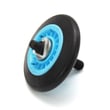
- Drum support rollers (rumbling or thumping): Samsung dryer drum support roller DC97-16782A
- Drum belt (drum not turning, burning rubber smell): dryer drum belt 6602-001717
- Heating system components (no heat or weak heat): Samsung dryer heating element assembly DC47-00030H
- Temperature sensing (overheating or poor drying): dryer thermistor DC90-10128G
Why it matters
A dryer that is maintained and vented correctly dries faster, runs cooler, and puts less load on the motor, belt, and drum support system. That combination is what drives real-world lifespan more than brand alone.
Last updated: February 2026
How do I find the model number on my DV22K6800EW?
The model number for your Samsung dryer is printed on the appliance’s rating label. On DV22K6800EW dryers, you’ll typically find that label around the door opening or on the door frame; match the full model string on the label to order the correct parts.
Where to look on the dryer
Check these common label locations first:
- Open the dryer door and inspect the door frame
- Look just inside the door opening on the front panel
- Check the inside face or edge of the dryer door
- If you have a stacked setup, look for a label near the lower front edge after opening the door
What to write down (so parts match)
Record the full identification details exactly as shown on the label:
- Model number (for example, DV22K6800EW)
- Version code or revision (often shown after the model)
- Serial number (helpful for service and production date)
- Electrical ratings (volts/amps), if you are troubleshooting power or heat issues
| Label item | Why it matters |
|---|---|
| Model number | Ensures diagrams and parts lists match your dryer |
| Version/revision | Prevents ordering a similar looking part that does not fit |
| Serial number | Helps narrow down production changes |
Why it matters
Samsung dryers often have multiple revisions under a similar model name. Using the exact model and version from the rating label helps you get the right fit for common repairs like a no-start door switch, belt issues, or heating problems.
For diagrams and model identification details, use the DV22K6800EW owner's manual.
Last updated: March 2026