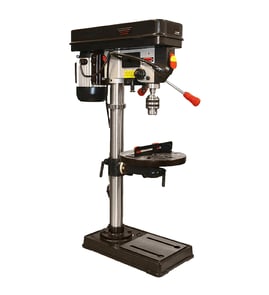

How much does a Craftsman 11324610 drill press weigh?
The exact weight for the Craftsman 11324610 drill press varies by configuration (bench vs. floor stand) and any installed accessories; the most reliable way to confirm it is to check the machine’s data plate or weigh the drill press in sections.
Best ways to confirm the weight
- Look for a data plate or spec label on the head, column, or base; it may list net weight.
- Weigh it in sections using a bathroom scale: base, column, table assembly, head/motor.
- Remove add-ons before weighing (vise, auxiliary table, work light, guards).
- If you are planning freight shipping, add packing materials and pallet weight.
Practical weight expectations (for planning moves)
Most cast-iron drill presses in this Craftsman class are heavy enough that one-person lifting is unsafe. Plan for a two-person move or a hand truck, and reduce weight by removing major assemblies first.
| What you’re doing | What to plan for | Why it helps |
|---|---|---|
| Moving within a shop | Two people plus a hand truck | Prevents tip-over and back injury |
| Loading into a vehicle | Disassemble into major sections | Lowers lift weight and center of gravity |
| Shipping | Crate or pallet plus straps | Protects the column, spindle, and table lift |
Safe handling basics
- Unplug the drill press and remove the chuck key.
- Lower the table and lock it; keep the center of gravity low.
- If you need to lighten it, remove the table first; then remove the head from the column if practical.
- Strap the head and column so they cannot rotate during transport.
Why it matters
Knowing the real weight helps you choose safe lifting equipment, avoid bending the column, and prevent damage to the spindle and table rack during transport.
For help confirming you have the correct model number before ordering parts, use how to find your appliance model number (and what it means for parts).
Last updated: February 2026
How to repair a drill press spindle?
On the Craftsman 11324610 drill press, spindle repair usually means removing the quill assembly, replacing worn spindle bearings or the spindle itself, then reassembling and checking runout. This restores smooth rotation and reduces wobble, chatter, and drilling inaccuracy.
Before you start (safety and setup)
- Unplug the drill press and remove the bit.
- Lower the table for clearance and lock it.
- Mark the depth stop and quill return spring housing position so reassembly is easier.
- Take photos as you go; small washers and spacers must go back in the same order.
- If the spindle is bent or the taper is damaged, plan on replacing the spindle, not just the bearings.
Spindle repair steps (typical process)
- Remove the quill retaining hardware: Take off the quill retaining ring or collar (varies by design) so the quill can slide out.
- Separate the quill and spindle: Support the quill and press or tap the spindle out carefully (avoid mushrooming the spindle end).
- Remove and inspect bearings: Pull the spindle bearings; replace any that feel gritty, have play, or show heat discoloration.
- Install bearings on the spindle: Press bearings on by the correct race (usually the inner race when pressing onto a shaft).
- Reinstall spindle into the quill: Press the spindle back into the quill, reinstall spacers, and secure the retaining ring/collar.
- Reassemble and adjust: Reinstall the quill, set the return spring tension, and verify smooth travel and return.
Quick diagnosis: what failed?
| Symptom | Most likely cause | What to do |
|---|---|---|
| Side-to-side chuck wobble | Worn spindle bearings | Replace bearings, then check runout |
| Vibration at all speeds | Bent spindle or damaged pulley | Inspect spindle straightness and pulleys |
| Chuck falls off taper | Dirty or damaged taper | Clean taper; replace spindle if scored |
| Grinding noise | Bearing failure | Replace bearings immediately |
Why it matters
A drill press spindle is the precision “shaft” that carries the chuck and bit. Any bearing play, taper damage, or spindle bend shows up as runout, oversized holes, burning, and broken bits.
Helpful DIY reference
For electrical checks while troubleshooting related issues (like a motor that hums or won’t start after reassembly), use our guide: how to use a multimeter to test electrical parts video.
Last updated: February 2026
What are 5 important rules for a drill press?
For the Craftsman 11324610 drill press, five key rules are: wear proper eye protection, secure the workpiece with a clamp or vise, remove the chuck key before starting, use the correct speed for the bit and material, and feed the bit smoothly (ease up as the bit breaks through). These rules prevent injuries and improve hole accuracy.
5 drill press rules we recommend
- Wear safety glasses; avoid loose sleeves, gloves, jewelry, and tie back long hair.
- Clamp the work in a vise or with clamps; never hold small parts by hand.
- Remove the chuck key immediately after tightening the bit.
- Set the right speed before drilling; slower for larger bits and harder materials.
- Control the feed pressure; steady pressure going in, then reduce pressure at breakthrough.
Quick setup checklist (before you pull the switch)
| Item to check | What “good” looks like | Why it matters |
|---|---|---|
| Bit condition | Sharp, straight, fully seated in chuck | Reduces grabbing and wobble |
| Work holding | Vise/clamps tight, table locked | Prevents spinning workpiece |
| Speed selection | Correct RPM for bit size/material | Prevents overheating and breakage |
| Table height | Bit clears the work and vise | Avoids binding and sudden stops |
Why these rules matter
A drill press creates high torque at the bit. If the workpiece is not secured or the speed is wrong, the material can spin, the bit can snap, or the hole can wander. Consistent clamping, correct RPM, and controlled feed protect you and your Craftsman drill press.
Helpful related DIY reading
- Use are diy appliance repairs safe for general safety habits that also apply to power tools.
Last updated: February 2026
What is a good horsepower for a drill press?
For a Craftsman drill press such as model 11324610, a good horsepower depends on what you drill most often. For general home-shop drilling, 1/2 to 3/4 HP is the practical sweet spot; choose 1 HP or more for frequent larger holes in steel and longer duty cycles.
Quick horsepower guide (what to buy for your work)
- 1/3 to 1/2 HP: light-duty drilling, small bits, occasional use
- 1/2 to 3/4 HP: most DIY and hobby work in wood and light metal
- 1 to 1-1/2 HP: frequent metal drilling, larger cutters, longer run times
- 2 HP+: heavy, industrial-style drilling and production work
Specs that matter as much as horsepower
Horsepower helps resist stalling, but drilling performance and safety usually depend more on speed and rigidity.
- Low RPM range: required for steel, hole saws, and large Forstner bits
- Pulley and belt condition/tension: belt slip feels like “low power”
- Quill travel: more travel reduces repositioning on deeper holes
- Chuck size and runout: affects accuracy and bit life
- Table and column rigidity: reduces chatter and oversized holes
Match HP to common jobs
| Job | Typical cutter size | Good HP range | Setup note |
|---|---|---|---|
| Wood drilling | 1/8 in. to 1/2 in. | 1/2 to 3/4 HP | Higher RPM for cleaner holes |
| Forstner in hardwood | 1 in. to 3 in. | 3/4 to 1+ HP | Slow speed, steady feed |
| Mild steel drilling | 1/8 in. to 1/2 in. | 3/4 to 1+ HP | Low RPM, cutting oil |
| Hole saws | 1-1/2 in. to 4 in. | 1+ HP | Clamp work to prevent grabbing |
Why it matters
Choosing enough motor power reduces stalling and overheating, but correct RPM, sharp bits, and clamped workpieces usually make the biggest difference in hole quality and control.
For help confirming you are shopping parts for the correct Craftsman model, use how to find your appliance model number (and what it means for parts).
Last updated: February 2026