

Where is the reset button on Amana dryer?
Most Amana dryers, including model NED4800VQ1, do not have a single “reset button.” Instead, the dryer “resets” by restoring power and, if needed, replacing a safety device that opened due to overheating or a no-start condition.
What to do instead of pressing a reset button
- Unplug the dryer (or switch the breaker off) for 1 minute, then restore power.
- Make sure the door is fully closed; a failed door switch can prevent starting.
- Clean the lint screen and check the vent for restrictions.
- If the dryer overheated or won’t run, inspect the thermal safety devices.
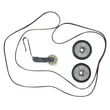
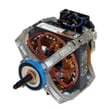
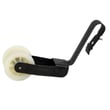
- If the drum won’t turn but the motor hums, check the belt and idler pulley.
Quick checks for “won’t start” vs “won’t heat”
| Symptom | Most common cause | What to check first |
|---|---|---|
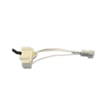
| Won’t start (no sound) | Power, door switch, timer | Breaker, door latch, dryer door switch WP3406107 |
| Runs but no heat | Heating circuit issue | Dryer element 279838, airflow, thermostats |
| Stops mid-cycle | Overheat protection opening | Venting, lint buildup, thermal cut-off kit |
Parts that act like a reset (safety devices)
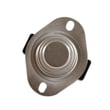
On an electric dryer, overheating can open a thermal cut-off or high-limit thermostat. These parts typically do not reset; they’re replaced after you correct the airflow problem.
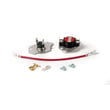
- Dryer thermal cut-off fuse kit 279816 (common after overheating)
- Dryer high-limit thermostat WP3977767 (protects against high temperatures)
- Dryer operating thermostat WP3387134 (helps regulate normal heat)
Why it matters
If you keep “resetting” by cycling power without fixing restricted airflow, the dryer can keep overheating, dry slowly, and repeatedly open safety devices. Good venting and a clean lint path protect the heater, motor, and wiring.
For step-by-step airflow and maintenance tips, use how to clean and maintain your clothes dryer.
Last updated: January 2026
Is a 7.4 cu ft dryer big?
Yes. For an Amana electric dryer like model NED4800VQ1, 7.4 cu. ft. is considered a large-capacity drum size, which typically handles bigger loads (like bulky towels or a comforter) more easily than standard-capacity dryers.
What “big” means for dryer capacity
Most dryers fall into a few practical capacity buckets:
| Capacity | Common label | Best for |
|---|---|---|
| 6.0 to 6.9 cu. ft. | Standard | Smaller households, lighter loads |
| 7.0 to 7.4 cu. ft. | Large | Most families, mixed loads, towels |
| 7.5 cu. ft. and up | Extra-large | Very large loads, frequent bulky items |
How to tell if 7.4 cu. ft. is the right size for you
We recommend thinking about your laundry habits, not just the number.
- You wash full baskets regularly (not small daily loads)
- You dry bulky items (blankets, hoodies, towels) every week
- You want fewer loads and shorter laundry days
- You have enough space for a full-size dryer footprint
- You want better airflow around larger loads (less bunching)
Why it matters
A larger drum can improve drying performance because clothes have more room to tumble, which helps warm air move through the load. If your dryer is taking too long to dry, capacity is only one factor; airflow and heat matter just as much.
If drying times are long, check these first
- Clean the lint screen every load
- Inspect and clean the vent duct and exterior vent hood
- Avoid overloading (even with a large drum)
- Confirm the dryer is heating properly (electric dryers rely on a heating element)
If you are troubleshooting heat or airflow issues on NED4800VQ1, common related parts include the dryer element 279838 and the dryer thermal cut-off fuse kit 279816.
For step-by-step airflow and performance tips, use our dryer takes a long time to dry guide.
Last updated: January 2026
What are common NED4800VQ1 problems?
Common problems on the Amana NED4800VQ1 electric dryer are: it will not start, it runs but does not heat well, it takes too long to dry, or it gets noisy (squealing, thumping, or rumbling). Most issues trace back to airflow restrictions, worn drum support parts, or a failed heat or safety component.
Most common symptoms and what usually causes them
- Won’t start: door switch not closing, timer/contact issue, motor problem, or a blown thermal cut-off from overheating
- No heat or weak heat: heating element failure, thermal cut-off kit open, high-limit thermostat tripped, or poor 240V supply
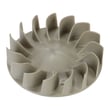
- Long dry times: clogged lint screen or venting, crushed vent hose, blocked exterior hood, or blower wheel issues
- Noisy operation: worn belt, idler pulley, drum support components, or a loose blower wheel
Quick checks we recommend first (fast, no parts)
- Clean the lint screen every load and wash it with mild soap if you see waxy buildup.
- Check airflow at the outside vent hood; it should be strong and steady.
- Confirm the dryer is getting 240V (a dryer can run on 120V but not heat properly).
- Avoid overloading; heavy loads increase dry time and wear on the belt and idler.
- Listen for the noise type (squeal vs thump vs rumble) to narrow the likely part.
Parts that commonly fix these problems on NED4800VQ1
| Symptom | Common part to check | What it affects |
|---|---|---|
| Squealing or drum not turning | Belt 341241 | Drum rotation and tension |
| No heat | Dryer element 279838 | Heat production |
| Overheats then stops heating | Dryer thermal cut-off fuse kit 279816 | Safety shutoff for overheating |
| Loud squeal or intermittent tumbling | Dryer idler pulley WP691366 | Belt tension and smooth rotation |
Why it matters
Dryer problems often start small (restricted venting or a squeaky pulley) and quickly turn into bigger failures like overheated safety fuses, damaged wiring, or a broken belt. Fixing airflow and wear items early keeps drying times down and protects the heating system.
Helpful DIY guidance
For step-by-step troubleshooting by symptom (no heat, long dry times, noisy), use dryer takes a long time to dry as a checklist to confirm airflow and venting before replacing parts.
Last updated: January 2026