 Error Codes


How do I tell what model my Kenmore dryer is?
To tell what model your Kenmore dryer is, we look for the model number on the appliance’s ID tag (for your dryer, it’s 11096320100). On most Kenmore electric dryers, the tag is easiest to spot when you open the door and check the door opening area.
Where to find the model number tag
Check these common locations on Kenmore dryers:
- Inside the dryer door opening on the cabinet frame
- On the back panel of the dryer
- Along the door opening edge near the latch area
- Near the lint screen housing area (depending on design)
- On the lower front frame behind the toe panel (some styles)
What the model number looks like (and why it matters)
Kenmore model numbers are usually a long string of digits. For this model page, the correct model number format is:
| What to look for | Example for this dryer | Why it matters |
|---|---|---|
| Model number | 11096320100 | Ensures parts match your exact dryer |
| Brand | Kenmore | Helps narrow compatible part families |
| Appliance type | Electric dryer | Confirms correct troubleshooting and wiring parts |
Quick tips to avoid ordering the wrong part
Once you find the tag, match the full model number exactly (all digits, no spaces). Then use it to choose parts that fit Kenmore 11096320100, such as:
- Drum belt 341241 if the drum won’t turn
- Dryer door switch W10820036 if the dryer won’t start when the door is closed
- Dryer thermal fuse WP3392519 if the dryer suddenly stopped and won’t run
Why it matters
Kenmore uses different manufacturers and designs across model series, so the exact model number is what ties your dryer to the correct drum belt, heating circuit parts, door switch, and lint system components.
Last updated: February 2026
Is it worth repairing an old Kenmore dryer?
Yes, repairing an older Kenmore electric dryer like model 11096320100 is usually worth it when the fix is a common wear item (belt, thermal fuse, door switch) and the cabinet and drum are still in good shape; these repairs are typically far cheaper than replacing the dryer.
Quick way to decide
Use this checklist to make the call fast:
- Repair it if the dryer tumbles poorly, won’t start, or shuts off early and the issue points to a belt, fuse, switch, or pulley.
- Repair it if the drum is solid (no major dents), the door closes normally, and the unit is not excessively noisy.
- Replace it if the drum support area is badly worn, the motor is failing repeatedly, or multiple major parts are needed at once.
- Replace it if you smell burning wiring, see heat damage at connections, or the dryer trips the breaker consistently.
- Repair it if airflow problems are the main issue; vent cleaning often restores performance.
Typical repair costs vs. “value”
For this style of Kenmore dryer, these are the most common, high-value repairs:
| Symptom | Common fix | Example part for this model | Why it’s a good repair |
|---|---|---|---|
| Drum won’t turn but motor runs | Replace belt and inspect idler | Drum belt 341241 | Low cost, high success rate |
| Dryer won’t start | Check door switch, thermal fuse | Dryer door switch W10820036 | Fast diagnosis, common failure |
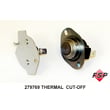
| Runs but no heat | Heating circuit checks, thermal cut-off kit | Cut-off kit 279769 | Often restores heat without replacing the dryer |
Why it matters
A well-maintained older Kenmore dryer is mechanically straightforward, so a single failed part often causes the whole symptom. Fixing the root cause (and correcting airflow restrictions) prevents repeat failures like blown thermal fuses.
If you decide to repair: what we recommend first
- Unplug the dryer and verify the vent is clear and not crushed.
- Clean the lint screen and inspect the lint chute area for buildup.
- Match the symptom to the most likely wear part (belt, idler pulley, thermal fuse, door switch).
- If the dryer is noisy, inspect the blower wheel and drum support components while it’s open.
For efficiency and prevention tips, use how to use your clothes dryer efficiently.
Last updated: February 2026
What replacement parts are most commonly needed for the 11096320100?
For the Kenmore 11096320100 electric dryer, the most commonly needed replacement parts are the wear items that keep the drum turning, the airflow parts that prevent overheating, and a few door and electrical connection parts. These are the parts we see replaced most often when a dryer won’t start, won’t heat, or makes noise.
Commonly replaced parts for this model
These parts are frequent fixes for typical dryer symptoms:
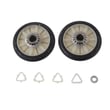
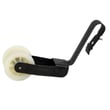
- Drum drive: drum belt 341241 and dryer idler pulley WP691366 (drum won’t tumble, squealing)
- Airflow and safety: dryer thermal fuse WP3392519 and dryer high-limit thermostat WP3390291 (no heat, shuts off, won’t run)
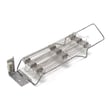
- Heating circuit support: cut-off kit 279769 and dryer heating element wire kit 279457 (heating problems, heat damage at terminals)
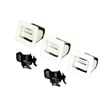
- Door and start safety: dryer door switch W10820036 and strike 279570 (won’t start because door switch is not closing)
- Lint path sealing: dryer lint chute seal W11415783 (lint leaks, poor airflow)
Quick symptom-to-part guide
| Symptom | Most common parts to check | What it affects |
|---|---|---|
| Drum not turning | Drum belt, idler pulley | Tumble action |
| Runs but no heat | Thermal fuse, high-limit thermostat, cut-off kit | Heating safety and control |
| Won’t start | Door switch, motor switch | Start circuit |
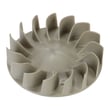
| Loud rumble or thump | Blower wheel, drum bearing ring | Noise and airflow |
Why it matters
On the 11096320100, restricted airflow and normal belt wear are the two biggest drivers of repeat repairs. Replacing the failed part and correcting airflow (lint screen, lint chute, vent duct) helps prevent the new part from failing early.
Before you order
We recommend these quick checks first:
- Clean the lint screen and confirm strong airflow at the outside vent
- Inspect the belt area for rubber dust or a loose belt
- If the dryer is dead, test the thermal fuse for continuity before replacing other heat parts
- Unplug the dryer before accessing internal components
Last updated: March 2026








