Installation guide
 Owner’s manual
 Error Codes


How do I know what model my Kenmore dryer is?
Your Kenmore dryer’s model number is printed on the appliance’s model and serial tag; once you find it, match that exact number (for example, 11061202010) when ordering parts or checking specifications in the 11061202010 owner's manual.
Where to find the model number tag
On most Kenmore electric dryers, the model and serial tag is in one of these common spots:
- Inside the door opening on the front panel
- On the door frame itself
- On the back panel of the dryer cabinet
- Near the lint screen housing (depending on the design)
How to read the number (and why it matters)
Kenmore model numbers are typically a long string of digits. The first three digits often indicate the manufacturing source (for example, many Kenmore dryers start with 110), but the most important step is using the full model number exactly as shown on the tag.
Why it matters
Using the exact model number helps us:
- Show the correct parts diagrams for your dryer
- Confirm fit for parts like a belt, heating element, or door switch
- Pull the right wiring and installation details from the documentation
Quick checklist before you order parts
- Copy the model number exactly (include every digit)
- Record the serial number too (helpful for production variations)
- Compare the number on the tag to what you see in the installation guide
- If the tag is worn, take a clear photo with good lighting
Model number vs. serial number
| Item | What it tells you | Used for |
|---|---|---|
| Model number | The exact dryer design and parts match | Parts lookup, manuals, diagrams |
| Serial number | Production run details | Verifying revisions, service history |
Last updated: February 2026
What does PF stand for on a Kenmore dryer?
PF on a Kenmore dryer means power failure. On Kenmore model 11061202010, it indicates the dryer’s cycle was interrupted because the unit lost power or the control sensed an unstable power supply.
What to do when you see PF
- Press Start to resume the cycle if the load is still damp.
- If the cycle will not resume, press Cancel/Stop and restart a new cycle.
- Check the home breaker for a tripped 240V dryer circuit (reset fully OFF, then ON).
- Make sure the dryer plug is fully seated in the outlet; avoid loose adapters or extension cords.
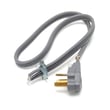
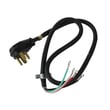
- If PF happens repeatedly, inspect the power cord and terminal block connections using the steps in the installation guide.
Quick checks that prevent repeat PF codes
Power interruptions are often caused by a weak connection, especially at the outlet or terminal block.
| Check | What you’re looking for | Why it matters |
|---|---|---|
| Breaker | One side tripped or weak reset | Dryer can run but heat or control may act erratic |
| Outlet/cord | Loose fit, heat marks, intermittent power | Causes brief dropouts that trigger PF |
| Terminal block | Loose screws, damaged wires | Creates arcing and voltage dips |
Why it matters
A PF code is usually not a failed part; it is the dryer protecting the cycle when voltage drops or power is interrupted. Fixing the power source and connections helps prevent no-heat symptoms, nuisance shutdowns, and repeated cycle restarts.
If you find damaged wiring at the terminal block or cord, replace the affected components and recheck connections per the 11061202010 installation guide.
Last updated: February 2026
What is the capacity of the Kenmore dryer model 11061202010?
The exact drum capacity (cubic feet) for Kenmore electric dryer model 11061202010 is not listed in the installation guide excerpt we have for this model. Most Kenmore 110-series (Whirlpool-built) 29-inch electric dryers are typically in the 6.5 to 7.4 cu. ft. range; use the 11061202010 owner's manual for the model-specific spec.
How to find the capacity for your exact model
We recommend checking the model’s literature first because capacity can vary within the Kenmore 110 family.
- Look in the Specifications or Features section of the 11061202010 owner's manual
- Check the model/serial tag on the dryer and match it to the manual’s spec page
- If you have a sales receipt or product listing, look for “cu. ft.” or “capacity”
- If you are comparing dryers for fit, use the installation dimensions from the 11061202010 installation guide
Capacity vs. size: what you can confirm from the install guide
Even when capacity is not stated, the installation guide helps confirm the platform size.
| Spec type | What you can use | Why it helps |
|---|---|---|
| Platform size | 29-inch wide electric dryer format | Confirms it is a full-size dryer class |
| Installation clearance | Allow space for venting behind the dryer | Prevents airflow restrictions |
| Location requirements | Sturdy, level floor and proper exhaust | Supports proper tumbling and drying performance |
Why it matters
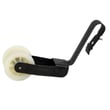
Capacity affects how well bulky loads (comforters, towels, jeans) tumble and dry. Overloading a dryer that is closer to 6.5 cu. ft. can increase dry time and wear on drive components like the belt 341241 and dryer idler pulley WP691366.
Last updated: February 2026
How do I know if my Kenmore dryer thermal fuse is blown?
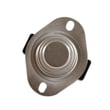
On a Kenmore electric dryer model 11061202010, a blown thermal fuse commonly shows up as a dryer that won’t start or runs but won’t heat. The sure way to know is to unplug the dryer and test the fuse with a multimeter for continuity, then correct the airflow problem that caused it.
Quick symptoms to look for
- Dryer will not start even though the door is closed
- Motor hums briefly, then stops (varies by design)
- Drum tumbles but there is no heat
- Cycle ends with clothes still damp
- You recently had long dry times (often points to restricted venting)
Confirm it with a continuity test (best method)
- Unplug the dryer (or switch off the breaker) before opening any panels.
- Access the thermal fuse area (location varies by design); follow the access steps in the 11061202010 installation guide.
- Pull at least one wire off the fuse terminal.
- Set a multimeter to continuity or lowest ohms.
- Test across the fuse terminals:
- Good fuse: continuity (near 0 ohms)
- Blown fuse: no continuity (open circuit)
Fix the cause before replacing parts
A thermal fuse usually opens because the dryer overheated from poor airflow. After any fuse replacement, we recommend:
- Clean the lint screen and housing
- Inspect the vent hose for kinks or crushing
- Clear lint buildup in the vent run to the outside
- Confirm the outside damper opens freely
- Run a timed high-heat cycle and check for strong airflow
What to check next if there’s still no heat
The installation instructions note that electric dryers can have two household fuses or breakers, and both must be good for heat.
| Symptom | Most likely checks |
|---|---|
| No start | Door switch, thermal fuse, timer/control, motor circuit |
| Runs but no heat | Both breakers/fuses, heating circuit, airflow restriction |
Helpful related parts for this model
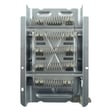
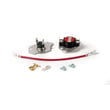
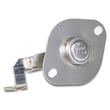
- If you’re diagnosing a no-heat condition, the dryer element 279838 and the dryer thermal cut-off fuse kit 279816 are common heat-circuit service items on this platform.
Why it matters
The thermal fuse is a safety device. Replacing it without fixing restricted venting often leads to repeat overheating, longer dry times, and additional failures in the heating circuit.
Last updated: February 2026
How to remove Kenmore dryer panel?
To remove the main panels on your Kenmore electric dryer model 11061202010, we start by disconnecting power, then remove the top (main top) and release the front panel retaining clips. This gives safe access to internal parts like the belt, idler pulley, and door switch.
Safety first (before you remove any panel)
- Unplug the dryer from the wall outlet.
- If it is hard-wired, switch the breaker OFF.
- Wear cut-resistant gloves; cabinet edges are sharp.
- Keep screws grouped by location so reassembly is easy.
- Use a towel or cardboard to protect the finish when setting parts down.
Basic panel removal steps (typical for this Kenmore 110 series design)
- Remove the lint screen (if it is in the top) and take out any screws under it.
- Open the top: remove the screws securing the main top, then slide the top back and lift it off.
- Release the front panel clips: insert a flat-blade screwdriver between the upper and lower front panels to pop the two retaining clips.
- Disconnect door switch wiring if needed before fully removing the front panel.
- Lift the front panel up and off the lower mounting tabs.
For model-specific fastener locations and the exact sequence, follow the 11061202010 installation guide.
What you can inspect once the front is off
- Drum support and wear items (rollers, idler pulley)
- Belt condition and routing
- Lint buildup around the blower housing
- Door switch operation
| Symptom after reassembly | Most common cause | Related part for this model |
|---|---|---|
| Drum will not turn, motor runs | Broken or slipped belt | Belt 341241 |
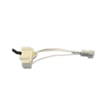
| Dryer will not start when door closes | Failed door switch or loose connector | Dryer door switch WP3406107 |
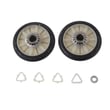
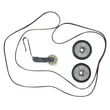
| Loud squeal or thump | Worn idler/rollers (often serviced as a kit) | Dryer repair kit 4392065 |
Why it matters
Removing panels the right way prevents bent cabinet tabs, broken clips, and pinched wiring. It also helps you correctly diagnose common no-start and no-tumble problems before replacing parts.
Last updated: February 2026
How do I reset my Kenmore dryer?
To reset your Kenmore electric dryer model 11061202010, do a hard reset: unplug the dryer (or switch off the breaker) for 1 to 5 minutes, then restore power and start a cycle. This clears many control glitches; if the dryer still will not run, focus on power, door closure, and airflow checks.
Quick reset steps (safe and effective)
- Turn the dryer OFF.
- Unplug the power cord (or turn both dryer breakers OFF).
- Wait 1 to 5 minutes.
- Restore power.
- Set a timed, heated cycle and press Start firmly.
- If the dryer is unresponsive, confirm the door is fully closed and latching.
For model-specific operating steps and cycle behavior, use the 11061202010 owner's manual.
If it still will not start after resetting
The installation checklist for this 29-inch wide electric model points to a few common “no start” causes you can verify quickly:
- Controls are set to an active cycle and the Start button is pressed firmly.
- The dryer is plugged in and the electrical supply is on.
- Household fuses are intact, or the circuit breaker has not tripped (many electric dryers use two fuses or breakers).
- The dryer door is fully closed.
Parts that commonly stop a dryer from starting
| Symptom | What to check | Common related part |
|---|---|---|
| Nothing happens when you press Start | Door not registering closed | Dryer door switch WP3406107 |
| Runs briefly then stops, or acts “dead” | Overheat protection opened due to restricted venting | Dryer thermal cut-off fuse kit 279816 |
| Runs but tumbles inconsistently or squeals | Worn belt or support parts | Belt 341241 or dryer repair kit 4392065 |
Why it matters
A reset can clear a temporary control-board state, but repeated “needs a reset” behavior usually traces back to power supply issues, a door switch problem, or overheating from poor airflow. Fixing the root cause prevents repeat shutdowns and helps drying performance.
Last updated: February 2026