Owner’s manual
 Error Codes


Which is better, top mount or bottom mount fridge?
For the Kenmore Elite 79574025411 (a bottom-mount design), “better” usually means easier everyday access: the fresh-food section sits at eye level, so you bend less and organize groceries more efficiently. A top-mount can be a better pick if you prioritize lower upfront cost and simpler design.
Bottom-mount and top-mount refrigerators both cool well; the difference is convenience, layout, and how you use the freezer.
- Bottom-mount (like model 79574025411): fresh food is easiest to reach; freezer is a pull-out drawer.
- Top-mount: freezer is at eye level; refrigerator section is lower.
- Organization: bottom-mount layouts often feel easier for weekly grocery loading.
- Ergonomics: bottom-mount reduces bending for produce, drinks, and leftovers.
- Simplicity: top-mount designs are often simpler to live with and service.
| If you care most about... | Choose this style | Why |
|---|---|---|
| Fresh-food convenience | Bottom-mount | Most-used items are higher up |
| Easy freezer access | Top-mount | Freezer shelves are at eye level |
| Fewer bends and squats | Bottom-mount | Freezer is lower, fridge is higher |
| Straightforward layout | Top-mount | Typically fewer compartments and mechanisms |
Your 79574025411 use & care information covers features common to this bottom-mount platform (controls, airflow, ice maker, filter maintenance, and storage features). For operating tips and feature locations, use the 79574025411 use & care manual.
Choosing the right mount style affects daily comfort (how often you bend), how quickly you find food, and how well you keep items visible so less gets forgotten and wasted.
Last updated: January 2026
Can the height of a refrigerator be adjusted?
Yes. On Kenmore Elite model 79574025411, you can adjust the refrigerator’s height by turning the two front leveling legs to raise or lower the cabinet, then recheck door closing and alignment. The procedure and tool size are shown in the 79574025411 use & care manual.
Before you start, make sure the refrigerator is in its final spot and sitting on a solid floor.
- Open both fresh-food doors so you can check closing and gaps as you adjust.
- Use an 11/16-inch wrench or a flat-blade screwdriver (as specified for this model).
- Turn a leveling leg left to raise that side.
- Turn a leveling leg right to lower that side.
- Adjust in small increments; it can take several turns to see a noticeable change.
- If doors do not close easily, raise the front slightly (tilt the cabinet a bit more to the rear) by turning both leveling legs left the same amount.
This model also supports door height alignment at the bottom hinge using an adjustable nut.
| What you see | Likely adjustment | What to do |
|---|---|---|
| Refrigerator rocks or feels unsteady | Cabinet leveling | Adjust the front leveling legs |
| Doors swing open or do not self-close | Cabinet tilt | Raise the front slightly (both legs) |
| Uneven gap between the two fresh-food doors | Door alignment | Adjust the hinge nut to raise/lower a door |
Proper leveling helps the doors seal evenly, reduces warm air leaks (frost and temperature swings), and can prevent vibration noise. It also helps the ice maker and water dispenser perform more consistently.
Last updated: January 2026
How to tell if a Kenmore refrigerator compressor is bad?
On Kenmore Elite model 79574025411, a “bad compressor” usually shows up as poor cooling (fresh food and freezer warming) along with abnormal compressor behavior (overheating, repeated clicking, or running constantly). Before condemning the compressor, we verify airflow, condenser cleanliness, and the start components listed in the 79574025411 use & care manual.
Look for a pattern of symptoms, not just one:
- Refrigerator and freezer both warm even after 24 hours of stable settings
- Compressor area is very hot and the unit runs almost nonstop
- Repeated clicking every few minutes (often start device trying and failing)
- Breaker trips shortly after the compressor tries to start
- Little to no heat coming off the condenser area while the unit “runs”
Many “compressor” complaints are actually airflow or start-device issues.
- Confirm control settings and allow 24 hours after changes
- Clean condenser coils (dust can cause long run times and overheating)
- Listen for fans: evaporator fan in freezer and condenser fan near compressor
- Check door sealing (warm air leaks can mimic weak cooling)
- Look for frost patterns: heavy frost can indicate a defrost problem, not a compressor
If you hear clicking or the compressor will not start, these are prime suspects:
| What you observe | More likely cause | Example compatible part for this model |
|---|---|---|
| Clicks, then stops; compressor won’t start | Start relay/overload issue | Refrigerator compressor start relay EBG60663230 |
| Runs hot, poor cooling, condenser fan not running | Condenser fan problem | Refrigerator condenser fan EAU62025701 |
| Runs constantly, cooling weak, coils packed with dust | Dirty condenser coils | Refrigerator condenser coil ACG73645004 |
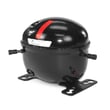
If testing confirms the sealed system is at fault, the replacement compressor for this model is the refrigerator compressor TCA38091801.
A true compressor or sealed-system failure is a higher-skill repair (electrical testing and refrigerant handling). Ruling out the start relay, condenser fan, and airflow issues first can save time and avoid replacing the wrong part.
Last updated: January 2026