Owner’s manual
 View engine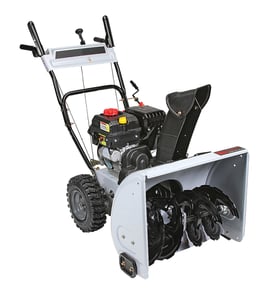




Can you use 10W30 instead of 5W30 in a snowblower?
For the Craftsman snow thrower model 536887750, we use S.A.E. 5W30 engine oil for normal operation and cold-weather starting; 10W-30 can crank slower in freezing temperatures, so it is not our go-to choice for winter use. For 0°F and below, we use partial synthetic 5W30 for easier starting (see the 536887750 owner's manual).
What the manual recommends for this model
The manual guidance for the 536887750 focuses on 5W30:
- Use S.A.E. 5W30 as needed when checking oil level during operation.
- Fill to the safe range on the dipstick; oil level must be between ADD and FULL.
- For 20°F and lower, 5W30 is used to make starting easier.
- For 0°F and below, use partial synthetic 5W30 for easier starting.
When 10W-30 is most likely to cause trouble
10W-30 is thicker at cold start than 5W-30, so the main downside is starting and initial lubrication in cold weather.
- Harder pull-starting or slower electric cranking
- More wear risk during the first seconds after start in very cold temps
- Rough running until the engine warms up
- More frequent stalling right after start (cold, thick oil load)
Quick comparison
| Oil grade | Best use case in a snowblower | Cold-start behavior |
|---|---|---|
| 5W-30 | Winter operation and storage in cold climates | Easier starting in cold |
| Partial synthetic 5W-30 | Extreme cold (around 0°F and below) | Best cold-flow and starting |
| 10W-30 | Mild winter temps, warmer storage, or off-season use | Can be harder to start when cold |
Why it matters
Snowblowers run in cold air and often sit between uses; oil that flows quickly at startup protects the crankshaft, piston, and valve train sooner. That is why 5W30 (and partial synthetic 5W30 in extreme cold) is the practical choice for reliable starts and engine protection.
Last updated: February 2026
How do I tell what year my Craftsman snowblower is?
For Craftsman snow thrower model 536887750, the most reliable way to tell the year is to use the date of purchase on your receipt; the owner documentation ties warranty coverage to that purchase date. For the actual build year, use the model and serial information from the ID label and decode the serial number format shown in the 536887750 owner's manual.
Where to find the model and serial information
Check these common locations on a Craftsman snow thrower frame:
- On the rear of the frame near the handles
- On the side of the auger housing
- Under the belt cover area (engine and frame rail)
- Near the axle or wheel area
Write down both the model number (536887750) and the serial number exactly as shown.
How to determine the year (practical methods)
Use the method that matches what you have available:
- Receipt method (fastest): Use your purchase receipt date as the “year” for warranty and ownership records.
- Serial number method (most accurate for manufacturing): Many Craftsman-built units encode a date in the first characters of the serial number (often month and year). Compare the serial format to the identification information section in the 536887750 owner's manual.
- Parts and decal cross-check (helpful clue): If your unit has original decals and hardware, you can compare what is installed to the parts list in the manual; for example, the chute hardware and inner ring are shown in the chute rod section, including the chute retainer ring, inner. (If you are replacing it, use the exact part listing snowblower chute retainer ring, inner 337227MA.)
Quick reference table
| What you have | What it tells you | Best use |
|---|---|---|
| Receipt date | Purchase year | Warranty, resale paperwork |
| Serial number | Manufacturing year | Dating the machine accurately |
| Manual parts diagrams | Era and configuration clues | Confirming originality and correct parts |
Why it matters
Knowing the year helps us match the correct Craftsman parts (belts, chute components, friction drive items) and maintenance specs so your 536887750 snow thrower runs safely and throws snow at full performance.
Last updated: February 2026
How many years should a snowblower last?
A gas snowblower like Craftsman model 536887750 typically lasts 15 to 20 years with normal residential use and consistent maintenance. Regular oil changes, lubrication, and belt adjustments (as outlined in the 536887750 owner's manual) are what keep the engine, auger, and drive system running for the long haul.
Typical lifespan by use and care
- 15 to 20 years: well-maintained, homeowner use, stored properly in the off-season
- 10 to 15 years: heavier use, occasional missed maintenance, frequent wet or icy snow
- Under 10 years: poor storage, old fuel issues, repeated belt or shear pin failures, corrosion
Maintenance that extends life the most
These items have the biggest impact on longevity for model 536887750:
- Change engine oil on schedule (the manual specifies SAE 5W30, about 20 oz capacity).
- Grease the auger shaft zerks about every 10 operating hours; grease again whenever a shear bolt is replaced.
- Check the spark plug about every 25 hours; set gap to 0.030 in.
- Adjust belts early and often; the manual calls for auger belt adjustment after the first 2 to 4 hours, then mid-season and thereafter.
- Store it clean and dry; protect bare metal on the auger housing and impeller with a rust preventative.
Quick reference: what wears out vs. what should last
| Item | Expected pattern | What it means for lifespan |
|---|---|---|
| Drive/auger belts | Wear item | Replacing belts is normal maintenance |
| Spark plug | Tune-up item | Helps starting and smooth running |
| Auger/drive system | Long-life assemblies | Lasts much longer when adjusted and lubricated |
| Engine | Long-life component | Lasts decades with clean oil and good fuel practices |
Why it matters
Most “snowblower failures” are really maintenance issues (old oil, lack of grease, belt slip, or storage corrosion). Keeping up with the service intervals prevents expensive wear on the drive and auger components and helps the engine start reliably in cold weather.
Last updated: February 2026
Is it worth fixing an old snowblower?
Yes, it’s worth fixing a Craftsman snow thrower like model 536887750 when the problem is a normal-wear item (belt, scraper blade, spark plug) or a simple adjustment, and the machine is otherwise solid. It’s usually time to replace when the repair involves major drivetrain or engine damage and the total cost approaches about half the price of a comparable new unit.
Quick decision checklist
- Fix it if it starts reliably, throws snow well, and only needs wear parts (belts, springs, scraper blade).
- Fix it if the frame, auger housing, and chute are not cracked or badly rusted.
- Fix it if the issue is maintenance-related (old fuel, dirty plug, lack of lubrication).
- Replace it if it has persistent abnormal vibration after inspection and repairs.
- Replace it if the engine has low power plus fuel leaks or heavy smoking (often a bigger investment).
- Replace it if multiple major systems need work at the same time (engine + drive + auger).
What “minor repair” looks like on this model
Many “old snowblower” repairs are straightforward and parts-based:
| Symptom | Common cause | Typical fix |
|---|---|---|
| Won’t move or slips in drive | Worn ground drive belt | Replace the snowblower drive belt 1733324SM |
| Auger does not spin or slips | Worn auger drive belt | Replace the snowblower gas belt 585416MA |
| Leaves snow behind | Worn shave plate/scraper | Replace the snowblower scraper blade 1740949BMYP |
| Hard starting | Spark plug worn or gap off | Clean/replace plug; set gap to 0.030 in per the 536887750 owner’s manual |
Why it matters
A well-maintained snow thrower can deliver years of reliable service, and the manual specifically treats items like drive belts as normal wear parts. When you keep up with lubrication, tune-ups, and basic safety checks, you often avoid the expensive failures that make replacement the better value.
Safety and cost tips before you decide
- Disconnect the spark plug wire before inspections or repairs.
- If you hit a foreign object, stop the engine and inspect for damage before using it again.
- Don’t run the engine indoors; exhaust contains carbon monoxide.
- Compare repair cost to the value of a similar replacement; if you are near 50%, replacement often wins.
Last updated: February 2026
Should I spray my snowblower with WD-40?
Yes; for Craftsman snow thrower model 536887750, spraying a light rust preventative on bare metal (auger housing and impeller area) is a good practice, especially before storage. For day-to-day snow shedding in the chute, a silicone-style spray typically lasts longer than original WD-40.
Where spraying helps most (and where it does not)
- Helps: bare metal surfaces to reduce rust during storage (auger housing, impeller area)
- Helps: inside the discharge chute to reduce wet-snow sticking (best with silicone)
- Does not help: belts, friction disc, or drive surfaces; overspray can cause slipping
- Avoid: controls, grips, and any braking or traction surfaces
- Use lightly: a thin film is enough; wipe off drips
What the manual supports for this model
The storage steps for model 536887750 include cleaning the machine, lubricating points, and covering bare metal parts of the blower housing/auger/impeller with a rust preventative such as a spray lubricant. For the full storage and maintenance routine, follow the 536887750 owner's manual.
Quick product comparison
| Goal | Best choice | Why |
|---|---|---|
| Prevent rust during storage | Light spray lubricant or rust preventative | Leaves a protective film on bare metal |
| Reduce chute clogging in wet snow | Silicone spray | More durable, slick coating |
| Free up stuck fasteners | Original WD-40 | Good penetrant, short-lived protection |
Why it matters
Using the right spray in the right place keeps the auger/impeller area from corroding and helps the chute stay clear. Spraying the wrong areas (drive system parts) can create traction problems and lead to poor self-propel performance.
Last updated: February 2026
What are common Craftsman snowblower problems?
Common problems on the Craftsman snow thrower model 536887750 fall into four buckets: engine starting/running issues, auger or impeller not moving snow, drive system not pulling, and chute or housing problems. Most fixes come down to fuel and ignition maintenance, belt and cable adjustments, and replacing normal-wear items.
Most common symptoms and what usually causes them
- Won’t start or runs rough: stale fuel, dirty carburetor, fouled spark plug, or incorrect choke/throttle setting
- Auger won’t turn or won’t throw snow: jam in auger housing, worn belt, or gearbox/auger drive wear
- Unit won’t drive or slips: worn or stretched ground drive belt, idler/pulley issues, or drive control out of adjustment
- Poor scraping or leaves snow behind: worn scraper blade or skid shoe height set too high
- Oil/grease leaks near auger gearbox: worn seals or gasket in the gear case
Quick checks we recommend (fast, no special tools)
- Confirm fresh fuel and the fuel shutoff (if equipped) is on.
- Inspect belts for glazing, cracking, or slack.
- Clear packed snow and ice from the auger housing and chute (engine off, key removed).
- Check that controls fully engage and return freely.
- Look for abnormal noises from the auger gear case when the auger is engaged.
Parts that commonly wear on this model
The owner’s manual notes that some items are normal-wear components (for example, spark plugs and drive belts). Use these model-matched parts when symptoms point to belt or scraping issues:
| Symptom | Likely wear item | Model-matched part anchor |
|---|---|---|
| Won’t drive or slips under load | Ground drive belt | Snowblower drive belt 1733324SM |
| Auger stops or won’t throw well | Auger drive belt | Snowblower gas belt 585416MA |
| Leaves a layer of snow behind | Scraper blade | Snowblower scraper blade 1740949BMYP |
Why it matters
Catching belt wear, scraper wear, and gearbox issues early helps prevent bigger failures (like damaged pulleys, stripped gears, or excessive auger housing wear) and keeps your Craftsman snowblower throwing snow consistently.
Model-specific help
For the exact adjustment points, maintenance intervals, and the troubleshooting chart for model 536887750, use the 536887750 owner’s manual.
Last updated: February 2026