 Owner’s manual
 Error Codes
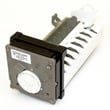



Why is my Kenmore side by side ice maker not working?
Your Kenmore 59658695890 side-by-side refrigerator ice maker usually stops working because the ice maker is turned OFF (arm up), the freezer is not cold enough yet, or the water supply or water filter is restricting water flow. Use the checks below, then confirm the exact control and ice maker details in the owner's manual.
Quick checks (most common fixes)
- Make sure the ice maker arm is down (ON position).
- Confirm the freezer door closes completely; an open door can stop ice production.
- Verify the household shut-off valve to the refrigerator is fully ON.
- If the refrigerator was just installed or recently moved, allow 24 hours for ice production.
- If your model uses a water filter, replace it if it is clogged (a plugged filter reduces water pressure).
Water supply and pressure checks
The ice maker needs a steady cold-water supply. In the troubleshooting guidance for this model, proper water pressure is 20 to 120 psi.
- Look for a kinked supply line behind the refrigerator.
- Avoid self-piercing or saddle valves; they can restrict flow and clog over time.
- Use copper tubing when possible; plastic lines can kink more easily.
What to look for
| Symptom | Likely cause | What we do next |
|---|---|---|
| Ice maker mold is dry | Water valve off, line kinked, low pressure, clogged filter | Turn on valve, straighten line, replace filter |
| No ice after install | Freezer not cold yet | Wait 24 hours, then recheck |
| Ice in bin but dispenser issues | Ice stuck in chute or bin not seated | Clear chute with a plastic utensil; reseat bin |
If the dispenser works but ice production does not
If water dispenses but the ice maker does not make ice, focus on:
- Ice maker arm position (OFF vs ON)
- Freezer temperature being cold enough to cycle the ice maker
- Filter restriction (if equipped)
Why it matters
An ice maker is a small water system. Any restriction (valve not fully open, kinked line, clogged filter) or a warm freezer prevents the mold from filling and freezing, so ice production stops.
For step-by-step model-specific troubleshooting and feature details, follow the owner's manual.
Last updated: February 2026
Where is the model number on a Kenmore side by side refrigerator?
On Kenmore side-by-side refrigerators like model 59658695890, the model number is printed on the serial plate inside the fresh food (refrigerator) compartment. For this style, the serial plate is located on the top left wall of the refrigerator compartment; use the owner's manual as a visual reference.
How to find it quickly
- Open the refrigerator (fresh food) door, not the freezer door.
- Look along the top left interior wall.
- Find the serial plate (a label/plate with model and serial information).
- Record the full model number exactly as shown (including any prefix like 596. if it appears).
- Write down the serial number too; it helps match the correct parts and diagrams.
What the label typically shows
| Item on the serial plate | What it’s used for |
|---|---|
| Model number (example: 596.58695890) | Identifies the exact refrigerator configuration for parts lookup |
| Serial number | Helps determine production details and correct revisions |
| Electrical ratings | Useful when checking power requirements |
Why it matters
Kenmore model numbers can look similar across different side-by-side refrigerators. Using the exact model number from the serial plate helps us match the correct replacement parts (like a water filter, ice maker components, door bins, or a defrost part) and avoid ordering the wrong item.
Last updated: February 2026
What are the most common problems with Kenmore refrigerators?
The most common problems we see on Kenmore refrigerators like model 59658695890 are warm temperatures from blocked airflow or dirty condenser coils, ice maker and water dispenser issues, water leaks from a clogged defrost drain, and new or louder operating sounds that are actually normal. Use the 59658695890 owner's manual troubleshooting guide to narrow the cause fast.
Most common symptoms and what usually causes them
- Not cooling or temperature too warm: blocked air vents, doors opened often, controls set incorrectly, dirty condenser coils
- Moisture build-up inside: blocked vents, frequent door openings, food not packaged well, door not closing fully
- Water leaks or puddles: commonly a clogged/iced defrost drain or a door gasket that is not sealing
- Ice maker problems: ice maker turned off, water supply turned off, or a water supply issue
- Noises you did not hear before: fan airflow, control clicks, and other normal operating sounds
Quick checks we recommend first (safe DIY)
- Confirm power and controls: make sure the cord is firmly plugged in and the freezer control is not set to OFF.
- Check for a defrost-cycle pause: if lights work but the compressor and fans are off, wait about 40 minutes to see if it restarts.
- Feel for airflow at vents: blocked vents can make the fresh food section warm.
- Clean condenser coils: dirty coils can make the compressor run longer and cooling performance drop.
- Inspect door closing and gaskets: misalignment or dirty gaskets can cause warm temps and moisture.
Symptom-to-cause cheat sheet
| What you notice | Most likely area to check | What to do next |
|---|---|---|
| Fridge warm, freezer OK | Airflow/vents, evaporator fan | Clear vents; listen for fan; verify doors seal |
| Both sections warm | Power, controls, condenser coils | Verify settings; clean coils; check for defrost-cycle pause |
| Runs a lot | Coils, room temp, door openings | Clean coils; reduce door openings; allow time after loading food |
| Unfamiliar noises | Normal operating sounds | Compare to the “Normal Operating Sounds” section in the manual |
Why it matters
Most “not cooling” and “too warm” complaints come down to airflow, heat removal (condenser coils), or door sealing. Fixing those basics first prevents food spoilage and reduces compressor run time.
Related DIY help
Last updated: February 2026
How to tell cubic feet of Kenmore refrigerator by model number?
You typically cannot determine the exact cubic-foot capacity from the Kenmore model number alone. For Kenmore model 59658695890, the most reliable way is to check the capacity listed on the model’s rating label or in the specifications section of the 59658695890 owner's manual.
Fast ways to find the cubic feet
Use these options in order (fastest and most accurate first):
- Check the rating label inside the fresh food section (often on a side wall or near the top). Capacity is commonly listed as “cu. ft.” or “total capacity.”
- Look in the specifications section of the manual for “capacity” or “volume.”
- Search the manual PDF for keywords like “capacity,” “cu,” “cubic,” or “specifications.”
- Measure and estimate only as a last resort (useful when labels are missing).
Where capacity is usually listed
| Location | What you’ll see | Accuracy |
|---|---|---|
| Rating label inside refrigerator | Total capacity (and sometimes refrigerator/freezer split) | Highest |
| Manual specifications | Total capacity and key dimensions | High |
| Measure and estimate | Approximate capacity based on interior volume | Medium |
If you need to estimate capacity (backup method)
If the label and manual spec page are unavailable, you can estimate interior volume:
- Measure usable interior width, height, and depth of the refrigerator section and freezer section.
- Multiply each section’s measurements to get cubic inches.
- Add both sections together.
- Convert to cubic feet: cubic inches ÷ 1,728 = cubic feet.
Why it matters
Cubic-foot capacity helps you compare storage space between refrigerators and can affect what replacement items fit and how you organize airflow around shelves and bins. It is also useful when planning kitchen layout clearances and loading patterns.
Last updated: February 2026
Where is the water filter on my Kenmore side by side refrigerator?
On Kenmore side-by-side refrigerator model 59658695890, the water filtration cartridge (on models equipped with filtration) installs at the water filter head in the rear right corner of the refrigerator (fresh food) section. Access it from inside the refrigerator compartment, not the freezer.
How to locate the filter housing
- Open the refrigerator door.
- Look along the back wall inside the fresh food section.
- Focus on the rear right corner area where the filter head mounts.
- If a cartridge is installed, you will see it hanging from the filter head.
- If a bypass cartridge is installed, the refrigerator is set to run without filtration.
How the cartridge releases
The cartridge uses a quarter-turn lock.
- Place a towel under the filter area to catch drips.
- Twist the cartridge counterclockwise about 1/4 turn.
- Pull the cartridge straight down to remove.
- Install the new cartridge by aligning it, pushing up, then twisting to lock.
- Flush the system by dispensing and discarding several quarts of water.
Quick reference table
| What you find at the filter head | What it means | What to do |
|---|---|---|
| Filter cartridge installed | Filtration is active | Replace on schedule; flush after replacement |
| Bypass cartridge installed | Water bypasses filtration | Install a filter cartridge if you want filtered water |
| No cartridge installed | Water flow can be restricted or leak | Install the bypass or a filter cartridge |
Why it matters
A missing, clogged, or misinstalled cartridge commonly causes slow water dispensing, hollow ice cubes, or no ice production. This refrigerator also needs adequate household water pressure for the dispenser and ice maker to work normally.
For model-specific illustrations and handling notes, use the 59658695890 owner's manual.
Last updated: February 2026





