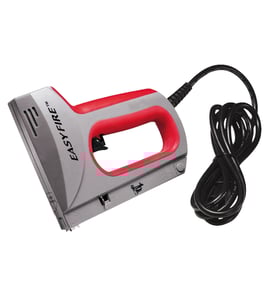

How do I know what staples fit my staple gun?
For your Craftsman 193684770 electric stapler, the correct staples are the size and crown type listed on the tool’s staple magazine, base plate, or a label near the loading channel. Match those markings exactly before buying staples to prevent jams and misfires.
Where to find the staple size on the tool
Check these common locations on a power stapler:
- Bottom of the stapler (often stamped or printed)
- Inside the magazine door or on the magazine rail
- Near the staple loading slot or pusher assembly
- On a side label showing a range (example: “6-14 mm”)
- On the original staple strip packaging (if you still have it)
What the markings mean (so you buy the right staples)
Staples are defined by a few key specs. You need all of them to match what your stapler accepts.
| Spec | What it controls | What to match |
|---|---|---|
| Leg length | How deep the staple can go | The exact length or the allowed range printed on the tool |
| Crown width | How wide the top bridge is | The crown type your stapler is designed for |
| Wire gauge | How thick the staple wire is | The gauge/type listed on the stapler or packaging |
| Staple “series” | Standardized family name | The series shown on the stapler (if provided) |
Quick fit check before you load a full strip
- Unplug the stapler before checking or loading staples.
- Confirm the staple strip sits flat in the magazine without forcing it.
- Make sure the pusher slides smoothly and latches.
- Fire a test staple into scrap wood; listen for a clean drive (no double-hit sound).
- If staples bend, don’t sink, or jam immediately, the crown or gauge is usually wrong.
Why it matters
Using the wrong staple size in an electric stapler commonly causes magazine jams, bent staples, weak drive depth, and damage to the driver blade or pusher. Matching the printed staple specs protects the tool and gives consistent fastening.
For help confirming you’re using the correct model number when ordering supplies or parts, use how to find your appliance model number (and what it means for parts).
Last updated: February 2026
How to refill bullet stapler?
To refill (load) a Craftsman 193684770 electric stapler, you typically release the pusher rod/spring, place a strip of staples onto the magazine rail, then reinsert the pusher so it feeds staples forward under spring tension.
How to load staples (common “bullet stapler” steps)
- Unplug the stapler (or remove the battery, if applicable) before loading.
- Open the magazine: press the magazine release and pull the pusher rod straight out.
- Load staples: set one strip of staples onto the magazine rail with the legs facing down and the strip seated flat.
- Reinstall the pusher rod: slide it back in until it latches; keep fingers clear of the staple channel.
- Test on scrap material: plug in and fire a few staples into cardboard or softwood.
Staple fit checklist (prevents jams)
| What to check | What “right” looks like | What happens if it’s wrong |
|---|---|---|
| Staple type | Matches the stapler’s required series | Misfeeds, won’t advance |
| Staple length | Appropriate for the material thickness | Blow-through or poor hold |
| Strip position | Flat on the rail, not tilted | Jams, double-feeds |
If it won’t load or keeps jamming
- Remove the staples and reload with a fresh strip (bent staples cause repeat jams).
- Make sure the pusher rod fully latches; a half-latched pusher will not feed.
- Clear the nose area: unplug, open the magazine, and remove any broken staple pieces.
- Use a consistent trigger pull; “half pulls” can cause partial drives on some electric staplers.
Why it matters
Correct loading keeps the magazine spring feeding smoothly, which reduces staple jams and helps the driver blade seat staples consistently in wood, upholstery backing, or light trim.
For general electrical troubleshooting steps (power cord, switch, internal wiring), use our guide: how to repair broken or damaged wires video.
Last updated: February 2026
Is an electric stapler worth it?
Yes. For most DIY and light workshop jobs, an electric stapler like the Craftsman 193684770 is worth it because it drives staples faster and more consistently than a manual stapler, with far less hand and wrist strain during repetitive work.
When an electric stapler is the better choice
- You’re doing high-volume stapling (upholstery, fabric, vapor barrier, house wrap)
- You want more consistent staple depth with fewer misfires
- You have hand fatigue, arthritis, or limited grip strength
- You’re working overhead or on ladders and want quicker fastening
- You need cleaner results on trim, paneling, or light craft builds
When a manual stapler (or another tool) can be a better fit
Electric staplers are great for speed, but they are not the best answer for every material.
- Very hard materials can cause shallow staples or jams
- Tight corners can be easier with a smaller manual stapler
- If you need heavy fastening into dense lumber, a pneumatic stapler or brad nailer is often the right step up
Quick comparison
| Feature | Electric stapler | Manual stapler |
|---|---|---|
| Effort per staple | Low | Medium to high |
| Speed for repetitive work | High | Medium |
| Consistency of drive depth | High | Varies by user/material |
| Best for | Upholstery, insulation, light fastening | Occasional repairs, tight spaces |
What to check if performance is disappointing
If your Craftsman 193684770 is not driving staples flush, these checks usually fix it:
- Confirm you’re using the correct staple type and leg length for the job
- Reduce staple length when fastening into harder wood
- Press the nose firmly and squarely to the surface before firing
- Unplug the tool before clearing a jam; then reload carefully
- Inspect the power cord and trigger for damage or intermittent operation
Why it matters
Choosing the right stapler prevents jams, protects your work surface, and reduces fatigue. For projects like upholstery and insulation, the time and effort savings from an electric stapler add up quickly.
For general electrical troubleshooting techniques that apply to corded tools, we recommend how to use a multimeter to test electrical parts video.
Last updated: February 2026