Installation guide
 Owner’s manual
 Error Codes


What does DH mean on Kenmore 79575543400 refrigerator?
On a Kenmore Elite 79575543400 bottom-mount refrigerator, dH (often shown as Er dH) indicates a defrost heater problem. The refrigerator may stop responding to buttons while the code is active, and cooling can suffer if frost builds up on the evaporator.
- Unplug the refrigerator (or switch off the breaker) for 5 minutes, then restore power to see if the code clears.
- Check for heavy frost on the rear panel inside the freezer; heavy frost points to a defrost system failure.
- Make sure the doors fully close and the gaskets seal; warm air leaks can worsen frost buildup.
- Confirm the temperature settings are at normal targets (about 37°F fresh food, 0°F freezer).
- If the code returns quickly, plan to troubleshoot the defrost heater circuit (heater, sensor, wiring).
On this model family, the defrost system typically centers on the heater and the defrost sensor.
| What it affects | What you may notice | Related part on this model page |
|---|---|---|
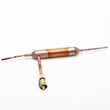
| Defrost heating | Frost buildup, warm freezer, fan noise changes | Lg refrigerator defrost heater 5300JK1005D |
| Defrost sensing | Defrost not starting or ending correctly | Refrigerator defrost sensor assembly 6615JB2005H |
When the defrost heater system is not working, ice can block airflow across the evaporator. That reduces cooling performance, can cause temperature swings, and can lead to water leaks when ice later melts.
Use the troubleshooting and control information in the owner's manual for the Kenmore Elite 795.75543400 series to confirm display behavior, control settings, and basic checks before replacing parts.
Last updated: February 2026
What is the average lifespan of a Kenmore 79575543400 refrigerator?
A Kenmore Elite bottom-mount refrigerator like model 79575543400 typically lasts 10 to 15 years. Regular care (cleaning condenser coils, keeping door gaskets sealing, and maintaining airflow) helps it reach the upper end of that range and reduces cooling and ice maker problems.
Most refrigerators in this class land in the 10 to 15 year window. The biggest factors that shorten life are heat buildup, poor door sealing, and chronic frost or airflow restrictions.
- Keep condenser coils clean and unobstructed
- Make sure doors close fully and gaskets seal all the way around
- Avoid overpacking so air can circulate through the compartments
- Keep temperatures stable (avoid frequent warm-ups)
- Fix water leaks quickly to prevent corrosion and ice buildup
Use the care and cleaning guidance in the owner's manual as your baseline, then focus on these items:
- Condenser coils: clean periodically to reduce compressor run time
- Door gaskets: wipe clean; check for gaps, tears, or hardened sections
- Air vents: keep clear inside both refrigerator and freezer sections
- Defrost symptoms: address heavy frost early (often tied to airflow or defrost components)
- Water system: inspect tubing and fittings for slow leaks or kinks
When a refrigerator is in the second half of its expected life, we recommend weighing repair cost against overall condition.
| Situation | What it usually means | Practical next step |
|---|---|---|
| Minor leak, cracked line, or fitting issue | Often repairable and worth fixing | Inspect tubing and connections; replace damaged sections |
| Repeated warm temps or heavy frost | Airflow/defrost issue may be developing | Check vents, fan noise, and frost pattern |
| Sealed system or compressor symptoms | Higher-cost repair category | Compare repair cost to remaining expected life |
If you are chasing a water supply issue (slow fill, no ice, or leaking), common related parts for this model include the refrigerator valve assembly 5221JB2006K and refrigerator water tubing MJU62070602.
A refrigerator that runs hot (dirty coils) or leaks cold air (bad gasket) forces the compressor to run longer. That increases wear on the sealed refrigeration system and can shorten the overall lifespan.
Last updated: February 2026
What are the common problems with Kenmore 79575543400 refrigerators?
Common problems we see with the Kenmore 79575543400 bottom-mount refrigerator include warm temperatures from restricted airflow (dirty condenser coils or a failed evaporator fan), frost buildup from defrost-system issues, water leaks from a clogged defrost drain, and door sealing problems that cause temperature swings. Use the owner's manual troubleshooting and care sections to narrow the cause.
- Refrigerator or freezer not cooling well: dirty condenser coils, evaporator fan issue, or sealed-system/compressor problem
- Frost or ice buildup on the back wall/freezer: defrost heater, defrost sensor, or airflow blockage
- Loud humming, rattling, or grinding: fan blade rubbing ice, worn fan motor, or compressor/start components
- Water under crisper or on floor: defrost drain restriction or water line connection leak
- Doors not closing or uneven doors: leveling/door alignment or worn hinge/stop parts
- Confirm airflow: do not block vents; allow space around food for circulation.
- Clean condenser coils: dirty coils are a top cause of poor cooling and long run times.
- Check door seal contact: look for gaps, torn gasket areas, or doors that bounce open.
- Listen for the evaporator fan: a steady fan sound in cooling mode is normal; intermittent scraping often means ice contact.
- Look for ice buildup patterns: heavy frost often signals a defrost problem.
| Symptom | Common system | Example part on this model page |
|---|---|---|
| Frost buildup, warm fridge | Defrost system | Refrigerator defrost sensor assembly 6615JB2005H or lg refrigerator defrost heater 5300JK1005D |
| Warm temps, weak airflow | Evaporator airflow | Refrigerator evaporator fan blade 5901JA1021A |
| No ice or no water | Water supply/inlet | Refrigerator valve assembly 5221JB2006K |
| Door not sealing, frost at edges | Door sealing | Refrigerator gasket assembly MDS64172918 |
Cooling, defrost, and door sealing work together. A small issue like dirty coils or a weak door seal can lead to longer run times, frost buildup, and temperature swings that spoil food.
If your display shows an error or you suspect a sensor/defrost issue, use Kenmore 795 model bottom freezer refrigerator error codes to match the code to the most likely system.
Last updated: February 2026
Why is my refrigerator not getting cold at the bottom?
If your Kenmore Elite 79575543400 is warm at the bottom of the fresh-food section, the most common causes are restricted airflow (blocked vents or frost buildup) or a fan/defrost issue that prevents cold air from circulating down and exiting at the bottom return.
- Make sure food packages are not blocking the air vents; blocked vents interrupt airflow and cause temperature problems.
- Confirm the temperature settings are reasonable; we recommend starting at 37°F for the refrigerator and 0°F for the freezer, then waiting 24 hours before adjusting.
- Check for weak airflow from the top refrigerator vent; poor airflow usually points to an evaporator fan or frost restriction.
- Look for frost or ice buildup on the freezer back wall; heavy frost often indicates a defrost system problem.
- Clean dust from the condenser area (typically underneath or behind); poor heat release can reduce overall cooling.
This refrigerator uses a top-to-bottom circulation path: cold air enters the refrigerator through the top vent, circulates, and exits at the bottom to return to the freezer. When that path is restricted, the bottom shelves are often the first area to warm up. See the airflow diagram and vent guidance in the owner's manual.
If airflow is weak or frost is present, these model-compatible parts are often involved:
| Symptom you notice | What it often points to | Example part for this model |
|---|---|---|
| Warm bottom, freezer OK, little airflow | Evaporator fan issue (blade obstructed or damaged) | Refrigerator evaporator fan blade 5901JA1021A |
| Frost on freezer back panel, warming in fridge | Defrost system not clearing ice | Refrigerator defrost sensor assembly 6615JB2005H or lg refrigerator defrost heater 5300JK1005D |
| Temps swing or seem inaccurate | Temperature sensing problem | Refrigerator temperature sensor 6500JB2002X |
When the bottom of the refrigerator stays warm, food safety and freshness drop quickly. Restoring proper venting and circulation usually fixes the temperature gradient and helps the compressor run more efficiently.
Last updated: February 2026
What size is Kenmore refrigerator model 79575543400?
Kenmore Elite bottom-mount refrigerator model 79575543400 is a full-size bottom-freezer unit; the exact exterior width, height, depth, and required installation clearances are specified in the 79575543400 owner's manual and the 79575543400 installation guide. Use those specs for delivery planning and cabinet fit.
When customers ask for size, we confirm these measurements:
- Overall width (widest point, often at hinges)
- Overall height (floor to top of hinge cover)
- Overall depth (cabinet depth and depth to the front of doors/handles)
- Door swing clearance (space needed to open doors fully)
- Freezer drawer clearance (space in front for full pull-out)
Even with published specs, measuring your space prevents delivery surprises.
- Measure the opening width at the front and back of the cutout
- Measure height at the lowest overhead cabinet or trim point
- Measure depth to the nearest wall or island, then account for door/handle projection
- Measure pathway clearance (doorways, hallways, turns)
- Plan for airflow space behind and above the refrigerator
Most Kenmore bottom-mount refrigerators in this class commonly fall into these planning ranges; use the manual for the exact numbers for 79575543400.
| Measurement | Common planning range |
|---|---|
| Width | 32 to 36 in. |
| Height | 67 to 71 in. |
| Depth to doors (varies by handle style) | 29 to 36 in. |
Correct sizing protects door seal performance and cooling efficiency by ensuring proper leveling, full door and drawer travel, and the ventilation clearances the refrigerator needs.
Last updated: February 2026