Installation guide
 Owner’s manual


Do Amana washers have a filter to clean?
Amana top-load washers like model NTW4516FW2 typically do not have a customer-cleanable drain pump filter like many front-load washers. Instead, routine maintenance focuses on running the built-in cleaning cycle and keeping the tub, lid area, and dispensers free of residue (per the NTW4516FW2 owner's manual).
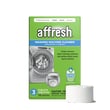
- Run the Clean Washer cycle (often labeled “Clean Washer with affresh®”) on a regular schedule.
- Wipe the lid underside and top rim of the tub to remove detergent and soil residue.
- Clean the dispenser areas by wiping with a damp cloth; the dispensers and trim are not removable.
- Clean the outside surfaces with mild soap and a soft cloth (avoid abrasives).
- Leave the lid open between uses to help the tub dry and reduce odor.
Most owners get the best results by running the washer cleaning cycle about every 30 washes, using an empty tub.
| Maintenance task | Typical frequency | What it helps prevent |
|---|---|---|
| Clean Washer cycle | Every ~30 washes | Odor, residue buildup |
| Wipe lid and tub rim | Weekly or as needed | Slime, detergent film |
| Dispenser wipe-down | Monthly or as needed | Clogs, sticky residue |
A “no drain” symptom is usually a clog or a failing drain component, not a filter that needs cleaning.
- Make sure the drain hose is not kinked or pushed too far into the standpipe
- Check the standpipe or laundry sink for a slow household drain
- Listen for the drain pump running during Drain & Spin
- If the pump hums but water does not move, inspect for a blockage in the hose path
- If the pump is not running, the issue can involve the pump, wiring, or controls
If you’re troubleshooting a drain problem, the washer drain pump W10919003 is the model-matched pump commonly involved.
Regular cleaning keeps wash performance consistent and helps prevent odor-causing residue from building up inside the basket and around the lid. It also reduces the chance of drain issues caused by buildup and debris moving through the system.
Last updated: February 2026
How much does it cost to fix an Amana washing machine?
For an Amana washer like model NTW4516FW2, most professional repairs typically land in the $250 to $490 range once you factor in the service call, labor, and the specific parts needed. Costs rise when the repair involves major drive or control components.
Repair totals mainly come down to diagnosis time, labor rates in your area, and whether the fix is a quick swap or a deeper teardown.
Common cost drivers include:
- Service call/diagnostic fee (often applied toward the repair)
- Labor time (simple access vs. cabinet/tub removal)
- Part type (mechanical parts usually cost less than electronic controls)
- Multiple failures (for example, a drain issue plus a lid lock issue)
- Installation condition (hard-to-access hookups can add time; see the installation guide)
These are frequent repair categories for top-load washers like the NTW4516FW2:
- Won’t fill or fills slowly: water inlet valve issues (often the water inlet valve assembly W11210463)
- Won’t drain: drain pump or drain hose problems (often the washer drain pump W10919003 or washer drain hose W11244231)
- Won’t spin or stops mid-cycle: lid lock problems (often the washer lid lock W11307244)
- Loud squeal or no agitation/spin: belt or pulley wear (often the washer drive belt WPW10006384 or whirlpool washer drive pulley W10721967)
| Repair type | Typical complexity | Why it affects cost |
|---|---|---|
| Water inlet valve | Low | Usually accessible from the rear/top with basic disassembly |
| Lid lock | Low to medium | Access is straightforward but requires careful alignment |
| Drain pump/hose | Medium | May require tipping the washer and clearing obstructions |
| Control board | Medium to high | Diagnosis time is higher; parts cost more |
| Gear case/drive system | High | Labor-intensive teardown and reassembly |
If the washer is pumping out water early because the lid is left open too long, or a cycle issue is caused by loading/usage, you can avoid an unnecessary service call by following the troubleshooting steps in the owner's manual. That keeps repair spending focused on true part failures.
Last updated: February 2026
What does E1 and F9 mean on an Amana washing machine?
On the Amana NTW4516FW2 washer, F9 E1 points to a drain problem (the washer is taking too long to pump water out). The most common fixes are correcting the drain hose setup, clearing a clog, or addressing a weak drain pump so the tub can empty and spin normally.
- Cancel the cycle and unplug the washer for safety.
- Confirm the lid is fully closed; the washer uses a lid lock during operation.
- Inspect the drain hose for kinks, crushing, or a tight bend behind the washer.
- Make sure the drain hose is installed at the correct height and not sealed airtight in the standpipe; follow the NTW4516FW2 installation guide.
- Check the standpipe or laundry sink for a slow household drain (water backing up can trigger drain errors).
| What’s happening | Most likely cause | What you’ll notice |
|---|---|---|
| Washer won’t drain at all | Clog in hose or pump | Water stays in tub, humming or intermittent pumping |
| Drains slowly | Partial blockage or restricted hose install | Long drain time, may stop before spin |
| Drains but error returns | Weak pump or intermittent electrical issue | Works sometimes, fails on larger loads |
If the hose and home drain are good, the next most common repair is the pump.
- Washer drain pump W10919003: Replaces a weak or failed pump that cannot move water out fast enough.
- Washer drain hose W11244231: Helps when the hose is split, internally restricted, or permanently kinked.
A drain error prevents proper spinning, which leaves clothes soaking wet and can cause the washer to stop mid-cycle. Fixing the drain path restores normal cycle completion and helps protect the drive system from strain.
For model-specific steps and safety notes, follow the troubleshooting and drain hose installation details in the NTW4516FW2 owner's manual.
Last updated: February 2026
What is the life expectancy of an Amana washing machine?
Most Amana top-load washers like model NTW4516FW2 typically last about 10 to 14 years with normal household use, proper installation, and routine maintenance. How long yours lasts depends most on load size, leveling, water quality, and keeping the washer maintained as outlined in the NTW4516FW2 owner's manual.
A washer’s life is mainly driven by mechanical wear (drive system, suspension, bearings) and how hard it is worked.
- Load size and frequency: frequent oversized loads shorten life
- Leveling and vibration: an unlevel washer stresses the suspension and tub
- Water quality: hard water can increase residue and component wear
- Maintenance habits: periodic cleaning and correct detergent use help
- Early symptom response: fixing small issues prevents bigger failures
These are the most common signs a top-load washer is nearing a major repair:
| Symptom | Common area involved | What to check first |
|---|---|---|
| Loud banging or walking during spin | Suspension and leveling | Level the feet; reduce load size |
| Won’t spin or agitates inconsistently | Drive and shifting system | Belt condition; actuator operation |
| Won’t drain or leaves water | Drain system | Kinked hose; pump obstruction |
| Lid won’t lock or cycle won’t start | Lid lock system | Lid strike alignment; lock function |
We recommend these habits for this Amana washer:
- Keep loads balanced; mix items to avoid a single heavy clump
- Use HE detergent and avoid over-dosing (extra suds strain the drain system)
- Confirm the washer is level after moving it or after repeated vibration
- Periodically run cleaning/maintenance steps from the NTW4516FW2 owner's manual
- Address common wear items early (for example, a slipping belt such as the washer drive belt WPW10006384)
A realistic lifespan helps you decide whether to repair or replace. If your NTW4516FW2 is under about 7 years old, many problems are cost-effective to fix; past 10 years, comparing repair cost to replacement value becomes more important.
Last updated: February 2026