Owner’s manual
 Error Codes


How much does it cost to replace a dryer start switch?
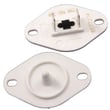
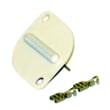
For a Kenmore 11060956990 electric dryer, the start switch part typically costs about $10 to $30; total replacement cost is higher if you pay for service. Confirm the exact switch style and access steps in the owner's manual.
- DIY part only: about $10 to $30 for many Kenmore-style push-to-start switches
- Service call and labor: commonly adds $100 to $250+ depending on your area and access
- Extra parts (sometimes needed): knob, timer, or door switch if the symptom is misdiagnosed
| Cost item | Typical range | What it covers |
|---|---|---|
| Start switch (part) | $10 to $30 | The electrical push-to-start switch only |
| Professional labor | $100 to $250+ | Diagnosis, disassembly, install, basic test |
| Total (common) | $110 to $280+ | Part plus labor |
A bad start switch is only one reason a dryer will not start. Before buying parts, we recommend these quick checks:
- Dryer has power (breaker not tripped; outlet has correct voltage)
- Door closes firmly and the door switch clicks
- Timer is set to a cycle and not between positions
- Lint screen and airflow are clear (overheating can open a safety fuse)
- No burning smell or repeated blown fuse symptoms
Replacing the wrong part is the most expensive outcome. On this model, a no-start complaint is often caused by a safety device such as the dryer thermal fuse WP3390719, not the start switch itself.
- Unplug the dryer before opening the console
- Take a photo of wire positions before moving anything
- After replacement, run a short timed cycle to confirm the motor starts and the drum turns
Last updated: February 2026
What is the life expectancy of a Kenmore dryer?
A Kenmore electric dryer like model 11060956990 typically lasts 10 to 13 years with normal household use. With consistent lint and vent maintenance and timely replacement of wear parts, it commonly reaches the upper end of that range.
A dryer’s life is usually determined by heat stress, airflow restriction, and normal wear on moving parts.
- Clean the lint screen before every load (restricted airflow overheats components)
- Keep the exhaust venting short, smooth, and clear of lint buildup
- Avoid overloading; heavy loads strain the drive system and drum supports
- Use the correct cycle and temperature for the fabric (lower heat reduces wear)
- Address new noises early (squealing, thumping, grinding)
Use these habits to reduce overheating and mechanical wear.
- Inspect and clean the vent path periodically (dryer outlet to exterior hood)
- Vacuum lint from the cabinet area during service intervals
- Confirm the drum turns smoothly and quietly
- Watch for longer dry times; it often signals airflow problems
- Follow cycle and temperature guidance in the owner's manual
If the dryer runs but gets noisy, stops mid-cycle, or dries poorly, these parts are frequent culprits on many Kenmore electric dryers.
| Symptom | Common cause | Example part for this model |
|---|---|---|
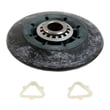
| Squealing or rumbling | Worn drum support rollers | Support kit WPW10314173 |
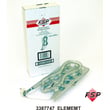
| No heat or weak heat | Failed heater or heat safety device | Dryer heating element WP3387747 |
| Runs then stops, no heat | Overheat protection opened | Dryer thermal fuse WP3390719 |
A dryer that overheats or struggles to move air wears out faster and can repeatedly trip safety devices. Good airflow and correct temperature selection help protect the heating circuit, motor, and drum support system.
Last updated: February 2026
How to test a dryer temperature switch?
To test the temperature switch (thermostat) in your Kenmore 11060956990 electric dryer, we use a multimeter to check continuity when the dryer is unplugged. A good switch shows continuity at room temperature (or changes state when heated, depending on the switch type). See the owner's manual for access and component location details.
- Multimeter with continuity (audible) or ohms setting
- Phillips screwdriver or nut driver (typical for dryer panels)
- Work gloves
- Phone camera (to record wire placement)
- Unplug the dryer (or switch off the breaker). Electric dryers use 240V.
- Access the thermostat/temperature switch (commonly on the blower housing or heater housing).
- Label and remove the wires from the switch terminals (pull on connectors, not wires).
- Set the meter to continuity; touch the probes together to confirm the meter beeps.
- Touch one probe to each switch terminal.
- Beep/near 0 ohms: switch is closed (continuity present).
- No beep/OL: switch is open (no continuity).
Some temperature switches are designed to open at a set temperature.
- With probes still on the terminals, gently warm the switch area with a hair dryer.
- Watch for the reading to change state (closed to open, or open to closed depending on design).
| Meter result | Typical meaning | What to check next |
|---|---|---|
| Continuity at room temp | Switch is likely OK | Check airflow restrictions and cycling behavior |
| No continuity at room temp | Switch is likely failed (if it should be closed) | Confirm you are on the correct terminals; replace if confirmed |
| Intermittent readings | Loose terminals or failing switch | Inspect connectors; replace if readings stay unstable |
The temperature switch helps regulate drum temperature and prevent overheating. If it fails, your dryer can run too hot, not heat correctly, or shut down unexpectedly. Overheating problems often trace back to restricted venting or a safety device opening.
Last updated: February 2026