Owner’s manual
 Error Codes


What is the average life of a Kenmore dryer?
A Kenmore electric dryer like model 11060902990 typically lasts 10 to 13 years. With consistent airflow maintenance (lint screen and venting) and prompt repair of wear items, it’s common for these dryers to reach 15 years of service.
The biggest life-shorteners are heat stress and restricted airflow. We recommend following the cleaning and venting guidance in the 11060902990 owner's manual.
- Clean the lint screen before or after every load
- Keep the exhaust vent clear and as straight as possible
- Avoid plastic or foil venting; use 4-inch heavy metal venting
- Don’t overload; bulky loads strain the drive system and reduce airflow
- Address new noises early (rollers, idler pulley, belt)
| Task | How often | Why it helps |
|---|---|---|
| Clean lint screen | Every load | Prevents overheating and long dry times |
| Check outside exhaust hood airflow | Monthly | Confirms vent is not restricted |
| Clean vent duct run | Yearly (or sooner if slow drying) | Reduces heat buildup and wear |
| Inspect drum support and belt system | If squealing/thumping starts | Prevents secondary damage |
If your 11060902990 still heats well and the cabinet and drum are in good shape, replacing common wear parts can be a cost-effective way to extend life.
Common “wear” parts on many Kenmore 110-series dryers include:
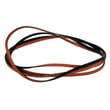
- Dryer drum belt 661570V (drives the drum)
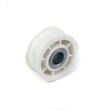
- Dryer idler pulley 279640 (keeps belt tension)
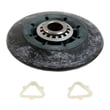
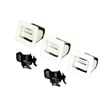
- Support kit WPW10314173 (drum support roller components)
A dryer that’s venting properly runs cooler and finishes cycles faster; that reduces stress on the heating circuit, motor, and thermostats, which is the simplest way to get the longest life from a Kenmore dryer.
Last updated: January 2026
How to tell if a dryer heating element is bad?
On the Kenmore electric dryer model 11060902990, a bad heating element usually shows up as a dryer that tumbles normally but produces little or no heat, causing damp clothes and long dry times. The most reliable confirmation is an unplugged continuity test of the element and a check for a short to the heater housing.
- Dryer runs but there is no heat on heated cycles
- Clothes take much longer than normal to dry
- Dryer heats intermittently (may stop heating mid-cycle)
- Burning smell or visible damage in the heater area (coil broken or touching metal)
- You also find a blown safety device such as a thermal fuse or thermal cut-off
Always disconnect power first. For access and safety notes specific to this dryer, follow the steps in the 11060902990 owner's manual.
- Continuity (element terminals): A good element typically shows continuity; an open circuit indicates a broken coil.
- Short to ground (terminal to metal housing): Any continuity to the metal heater housing indicates the coil is shorted and the element should be replaced.
| Test result | What it usually means | Next step |
|---|---|---|
| Continuity present | Element coil is not open | Check airflow, thermostats, and wiring |
| No continuity (open) | Element coil is broken | Replace the heating element |
| Continuity to housing | Element is shorted to ground | Replace the heating element |
On this model, “no heat” is not always the heater itself. We often check these in the same visit:
- Dryer thermal fuse WP3390719 (opens if the dryer overheats)
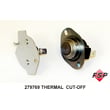
- Cut-off kit 279769 (thermal cut-off protection)
- Operating thermostat and high-limit thermostat
- House power supply (electric dryers can run on 120V but not heat if one leg of 240V is missing)
- Venting and lint buildup restricting airflow
A failed heating element stops proper drying, but restricted airflow can also overheat the heater circuit and repeatedly blow safety fuses. Fixing the root cause (often venting) helps protect the new part and restores normal drying performance.
Last updated: January 2026
Is it worth replacing a heating element in a dryer?
Yes, it’s usually worth replacing the heating element in your Kenmore 11060902990 electric dryer because the repair cost is typically far less than replacing the dryer. It’s most worthwhile when the dryer is otherwise in good condition and you also correct any airflow problems that caused overheating.
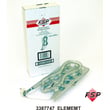
A failed element is a common, fixable “no heat” cause on electric dryers. For this model, the compatible replacement is the dryer heating element WP3387747.
- The drum turns and the timer runs, but clothes stay cold
- The dryer is in good overall shape (drum, motor, controls)
- You want to extend the dryer’s life with a targeted repair
- You can safely access the heater housing and wiring connections
- You will also clean the venting to prevent repeat failures
On Kenmore electric dryers like model 11060902990, restricted venting can overheat the heater circuit and blow safety devices. Before ordering parts, we recommend reviewing the troubleshooting and venting guidance in the 11060902990 owner’s manual.
- Clean the lint screen and confirm strong airflow at the outside vent hood
- Check for a crushed or kinked vent and avoid plastic or foil venting
- Verify the house power supply (a dryer can run but not heat if one leg of 240V is missing)
- Inspect the thermal safety parts; a blown fuse will stop heat even with a good element
| Symptom | Often involved part | Example compatible part for this model |
|---|---|---|
| Runs but no heat | Thermal fuse | WP3390719 |
| Overheats, then no heat | Thermal cut-off kit | 279769 |
| Cycles heat poorly | High-limit thermostat | WP3390291 |
Replacing only the heater without fixing airflow can lead to another burnout, longer dry times, and higher energy use. A clean, properly routed 4-inch metal vent helps the new element last and keeps drying performance strong.
Last updated: January 2026