Owner’s manual
 Error Codes


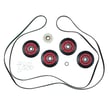
How to figure out dryer model number?
For Kenmore dryer model 11087562602, we find the model number on the model and serial label, which is typically on the door opening area (door frame or cabinet just inside the door). If it is not there, check the back panel of the dryer.
Where to look first (fastest checks)
- Open the dryer door and look around the door opening rim
- Check the cabinet face just inside the door
- Look on the back of the dryer cabinet
- Check the lower front area behind a small access panel (if your version has one)
- If the label is worn, use a flashlight and view from an angle to read faint print
What the model number looks like on this Kenmore dryer
Kenmore model numbers often appear as a long number with periods in the manual, but the model label usually shows the full number without punctuation.
| Where you see it | Example format you might see | What it means |
|---|---|---|
| Model/serial label on the dryer | 11087562602 | Exact model used to match parts |
| Manual model listing | 110.8756_, 110.8857_ | A model family range, not always your exact unit |
Why it matters
We use the exact model number to match the correct diagrams and compatible replacement parts (for example, a door latch kit or heating component). Even small model variations can use different switches, belts, or electrical parts.
If you cannot read the label
- Wipe dust off gently; do not scrub hard (printing can rub off)
- Take a close-up photo and zoom in
- Write down both the model and serial number for future reference
For more model-specific details and label references, use the 11087562602 dryer manual.
Last updated: January 2026
What does PF stand for on a Kenmore dryer?
On our Kenmore dryer model 11087562602, PF stands for power failure. It means the dryer’s electrical power was interrupted during a cycle, so the cycle may pause or stop until you restart it (see the 11087562602 dryer manual).
What to do when you see PF
- Press STOP/CANCEL to clear the display.
- Re-select your cycle and press START to resume drying.
- If the load is still wet, consider running a Timed Dry cycle to finish.
- Check that the dryer is plugged in firmly and the outlet is not loose.
- Check your home’s breaker(s) for the dryer circuit; reset if tripped.
Common causes of PF on model 11087562602
| Likely cause | What it looks like | What to check |
|---|---|---|
| Brief outage or flicker | PF appears after a storm or utility work | Restart cycle |
| Tripped breaker | Dryer has no power or won’t start | Reset both dryer breakers if applicable |
| Loose power cord or outlet | PF happens when the dryer vibrates | Inspect cord fit and outlet tension |
| Power drop from overloaded circuit | PF repeats when other appliances run | Avoid sharing the circuit; use a dedicated 30-amp circuit |
Why it matters
A PF code is usually not a dryer failure; it is the control telling you the cycle was interrupted. If PF happens repeatedly, fixing the power supply issue helps prevent incomplete drying and reduces wear on the motor and heating system.
When PF keeps coming back
If PF shows up frequently with no obvious outage, we recommend checking the dryer’s terminal block connections and power cord condition. If you find heat damage or loose connections, stop using the dryer and have it serviced.
For more code help across Kenmore dryers, use our Kenmore 110 series electronic control model dryer error codes reference.
Last updated: January 2026
How do I tell if my dryer heating element is bad?
If your Kenmore dryer model 11087562602 runs but doesn’t heat (or drying time suddenly gets much longer), the heating element is a top suspect. The most reliable confirmation is a multimeter continuity test with power disconnected; a failed element typically reads open (no continuity).
Symptoms that often point to a bad heating element
- Dryer tumbles normally but clothes stay cold and damp
- Cycles end “normally” but laundry is still wet
- Drying time increases with the same size load
- You see a broken coil in the heater
- The coil is touching the metal housing (can short to ground)
How we test the heating element on this model
- Disconnect power (unplug or switch off the breaker).
- Follow access and disassembly guidance in the 11087562602 dryer manual.
- Remove the wires from the heater terminals (take a photo first).
- Set the meter to ohms (Ω) and measure across the two element terminals.
- Check for a short by measuring from either terminal to the metal heater housing.
How to read the results
| Meter reading | What it usually means | What we do next |
|---|---|---|
| OL, infinite, or no continuity across terminals | Element is burned out | Replace the element |
| Continuity across terminals | Element may still be OK | Check safety devices and airflow |
| Continuity from terminal to housing | Element is shorted to ground | Replace the element |
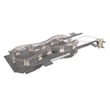
For this model, the compatible replacement is the dryer heating element WP8544771.
Other common “no heat” causes to check
A good element can still produce no heat if a safety device opens due to overheating or poor airflow:
- Restricted venting (crushed duct, lint buildup, blocked hood)
- Failed high-limit thermostat
- Thermal cut-off opened
- Temperature sensing issue
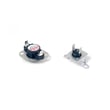
If you suspect overheating, inspect and correct venting first, then test the safety devices. For compatible safety parts used on this model, see the dryer thermal cut-off fuse kit 279973 and the dryer high-limit thermostat WP3391914.
Why it matters
If airflow is restricted, the dryer can overheat and open a thermal cut-off or thermostat. Fixing venting issues helps protect a new heating element and restores normal drying performance.
Last updated: January 2026