Installation guide
 Owner’s manual
 Error Codes


Is 4.5 cu ft a large washer?
Yes. A 4.5 cu ft washer is considered large capacity for most households; it handles bigger everyday loads and many bulky items more comfortably than standard 3.0 to 4.4 cu ft machines. For exact load guidance and cycle recommendations for your Whirlpool WTW4910XQ3, use the owner's manual.
What “large capacity” means in real use
A 4.5 cu ft tub typically works well for:
- Family-sized mixed loads (towels, jeans, kids’ clothes)
- Queen comforters and medium-thickness bedding
- Larger loads that reduce the number of weekly wash cycles
- Heavier fabrics when you avoid packing the basket tight
Quick capacity comparison
| Washer capacity | Common label | Best for |
|---|---|---|
| 2.0 to 2.9 cu ft | Compact | Small loads, tight spaces |
| 3.0 to 4.4 cu ft | Standard to mid | Most everyday laundry |
| 4.5 to 4.9 cu ft | Large | Families, towels, bedding |
| 5.0+ cu ft | Extra-large | Frequent bulky loads, very thick bedding |
How to load a large-capacity top-load washer (best results)
Even with a large tub, overloading is the top reason for poor cleaning and off-balance spinning.
- Load items loosely; don’t press clothes down
- Keep the top of the load below the rim of the basket
- Mix large and small items to balance the spin
- Use the right water level or cycle selection for the load
- For comforters, spread the fill evenly around the basket
Why it matters
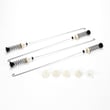
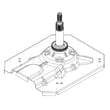
Choosing the right capacity helps prevent out-of-balance shaking, reduces wear on suspension components, and improves cleaning and rinsing performance. If your washer starts banging or walking during spin, worn suspension can be a factor; the suspension W10780048 is a common fix on this model.
Last updated: February 2026
Can too much detergent cause an E3 error?
Yes. In a Whirlpool WTW4910XQ3 top-load washer, too much detergent can create excess suds that interfere with proper water-level sensing and draining; that can trigger an E3-type overflow or drain-related error and stop the cycle until the suds clear.
What to do right now
- Press Cancel (or Pause/Cancel) to stop the cycle.
- Run a Drain/Spin cycle (or a rinse and spin) with no detergent.
- If you still see heavy suds, run an additional rinse.
- Reduce detergent on the next load; use less for soft water, small loads, or lightly soiled items.
- Avoid “extra” detergent for high-efficiency cycles; it increases suds without improving cleaning.
Detergent amount guidelines (practical)
Use this as a starting point, then adjust based on results.
| Load type | Typical detergent approach | What you should see |
|---|---|---|
| Small or lightly soiled | About 1/2 of the label amount | Minimal suds, normal drain |
| Normal load | Label amount or slightly less | Light suds, steady drain |
| Large/heavily soiled | Increase slightly (not double) | No foam buildup, normal spin |
Why it matters
Too many suds can trap air in the pressure system and slow draining. When the washer cannot “read” the water level correctly or cannot clear water fast enough, it protects itself by pausing and showing an error.
If the error keeps coming back (even with the right detergent)
A recurring E3 can also point to a real drain or water-level problem. Check these common causes:
- Kinked or restricted drain hose; confirm the drain setup matches the height and insertion guidance in the installation guide.
- Slow drain or no drain; inspect the washer drain pump assembly WPW10276397 for clogs or damage.
- Water-level sensing issues; check the hose WP353244 for pinches, cracks, or a loose connection.
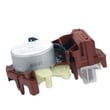
- Lid not locking consistently; a failed washer lid lock assembly W10404050 can interrupt cycles and mimic other faults.
Last updated: February 2026
How do I reset the lid lock on my Whirlpool washer?
To reset the lid lock on your Whirlpool WTW4910XQ3 washer, we recommend doing a power reset first: unplug the washer for 5 minutes, plug it back in, then start a cycle and close the lid firmly. If the lid still will not lock or unlock, the lid lock assembly is likely failing.
Quick reset steps (most common)
- Press Pause/Cancel once to stop the cycle.
- Unplug the washer for 5 minutes.
- Plug it back into a grounded 3-prong outlet.
- Close the lid completely (no laundry caught at the rim).
- Select Drain/Spin (or any cycle) and press Start.
If the washer still shows “lid locked” or will not start
These checks fix the most common causes on top-load Whirlpool washers.
- Make sure the washer is getting power (outlet is live; plug is fully seated).
- Confirm the lid is aligned and closing squarely; a bent lid can miss the strike.
- Listen for a click when you press Start; no click often points to the lock.
- If the lock was forced open, replace the lock instead of trying to “reset” it.
- If the tub will not drain, the control may keep the lid locked until water is out.
Parts that commonly solve lid lock problems
| Symptom | Most likely part | What it does |
|---|---|---|
| Won’t lock, won’t start | Washer lid lock assembly W10404050 | Senses lid closed and locks for spin |
| Lid locks but won’t drain/spin | Washer drain pump assembly WPW10276397 | Pumps water out so the cycle can finish |
Why it matters
The lid lock is a safety device; if the control does not see a solid “lid closed and locked” signal, it will stop agitation or prevent high-speed spin to reduce the risk of injury and water spills.
Where to find model-specific steps
For cycle behavior, indicator lights, and any model-specific reset or diagnostic sequences, follow the WTW4910XQ3 owner's manual.
Last updated: February 2026
What is the most common problem with Whirlpool washers?
The most common Whirlpool washer problems are draining or spinning issues (clothes stay wet), water leaks, excessive vibration or noise, and no-start symptoms. On the Whirlpool WTW4910XQ3, many of these come down to installation basics (hoses, drain setup, leveling) or a few high-wear parts.
Most common symptoms and what usually causes them
- Won’t drain or won’t spin: drain restriction, failing pump, or a lid lock that won’t engage
- Leaking: loose inlet hose connections, worn hoses, or a leaking pump
- Shaking, walking, loud banging: washer not level, unbalanced loads, weak suspension
- Won’t start: lid not locking, control not responding, or power/grounding issue
Quick checks we recommend first (WTW4910XQ3)
Use the setup steps in the installation guide as your baseline, because drain hose placement and leveling directly affect noise, vibration, and draining.
- Confirm the washer is plugged into a properly grounded outlet (do not use a neutral/ground fuse)
- Verify the drain hose is installed correctly; keep about 4.5 in. of hose inside the standpipe
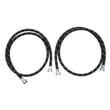
- Tighten inlet hose couplings and check for drips at the faucets and valve connections
- Level the washer so all four feet firmly contact the floor (reduces vibration and “walking”)
- Replace inlet hoses every 5 years and inspect for bulges, kinks, cuts, or leaks
Parts that commonly fix these problems
If the basic checks look good, these model-matched parts are common solutions:
| Symptom | Likely part to check | Part anchor |
|---|---|---|
| Won’t drain / wet clothes | Drain pump | Washer drain pump assembly WPW10276397 |
| Won’t start / lid won’t lock | Lid lock | Washer lid lock assembly W10404050 |
| Excessive shaking | Suspension rods | Suspension W10780048 |
| Agitation problems | Agitator drive components | Agitator dog 80040 |
Why it matters
Drain, leak, and vibration complaints often get worse over time. Correct drain hose setup, tight inlet connections, and proper leveling help prevent repeat failures and protect the gear case, belt drive, and tub components.
Last updated: February 2026