 Owner’s manual
 Error Codes




How do I know what model Kenmore refrigerator I have?
Your Kenmore refrigerator’s model number is printed on the serial plate inside the fresh food (refrigerator) compartment. For Kenmore model 59671813101, the serial plate location is the top left wall of the refrigerator compartment; use that label to record the full model and serial number exactly as shown in the owner's manual.
Where to look for the model number label
Check these common Kenmore refrigerator label locations first:
- Top left wall inside the refrigerator compartment (most common for this style)
- Side wall inside the refrigerator compartment near the crisper drawers
- Inside the refrigerator door frame (hinge side)
- Inside the freezer compartment wall (less common)
- Behind the toe grille (kick plate) at the bottom front
What to write down (and why)
Record the information exactly as it appears on the serial plate:
- Full model number (letters and numbers)
- Serial number
- Purchase date (if you have it)
This information helps us match the correct Kenmore 596-series parts diagrams and troubleshooting info when you search on Sears PartsDirect.
Quick ID checklist
Use this table to avoid common mix-ups:
| Item on label | What it’s used for | Tip |
|---|---|---|
| Model number | Finds the correct parts list and diagrams | Copy every character; do not shorten it |
| Serial number | Identifies the production run | Useful when parts change by revision |
| Purchase date | Helps with maintenance records | Write it in your manual for reference |
Why it matters
Kenmore refrigerators can look similar across multiple model families, but parts like door bins, crisper drawers, ice maker components, and control housings can vary by model number. Using the exact model number prevents ordering the wrong replacement part.
Last updated: February 2026
How to tell if a Kenmore refrigerator compressor is bad?
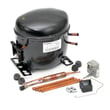
On Kenmore model 59671813101, a bad compressor usually shows up as poor or no cooling while the unit tries to run (often with repeated clicking or a brief hum), or as a compressor that never runs at all. Before condemning it, rule out power, control, and airflow issues listed in the 59671813101 owner's manual.
Quick checks before blaming the compressor
These steps catch the most common “compressor symptoms” that are actually something else:
- Confirm the refrigerator is plugged into a working outlet; check the fuse or circuit breaker.
- Make sure the freezer control is turned on (not set to Off).
- If the light works but the fans and compressor are not running, wait 40 minutes; the refrigerator may be in a defrost cycle.
- Clean the condenser coils; dirty coils can cause long run times and warm temperatures.
- Check door gaskets for a tight seal; warm air leaks can mimic sealed-system problems.
- Listen for normal operating sounds (fan airflow, refrigerant gurgle, compressor hum cycling on and off).
Symptoms that strongly point to a compressor or sealed-system problem
If the basics above check out, these signs are the most meaningful:
- Refrigerator and freezer both warm even though the unit “tries” to run
- Repeated clicking from the control area followed by silence (start attempt then shutdown)
- Compressor is very hot to the touch after repeated start attempts (do not touch bare tubing)
- Compressor runs but temperatures never recover, even after several hours
What you should hear: normal vs. concerning
| What you notice | Often normal | More concerning |
|---|---|---|
| Soft hum that cycles on/off | Yes | No |
| Gurgling/popping like boiling water | Yes | No |
| Single click when starting/stopping | Yes | No |
| Repeated click every few minutes with little/no run time | No | Yes |
Why it matters
The compressor is part of the sealed refrigeration system; when it cannot start or cannot pump refrigerant effectively, both compartments lose cooling. Doing the quick checks first prevents replacing major components when the real issue is a control setting, defrost timing, dirty coils, or a bad door seal.
For repair parts and diagrams for this Kenmore bottom-mount refrigerator, start with the model parts list and search by model number on Sears PartsDirect.
Last updated: February 2026
What are the most common problems with Kenmore refrigerators?
For Kenmore bottom-mount refrigerators like model 59671813101, the most common issues are cooling problems, ice maker and water dispenser troubles, leaks, frost buildup, odors, and unusual noises. Many are caused by airflow restrictions, dirty condenser coils, door seal gaps, or water supply problems; our troubleshooting steps below cover the usual fixes.
Most common problems (and what to check first)
- Not cooling or temperatures too warm: clean condenser coils, confirm controls are set correctly, and reduce frequent door openings.
- Runs too often: dirty coils, warm food load, or doors opening frequently can keep the compressor running.
- Ice maker not working: make sure the ice maker is turned on; if the refrigerator is not connected to water, raise the ice maker arm to the Off position to stop the sound.
- Water leaking or puddles: check the water line connection, inlet valve symptoms, and look for defrost drain issues.
- Frost buildup or moisture droplets: door left open, weak door gasket seal, or high humidity.
- Noisy operation: some sounds are normal; louder or new noises often point to a fan or airflow issue.
Quick troubleshooting by symptom
| Symptom | Most likely cause | What we do first |
|---|---|---|
| Fridge warm, freezer OK | Airflow issue, dirty coils, door openings | Clean coils; verify vents are not blocked |
| Both sections warm | Control setting, defrost cycle, power issue | Check outlet/breaker; wait about 40 minutes if in defrost |
| Water droplets inside | Humidity, frequent openings, unwrapped food | Wrap food tightly; limit door openings |
| Ice maker issues | Off position, no water supply, valve/line issue | Confirm ice maker is on; verify water supply |
Why it matters
These checks prevent food spoilage, reduce energy use, and help you avoid repeat failures. For example, the manual specifically calls out cleaning condenser coils, checking gasket seal, and allowing time for temperatures to stabilize after adding warm food.
Safety and model-specific notes
- Use a properly grounded 3-prong outlet on a dedicated 103 to 126V, 15-amp, 60-cycle circuit.
- If you need model-specific control settings, cleaning steps, or “before calling for service” guidance, use the 59671813101 owner's manual.
- For replacement parts for Kenmore 59671813101, start with the parts list for this model, or search by model number on Sears PartsDirect.
Last updated: February 2026
Why is my refrigerator not getting cold at the bottom?
If your Kenmore bottom-mount refrigerator model 59671813101 is warm at the bottom, the most common causes are restricted airflow or poor heat removal, especially from dirty condenser coils. Start with cleaning, then confirm the temperature controls and door gasket seal per the 59671813101 owner's manual.
Quick checks that fix most “warm bottom” complaints
- Clean the condenser coils (dust and pet hair reduce cooling performance).
- Verify the controls are set correctly; set no colder than necessary.
- Give it time after loading warm food; temperatures can take hours to stabilize.
- Check door gaskets for a tight seal; warm air leaks often show up as uneven temps.
- Confirm the refrigerator is level; poor leveling can affect door sealing and airflow.
- Allow proper ventilation space: about 1 inch at the top and extra space at the back if a water line is connected.
What to do first (in order)
- Unplug the refrigerator before cleaning.
- Clean condenser coils thoroughly; this is specifically called out in the care and cleaning guidance.
- Restore power and wait 24 hours for temperatures to fully recover.
- Recheck the gasket seal by closing a sheet of paper in the door; it should resist being pulled out.
Symptoms and likely causes
| What you notice | Most likely cause | What we recommend |
|---|---|---|
| Bottom shelves warm, freezer seems OK | Airflow restriction or heat not being rejected | Clean condenser coils; confirm vents are not blocked |
| Temps warm after grocery load | Normal recovery time | Wait several hours; avoid overpacking |
| Moisture or sweating near door | Door not sealing well | Clean gasket; level unit; replace gasket if worn |
| Unit seems to run a lot | Dirty coils or frequent door openings | Clean coils; minimize openings; confirm settings |
Why it matters
Bottom-area warming is often an early sign the refrigerator is struggling to move heat out efficiently. Keeping the condenser coils clean and the door gaskets sealing tightly helps your 59671813101 cool evenly, run less, and protect food.
Related DIY help
For replacement parts for your Kenmore 59671813101, use the parts list for this model or search by model number on Sears PartsDirect.
Last updated: February 2026





