Owner’s manual
 Error Codes



What's the average lifespan of a Whirlpool refrigerator?
Most Whirlpool refrigerators, including the Whirlpool WRF535SWHV00 bottom-mount style, typically last 10 to 15 years with normal household use. Consistent cleaning, good airflow around the cabinet, and keeping door seals tight help you reach the high end of that range; see the WRF535SWHV00 owner's manual.
- Condenser and airflow: Dust buildup and blocked vents make the compressor run longer.
- Door gasket condition: Leaks force longer run times and can cause frost or moisture issues.
- Room temperature and usage: Warm kitchens, frequent door openings, and large warm food loads increase run time.
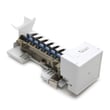
- Ice maker and water system health: Low water pressure or valve issues can stress components.
- Power quality: Repeated outages or surges can shorten control board life.
- Keep interior temps steady (avoid frequent big control changes).
- Clean spills promptly to prevent odors and corrosion.
- Confirm doors close fully and don’t bounce open.
- Leave space behind and above the refrigerator for ventilation.
- If cooling seems weak, listen for the evaporator fan and check for blocked air vents.
| Component | Typical role | When it often needs attention |
|---|---|---|
| Door gasket | Seals cold air in | If you see gaps, condensation, or frost |
| Ice maker | Produces ice | If cubes are small, hollow, or production stops |
| Evaporator fan motor | Moves cold air through compartments | If you hear squealing or airflow is weak |
| Compressor | Pumps refrigerant | Usually long-life; service if cooling fails |
If you’re troubleshooting cooling or ice issues on this model, the Whirlpool refrigerator error codes guide can help narrow down the system involved.
A refrigerator that runs “too much” is often still repairable, but the extra run time increases energy use and accelerates wear on the sealed system (compressor, evaporator, condenser, dryer). Catching airflow and sealing problems early helps the unit last longer.
Last updated: February 2026
Are all refrigerators 36 inches wide?
No. Refrigerators are not all 36 inches wide; widths vary by style and capacity. For Whirlpool model WRF535SWHV00, the exact cabinet width depends on the specific configuration, so we recommend confirming the published dimensions in the WRF535SWHV00 owner's manual before planning cabinetry or a replacement.
Most household refrigerators fall into a few common width groups:
- 24 inches: compact and apartment-size models
- 28 to 33 inches: many top-freezer and smaller bottom-freezer models
- 33 to 36 inches: many French door and larger bottom-mount models
- 36 to 40 inches: extra-capacity and some built-in style units
| Refrigerator type | Common widths | Notes |
|---|---|---|
| Top freezer | 28 to 33 in. | Often the narrowest full-size option |
| Bottom freezer | 29 to 36 in. | Width varies widely by capacity |
| French door | 33 to 36 in. | 36 in. is common, not universal |
| Side-by-side | 32 to 36 in. | Can be tall and narrower than French door |
Even if the cabinet width fits, you still need space for airflow, door swing, and water hookups.
- Leave about 1/2 inch on each side and at the top for ventilation
- Leave about 1 inch behind the refrigerator for airflow
- If you have an ice maker, allow extra room behind for the water line connection
- If the refrigerator sits next to a wall, allow hinge-side clearance so doors open fully
- Measure doorway and hallway clearance for delivery (handles can add depth)
A “standard 36-inch refrigerator” assumption can lead to tight installs, doors that do not open fully, poor ventilation, and harder water line routing. Verifying the WRF535SWHV00 dimensions first helps avoid return trips and installation headaches.
Last updated: February 2026
Do you remove cardboard from the bottom of a Whirlpool refrigerator?
No. On Whirlpool model WRF535SWHV00, any cardboard-like panel or cover at the bottom area is there to protect components and help manage airflow; it stays in place. The cardboard you should use is only temporary floor protection when sliding the refrigerator for cleaning or service (see the WRF535SWHV00 owner's manual).
Use this quick check to avoid removing the wrong piece.
- Remove shipping materials: tape, foam blocks, plastic wrap, and any loose cardboard used only for packing.
- Keep any fixed bottom cover or panel that is screwed on or clipped in place.
- Keep the base grille area parts unless you are leveling, aligning doors, or servicing.
- Remove the floor-protection cardboard you place under the unit while moving it.
- Stop and inspect if the “cardboard” is attached near wiring, tubing, or the compressor area.
| Item you see | Typical location | What to do |
|---|---|---|
| Loose cardboard/foam packing | Around doors, shelves, drawers | Remove before use |
| Fixed cover/panel that looks like cardboard | Bottom rear or underside area | Leave installed |
| Base grille (front) | Below the doors/freezer drawer | Remove only for leveling/service, then reinstall |
That bottom cover helps protect internal components and supports proper airflow. Removing it can lead to overheating, poor cooling performance, or extra noise.
When we pull a refrigerator out for cleaning or service, we protect the floor with cardboard or hardboard and pull the unit straight out (not “walking” it). That guidance is in the WRF535SWHV00 owner's manual.
Last updated: February 2026
What is the biggest problem in a Whirlpool refrigerator?
For the Whirlpool WRF535SWHV00 refrigerator, the biggest real-world problem we see is cooling trouble (fresh food or freezer not staying cold). It is usually caused by airflow issues (dirty condenser coils, a weak evaporator fan), door sealing problems, or a defrost-related ice buildup that blocks airflow.
- Not cooling or warm temperatures: food spoils, freezer softens, compressor seems to run a lot
- Runs constantly: long run times, especially after frequent door openings or warm room conditions
- Noisy operation: new-style compressors and fans can sound different, but grinding or squealing points to a fan issue
- Water leaks or puddles: often tied to a drain issue or ice buildup
- Ice maker not making ice: can be water supply, valve, or ice maker assembly
Start with these basics from the WRF535SWHV00 owner's manual before replacing parts:
- Confirm the power cord is plugged in and the outlet works.
- Check the household breaker or fuse.
- Make sure the controls are turned on.
- For a new installation, allow 24 hours for the refrigerator to cool completely.
- Avoid setting controls to the coldest setting expecting faster cooling; it does not speed recovery.
If the basics check out, these model-matched parts are often involved in “not cooling” symptoms:
| Symptom | Common cause | Example model-matched part |
|---|---|---|
| Warm fridge, freezer OK or both warm | Poor airflow in freezer | Refrigerator evaporator fan motor WPW10128551 |
| Fan noise, vibration | Damaged fan blade | Refrigerator evaporator fan blade WP2169142 |
| Temps swing, odd cycling | Sensor/control issue | Refrigerator thermistor 12002355 |
| No ice and no water fill | Water supply control problem | Refrigerator water inlet valve assembly WPW10420083 |
Cooling issues are the root cause behind most other complaints (food spoilage, heavy running, frost buildup, and ice maker trouble). Fixing airflow and sealing problems early helps the compressor and sealed system avoid unnecessary strain.
If your unit is showing a fault code or you suspect a control issue, use Whirlpool refrigerator error codes to narrow the problem to a system (cooling, defrost, sensors, or ice maker).
Last updated: February 2026