Installation guide
 Owner’s manual
 Error Codes



What's the life expectancy of a Maytag dryer?
A Maytag electric dryer like model MEDB835DW3 commonly lasts about 10 to 15 years with normal household use and consistent care. Real-world lifespan varies most with airflow (venting), load size, and how quickly small wear issues are fixed using the correct maintenance steps in the MEDB835DW3 user manual.
What affects dryer lifespan the most
These are the biggest factors we see that shorten or extend the life of a MEDB835DW3 dryer:
- Vent restriction (crushed duct, long run, clogged exterior hood) causing overheating and long dry times
- Lint buildup in the lint screen housing and blower area
- Overloading (extra strain on the drum, belt, rollers, and motor)
- Heat stress from poor airflow that can damage thermostats, fuses, and wiring
- Normal wear parts (rollers, idler pulley, seals) that eventually need replacement
Maintenance checklist (simple, high impact)
Use this routine to help your Maytag dryer run cooler and last longer:
- Clean the lint screen every load; wash it with mild soap monthly if you use dryer sheets
- Inspect and clean the vent duct and outside hood at least yearly
- Keep the dryer level so the drum rides evenly on support rollers
- Avoid packing the drum tight; dry bulky items in smaller loads
- If drying time suddenly increases, address airflow first (before replacing parts)
When repairs make sense (common wear items)
If your MEDB835DW3 starts squealing, thumping, or rumbling, it is often normal wear in the drum support system. A common fix is replacing wear components together, such as the dryer repair kit 4392067.
| Symptom | Likely wear area | Typical result |
|---|---|---|
| Squealing or chirping | Idler pulley, rollers | Noise, possible belt wear |
| Thumping | Drum support rollers | Flat spots, vibration |
| Longer dry times | Venting, blower, lint ducting | Overheating, poor performance |
Why it matters
A dryer that runs hot or takes too long to dry does more than waste energy; it accelerates wear on key components (motor, rollers, thermostats) and can turn a small maintenance issue into a bigger repair.
Last updated: January 2026
Are Maytag Bravos dryers good?
Maytag Bravos dryers are generally considered a solid, reliable choice when they’re installed correctly and maintained, and that same “good performance with routine care” expectation applies to your Maytag MEDB835DW3 electric dryer. For the best results, follow the care, venting, and cycle guidance in the MEDB835DW3 owner’s manual.
What “good” usually means for Bravos-style Maytag dryers
A dryer’s real-world performance depends more on airflow, load size, and maintenance than the badge on the front. In our experience, owners are happiest when they focus on these basics:
- Clean the lint screen before every load (and wash it occasionally to remove fabric-softener film)
- Keep the exhaust vent run short, smooth, and free of lint buildup
- Avoid overloading; packed loads dry slower and can feel “underpowered”
- Use sensor-dry cycles for mixed loads; use timed dry for specialty items
- Level the dryer to reduce vibration and premature wear
Quick checks if drying seems slow
If your MEDB835DW3 takes too long to dry, start with airflow first. A restricted vent is the most common cause of long dry times and overheating.
| Symptom | Most common cause | What to do first |
|---|---|---|
| Clothes still damp | Vent restriction | Inspect and clean venting and outside hood |
| Dryer runs hot | Poor airflow | Check lint screen, lint duct, and exhaust duct |
| No heat at all | Heat circuit issue | Verify power supply, then test heating components |
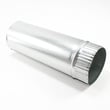
For model-compatible airflow parts, we often see issues tied to the lint path and ducting; examples include the dryer lint screen (white) W10859086 and the dryer exhaust duct W10608817 when they’re damaged or packed with lint.
Why it matters
A “good” dryer can still dry poorly if airflow is restricted; that can increase dry times, raise operating temperatures, and put extra stress on components like thermostats and thermal fuses.
Helpful DIY reading
Last updated: January 2026
How big is the Maytag medb835dw3?
We can’t confirm the exact cabinet dimensions or drum capacity for the Maytag MEDB835DW3 from the model-specific information available here. The most reliable way to get the precise width, height, depth, and required clearances for your exact unit is to use the MEDB835DW3 installation guide.
How to get the exact size for MEDB835DW3
In the installation instructions, look for sections such as “Dimensions,” “Location requirements,” or “Clearances.” Those sections typically list the measurements you need for a laundry room, closet install, or replacing an older Maytag dryer.
- Measure the space opening (width, height, depth)
- Compare to the dryer’s overall dimensions
- Check door-open clearance (depth with door open)
- Confirm rear clearance for the vent duct and power cord
- Verify side clearance if installed in a tight alcove
What to measure at home (quick checklist)
Use a tape measure and write down these numbers before ordering accessories or planning an install.
| Measurement | What you measure | Why it matters |
|---|---|---|
| Width | Wall-to-wall opening | Prevents fit issues in closets/alcoves |
| Height | Floor to overhead shelf/cabinet | Avoids interference with shelving |
| Depth | Back wall to front edge | Ensures the door can close and vent fits |
| Door clearance | Space in front of dryer | Confirms the door can open fully |
Why it matters
Correct sizing helps you avoid crushed venting, pinched cords, and poor airflow that can cause long dry times. It also helps you plan vent routing and placement for safer, more efficient drying.
Last updated: January 2026
What is the most common problem with the Maytag dryer?
On the Maytag MEDB835DW3 electric dryer, the most common complaint we hear is the dryer will not start. On this model, that is often caused by a power supply issue, the door not being sensed as closed, or a safety device opening after overheating from restricted airflow; use the MEDB835DW3 use & care manual for the model’s basic operating checks.
Quick checks first (no parts)
- Reset the house breaker fully (OFF then ON); electric dryers can run into “no start” issues if one leg of power is lost.
- Confirm the door closes firmly and the latch area is not blocked by lint.
- Try a different cycle and press and hold Start as directed for the cycle.
- Clean the lint screen and verify strong airflow at the outside vent hood.
- If the control is unresponsive, unplug the dryer for 1 minute, then restore power.
If it still won’t start: common part-related causes for MEDB835DW3
If the basics check out, these model-compatible parts are common “no start” suspects:
- Overheat safety opened (often tied to vent restriction): whirlpool dryer thermal cut-off fuse kit (352-degree f) 280148
- Control not responding or erratic operation: prog acu vma W10827974
- Door not being detected as closed due to alignment or wear: inspect the door catch and strike area
Symptom-to-likely-cause guide
| What you notice | What it often points to | What we recommend |
|---|---|---|
| No lights, no response | Power supply, cord/outlet, breaker | Verify 240V supply, reset breaker, check cord connections |
| Lights on, won’t start | Door not sensed closed, control issue | Re-seat door, try another cycle, then test door switch circuit |
| Starts then stops quickly | Overheat protection, airflow restriction | Clean venting, check for crushed/long duct runs |
| Runs but no heat | Heating circuit or airflow issue | Confirm airflow first, then test heat components |
Why it matters
A “won’t start” problem is sometimes a simple power or door-latch issue, but restricted venting can overheat the dryer and open safety devices. Restoring proper airflow helps prevent repeat shutdowns and improves dry times.
Last updated: January 2026