

How do I fix a low flow error on my washing machine?
A low flow (low fill) problem on your Whirlpool LXR7144EQ1 washer almost always means the washer is not getting enough water fast enough. We fix it by restoring full water supply to the inlet, cleaning the inlet screens, and then checking the fill system parts if the problem continues.
Quick checks first (no parts needed)
- Confirm both hot and cold shutoff valves are fully open.
- Straighten any kinked or crushed fill hoses.
- Make sure the hoses are connected to the correct hot and cold ports.
- Check for low house water pressure at the laundry faucet (weak flow can trigger low fill symptoms).
- If your hoses have flood-safety or auto-shutoff devices, reset them per the hose instructions.
Clean the inlet screens (most common fix)
- Unplug the washer.
- Turn off both water valves.
- Remove the fill hoses from the back of the washer.
- Carefully clean the small inlet screens inside the washer ports and the screens at the valve ends of the hoses.
- Reconnect hoses, turn water back on, and test a fill.
If it still fills slowly: what to check next
Low flow can also happen when a control or water-level sensing issue stops the fill early.
- Inspect the pressure hose for cracks, pinches, or a loose connection; a leak can confuse water-level sensing.
- If the washer overfills or underfills randomly, the water-level pressure switch system is a strong suspect.
- If the washer fills normally on one temperature but not the other, the inlet valve or a blocked screen on that side is likely.
Parts that commonly solve low fill symptoms on this model
| Symptom you see | Most likely area | Part on this page |
|---|---|---|
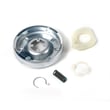
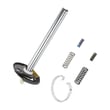
| Underfills, overfills, or stops filling too soon | Water-level sensing | Washer water-level pressure switch kit W10337780 |
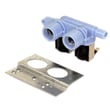
| Fills fine but will not advance because water is not entering as expected | Water inlet control (valve body) | Mixing valve 285805 |
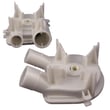
| Fills, then seems to “error” because water is leaving too fast | Drain system | Washer drain pump WP3363394 |
Why it matters
Low flow is not just a nuisance; it can cause poor cleaning, longer cycles, and repeated no-fill or slow-fill symptoms that stress the inlet valve and water-level system.
Helpful DIY guidance
If your washer is also not filling at all, this step-by-step video walks through the most common direct-drive top-load checks: troubleshooting a direct drive top load washer that wont fill video.
Last updated: February 2026
How do I reset my Whirlpool washer error code F7E1?
The Whirlpool washer model LXR7144EQ1 uses a mechanical timer and does not display digital fault codes like F7E1. If you are seeing “F7E1,” it is coming from a different Whirlpool washer (or from a separate device), so the right “reset” depends on the model that’s actually showing the code.
Confirm you have the right model
Check the model tag on the washer cabinet (commonly under the lid or along the rim) and match it exactly.
- If the tag says LXR7144EQ1, you will not have an F7E1 code display.
- If your control panel has a digital display, you likely have a different Whirlpool model.
- If you are using a smart plug, outlet monitor, or home app, the “code” may be from that device, not the washer.
What you can do on LXR7144EQ1 instead (common “reset” actions)
These steps address the most common “stuck” conditions on a timer-driven top-load washer.
- Turn the timer knob to Off.
- Unplug the washer for 1 minute, then plug it back in.
- Lift and close the lid firmly (a lid switch issue can stop agitation or spin).
- Set the timer to Drain/Spin and pull the knob to start.
- If the tub will not drain, check for a clog or a failing pump.
If the washer will not drain or spin
On LXR7144EQ1, symptoms that feel like an “error” are usually mechanical or switch related.
| Symptom | What to check first | Example part for LXR7144EQ1 |
|---|---|---|
| Water left in tub, no spin | Drain path and pump | Washer drain pump WP3363394 |
| No spin when lid closes | Lid switch circuit | Switch 3949247V |
| Motor runs but basket does not move | Drive connection | Coupling 285753A |
Why it matters
Using the correct model number prevents wasted troubleshooting. LXR7144EQ1 problems are diagnosed by symptoms (won’t drain, won’t spin, won’t agitate), not by electronic error codes.
Last updated: February 2026
How to tell if a Whirlpool drain pump is bad?
On a Whirlpool LXR7144EQ1 top-load washer, a bad drain pump usually shows up as standing water left in the tub, slow or no draining, or a loud grinding or buzzing sound during the drain portion of the cycle. If the drain path is clear and the pump still will not move water, the pump is the likely failure.
Quick symptoms checklist
- Tub stays full or partially full after the cycle ends
- Washer stops before spin because it cannot drain
- You hear a steady hum but little or no water flow
- Grinding or rattling noise (impeller damage or debris inside the pump)
- Draining is intermittent (works sometimes, fails other times)
Rule out the common non-pump causes first
Before replacing parts, we check the simple stuff that can mimic a bad pump:
- Make sure the drain hose is not kinked, crushed, or shoved too far down the standpipe
- Check for a clog in the drain hose or the tub-to-pump hose (coins, socks, lint)
- Confirm the standpipe or household drain is not backing up
- Verify the lid is closing and the washer is allowed to spin (a no-spin condition can look like a drain problem)
How we confirm the pump is the problem
- Listen and look during drain: If the motor runs but water barely moves, suspect a jammed or broken impeller.
- Inspect the pump inlet/outlet: Remove power, then check hoses for obstructions right at the pump ports.
- Electrical check (advanced): If the pump is powered but not pumping, or if it reads open on a continuity check, replacement is typically the fix.
What the results usually mean
| What you observe | Most likely cause | What we do next |
|---|---|---|
| Hums, no water movement | Jammed/broken impeller or seized pump | Clear debris; replace pump if damaged |
| Loud grinding | Impeller damage or debris | Inspect pump; replace if worn |
| Drains slowly | Partial clog or weak pump | Clear hoses; replace if flow stays weak |
| No sound during drain | Control, wiring, or switch issue | Check lid switch and wiring before pump |
Recommended replacement part for this model
If your diagnosis points to the pump, use the model-correct drain pump: washer drain pump WP3363394.
Why it matters
A washer that cannot drain often will not spin properly, leaving clothes soaking wet and putting extra strain on the drive system. Fixing a drain issue early helps prevent secondary problems like beltless drive wear, clutch strain, and repeated cycle interruptions.
Last updated: February 2026