Installation guide
 Owner’s manual


How to figure out dryer model number?
On a Kenmore electric dryer like model 11062342510, the model number is printed on the appliance’s identification label. The most common spot is the door opening area; open the door and look along the door frame or the rim of the opening for a sticker or metal tag.
Where to look first (fastest checks)
- Open the dryer door and inspect the door frame (left and right sides).
- Check the top or bottom lip of the door opening.
- Look on the inside face of the door itself.
- If you do not see it, check the rear panel of the cabinet.
- On some designs, the label is on the front cabinet behind the lower access area.
What the label looks like
The label typically includes both a model number and a serial number. For Kenmore models, the model number is usually a long number string (for example, 11062342510).
| You see on the tag | What it means | Why you need it |
|---|---|---|
| Model number | Identifies the exact dryer design | Ensures diagrams and parts match your dryer |
| Serial number | Identifies production run/date | Helps confirm correct revisions and compatible parts |
Why it matters
We use the model number to match the correct parts and instructions for your exact dryer. For example, common wear items on Kenmore 110-series dryers include the drum belt, idler pulley, and door switch; the model number prevents ordering a look-alike part that will not fit.
Helpful next step
Use the model number you find to reference the 11062342510 owner's manual for operating details and care guidance.
Last updated: January 2026
What is the life expectancy of a Kenmore dryer?
A Kenmore electric dryer like model 11062342510 typically lasts 10 to 13 years. With consistent venting and lint maintenance, many dryers reach the mid-teens, and some run 20 years when wear parts are replaced as needed and airflow stays strong (see the 11062342510 owner's manual).
What affects dryer lifespan most
- Vent airflow: restricted venting overheats the heater circuit and shortens component life.
- Lint control: cleaning the lint screen every load reduces strain on the blower and heater.
- Load size: overloading accelerates wear on the drum support system and belt.
- Cycle choice: automatic moisture-sensing cycles reduce overdrying and heat exposure.
- Timely wear-part replacement: replacing common wear items prevents secondary damage.
Maintenance checklist that adds years
- Clean the lint screen every load; replace it if damaged (example: dryer lint screen W11778253).
- Inspect and clean the vent duct and exterior hood regularly; keep runs short and smooth.
- Listen for squealing or thumping; service drum support parts before the belt slips or breaks.
- Keep the dryer level; vibration increases wear on rollers, idler, and motor mounts.
- Follow clearances and venting rules in the 11062342510 installation guide.
Common “end-of-life” symptoms and likely wear parts
| Symptom | What it often points to | Example part for this model |
|---|---|---|
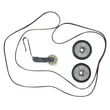
| Drum will not turn, motor runs | Worn/broken belt or idler issue | Belt 341241 |
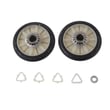
| Loud squeal or rumble | Drum support wear (rollers/idler) | Dryer repair kit (example: 4392065) |
| Runs but no heat | Heater circuit issue | Dryer heating element 279838 |
Why it matters
Most dryer “failures” are airflow or wear-part problems, not the cabinet or drum. Keeping airflow strong and replacing inexpensive wear items on time helps your Kenmore 11062342510 dry faster, run cooler, and last longer.
Last updated: January 2026
What is the AF code on a Kenmore dryer?
On Kenmore electric dryer model 11062342510, the AF code indicates restricted airflow. The dryer is not moving enough air through the lint screen and venting, so drying performance drops and the dryer may run hotter than normal.
What to check first (fast fixes)
- Clean the lint screen completely (wash with warm water and a soft brush if it has residue).
- Confirm the lint screen is seated correctly and the housing is not packed with lint.
- Make sure the dryer door closes fully and the door seal is positioned correctly.
- Inspect the vent hose behind the dryer for kinks, crushing, or sagging.
- Check the outside vent hood for a stuck flap, lint buildup, or a bird nest.
- Run a timed dry cycle and verify strong airflow at the outside vent.
Venting requirements that commonly trigger AF
Restricted airflow is often caused by the vent material or the way it is routed. For this Kenmore dryer, avoid flexible plastic venting and avoid thin foil-type duct because it can collapse and trap lint.
| Vent setup | Typical result | Recommendation |
|---|---|---|
| Crushed or kinked flexible duct | AF code, long dry times | Replace or reroute duct |
| Long vent run with many elbows | Weak airflow | Shorten run, reduce elbows |
| Lint buildup in duct or hood | AF code, overheating | Clean duct and hood |
Why it matters
Good airflow helps the heating system cycle correctly, keeps drying times reasonable, and reduces overheating stress on parts like the heating element and thermostats.
Helpful references
- Use the venting and maintenance guidance in the 11062342510 owner’s manual.
- Follow safe vent material and installation practices in the 11062342510 installation guide.
Last updated: January 2026
How to hard reset a Kenmore dryer?
To hard reset your Kenmore dryer model 11062342510, disconnect power by unplugging the dryer (or switching off the breaker) for about 1 to 5 minutes, then restore power and try a cycle. This clears many control glitches and is also the first safety step before any inspection.
Hard reset steps (safe and effective)
- Turn the dryer OFF.
- Unplug the power cord; if it is direct-wired, turn OFF the breaker.
- Wait 1 to 5 minutes.
- Restore power.
- Close the door fully and press and hold PUSH to START until the drum begins moving.
- If the dryer still will not run, follow the checks below before repeating the reset.
If the reset did not fix it: what to check next
A hard reset helps when the control is confused, but it will not fix a no-run or no-heat condition caused by power, airflow, or a failed safety device.
- Door not fully closed: the dryer will not run if the door is not shut completely.
- Power supply issue: electric dryers need 240 volts; a tripped breaker or blown fuse can let the drum run but stop heat.
- Start button technique: press and hold PUSH to START long enough to hear/see the drum begin moving.
- Airflow restriction: a clogged lint screen or vent can cause overheating and shutdown symptoms.
- Overheat protection opened: if the dryer overheated, a thermal cut-off can stop heat (and sometimes operation depending on design).
Common symptoms and the most likely cause
| Symptom | Most common cause | What we recommend |
|---|---|---|
| Won’t start at all | Door switch, start circuit, power issue | Verify door closes, confirm breaker, then test door switch |
| Runs but no heat | One leg of power missing, heater circuit issue | Reset both breakers, confirm 240V, then inspect heater circuit |
| Long dry times | Lint screen or vent restriction | Clean lint screen and check vent airflow |
Parts that often come up after a “reset” complaint
If your dryer still will not run or heat after the steps above, these model-compatible parts are common fixes:
- Dryer door switch WP3406107 (door must register closed)
- Dryer thermal cut-off fuse kit 279816 (opens if the dryer overheats)
- Dryer heating element 279838 (no-heat failures)
Why it matters
Resetting is a quick way to clear a temporary control issue, but checking power, door closure, and airflow prevents repeat shutdowns and helps protect the heating system and thermostats. For model-specific operating steps and safety notes, use the 11062342510 owner's manual.
Last updated: January 2026