Installation guide
 Owner’s manual


What's the average lifespan of a Whirlpool dryer?
A Whirlpool dryer typically lasts 10 to 13 years. For your Whirlpool WGD85HEFW1 gas dryer, consistent airflow maintenance (lint screen and venting) and avoiding chronic overheating are the biggest factors that help it reach the upper end of that range.
What affects dryer lifespan the most
- Vent restriction (long runs, too many elbows, crushed duct) increases heat and run time.
- Lint buildup in the lint screen housing and blower area reduces airflow.
- Overloading strains the drum support system and drive components.
- High heat use on every load accelerates wear on thermostats and fuses.
- Poor leveling can cause abnormal tumbling and extra mechanical wear.
Maintenance that extends life (high impact)
We recommend these habits for the WGD85HEFW1:
- Clean the lint screen before every load.
- Keep the exhaust route as straight and short as practical; use as few 90° turns as possible.
- Periodically check for longer dry times, hotter cabinet temps, or a burning smell; those point to airflow problems.
- Make sure the dryer sits level; an unlevel dryer can tumble poorly and affect sensor cycles.
- If you have a steam setup, inspect hoses periodically and replace them on a 5-year schedule.
Common wear items and what they usually mean
| Symptom | Most common cause | Typical fix |
|---|---|---|
| Squealing or thumping | Drum support wear | Replace rollers and related hardware |
| Dryer runs but heat is inconsistent | Gas ignition components | Test/replace ignition sensors or coils |
| Long dry times | Venting or airflow restriction | Clean venting, inspect blower area |
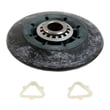
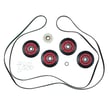
If you are hearing a steady squeal or rumble, a common mechanical wear item is the dryer drum support roller WPW10314173.
Why it matters
A dryer that is forced to run hotter and longer (usually from restricted venting) not only dries slower, it also shortens the life of key safety and temperature-control parts. Following the venting and spacing guidance in the WGD85HEFW1 installation guide helps protect performance and longevity.
Last updated: February 2026
Can I search for Whirlpool parts by model?
Yes. For your Whirlpool gas dryer model WGD85HEFW1, searching by the full model number is the most accurate way to get compatible parts because it ties your results to the exact diagrams and component list built for that dryer.
How to search by model number (best practice)
- Use the complete model number exactly as shown on the dryer’s model/serial tag: WGD85HEFW1.
- Match the part by name and ID (not just a description) to avoid look-alikes.
- Use the exploded-view diagrams to confirm where the part installs.
- If your symptom is performance-related (no heat, long dry times, noise), confirm the failure first so you do not replace the wrong part.
- Keep your installation setup in mind (venting, clearances, gas connection) because installation issues can mimic part failures.
Common WGD85HEFW1 parts customers search by model
| Symptom you’re fixing | Common part to check | Example part for this model |
|---|---|---|
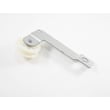
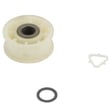
| Squealing, thumping, rumbling | Drum support rollers, idler pulley | Dryer drum support roller WPW10314173, dryer idler pulley W10837240 |
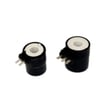
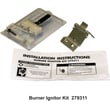
| No heat or heat cuts out | Gas ignition components, safety fuses | Dryer valve coil kit 279834, igniter 279311, thermal fuse W10909685 |
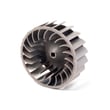
| Long dry times | Airflow and temperature sensing | Dryer blower wheel WP697772, dryer thermistor WP8577274 |
Why it matters
Model-based searching prevents ordering a part that “looks right” but does not fit your exact Whirlpool configuration. It also helps you confirm whether a symptom is caused by a failed part or by installation factors like vent restrictions and required clearances.
Helpful references for this model
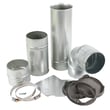
- Use the WGD85HEFW1 installation guide to confirm venting requirements, recommended spacing, and the complete installation checklist.
Last updated: February 2026
What does F-01 mean on a Whirlpool dryer?
On a Whirlpool dryer, the F-01 code points to an electronic control problem, most often the main control board (machine control) not processing inputs correctly. On model WGD85HEFW1, start by resetting power, then check wiring connections to the control before replacing parts.
What to do first (safe, quick checks)
- Unplug the dryer (or switch off the breaker) for 5 minutes, then restore power and retry a cycle.
- Confirm the dryer is on a dedicated 120V, 15- or 20-amp grounded outlet as specified in the WGD85HEFW1 installation guide.
- If the code returns, unplug the dryer and reseat the harness plugs on the control (a photo before unplugging helps).
- Look for pinched wires or loose connectors at the console and along the cabinet.
- If the display is erratic or buttons do not respond consistently, the control board is the most likely failure.
Common symptoms you may also see with F-01
- Dryer will not start, or starts then stops
- Buttons beep but do not change settings
- Cycle time or sensor cycles act “confused”
- Code returns immediately after power is restored
Parts that are often involved (and what they do)
F-01 is usually control-related, but these components can contribute to abnormal operation if they are failing.
| Component | What it affects | When to suspect it |
|---|---|---|
| Electronic control board | All dryer logic and user interface response | F-01 repeats after reset; controls act erratic |
| Moisture sensor | Auto-dry sensing | Auto cycles end too soon or run too long; no heat complaints are not primary |
| Thermistor | Temperature feedback | Temperature swings; drying performance issues alongside codes |
If you are troubleshooting drying performance at the same time, checking the dryer thermistor WP8577274 and dryer moisture sensor WP3387223 can be worthwhile.
Why it matters
When the control cannot reliably read sensors and inputs, the dryer can stop mid-cycle, run too long, or fail to start. Fixing the root cause (power, wiring, or control) restores normal cycle operation and helps prevent repeat shutdowns.
For code lookups and related Whirlpool dryer fault patterns, use our Whirlpool duet dryer error codes reference.
Last updated: February 2026
What are the common problems with Whirlpool dryers?
Common problems we see on the Whirlpool WGD85HEFW1 gas dryer include a no-start condition, the drum not tumbling, long dry times from restricted venting, and no-heat issues tied to the gas ignition system or safety thermostats. Use the WGD85HEFW1 installation guide to confirm power, gas, and vent setup first.
Most common symptoms and what they usually point to
- Dryer will not start: door not fully closed, Start not pressed firmly, tripped breaker or blown fuse, or a failed door switch
- Drum not spinning: worn belt, worn rollers, or a seized idler pulley
- No heat or heat cuts out: weak gas valve coils, failed igniter, failed radiant sensor, or an open thermal fuse
- Long dry times: crushed or kinked vent, clogged lint screen or ducting, poor airflow
- Thumping/squealing/grinding: worn drum support rollers or idler pulley
Quick checks we recommend (in order)
- Verify the door is fully closed and the Start button is pressed firmly.
- Confirm the dryer is plugged in and the household fuse or circuit breaker has not tripped.
- Run Timed Dry (heated) (not Air Only) to separate “sensor cycle” issues from true heating/airflow problems.
- Inspect the vent path for restrictions; most installs need about 5 in. clearance behind the dryer for the vent elbow.
- If the dryer is in a cold area (below 40°F), expect sensor cycles to run longer.
Parts that commonly fix these problems on WGD85HEFW1
| Symptom | Common wear item | Example part for this model |
|---|---|---|
| Squeal or drum drag | Idler pulley | Dryer idler pulley W10837240 |
| Thump or rumble | Drum support roller | Dryer drum support roller WPW10314173 |
| Heats once then stops | Gas valve coils | Dryer valve coil kit 279834 |
| No heat (ignition failure) | Igniter | Igniter 279311 |
| Runs but no heat (safety open) | Thermal fuse | Thermal fuse W10909685 |
Why it matters
On a gas dryer, airflow and safety devices work together. A restricted vent can overheat the dryer, trip a thermal fuse, and create repeated no-heat or shutdown complaints. Fixing airflow first prevents repeat failures.
Last updated: February 2026