

How to force a Kenmore Elite washer to drain?
On Kenmore washer model 11092573210, we force a drain by stopping the cycle, cutting power, then manually removing water through the drain system and clearing the most common blockage points (pump, hose, and tub-to-pump path). If the pump is jammed or failed, the washer will not drain until the restriction or pump issue is fixed.
Safe way to get the water out (manual drain)
- Unplug the washer (or switch off the breaker).
- Turn off both water supply valves.
- Set towels and a shallow pan under the drain hose connection (or where you can access the pump area).
- Lower the drain hose into a bucket or floor drain (keep it below tub level) to siphon water out.
- If siphoning is slow or stops, a clog is likely in the hose or pump.
Clear the most common drain blockage points
Check these in order; each one can prevent draining:
- Drain hose: kinks, crushed sections, or lint buildup.
- Standpipe or laundry sink: a slow household drain can mimic a washer drain failure.
- Pump inlet: coins, socks, hair pins, and lint can jam the impeller.
- Tub-to-pump path: small items can lodge before the pump.
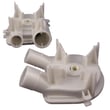
If you find the pump is seized, leaking, or noisy, replacement is the fix: washer drain pump WP3363394.
Quick diagnosis guide
| Symptom | Most likely cause | What we do next |
|---|---|---|
| Hums but no water moves | Pump impeller jammed | Remove obstruction; replace pump if damaged |
| Drains very slowly | Partial clog in hose/pump | Clear hose and pump inlet |
| Won’t drain and won’t spin | Lid switch or drain issue | Verify lid switch operation; then recheck pump |
| Water left in tub after cycle | Intermittent pump or restriction | Inspect wiring/hoses; replace pump if inconsistent |
Why it matters
Forcing a drain gets the door open and prevents overflow, but the real goal is restoring normal drain and spin. A restricted drain can also cause poor rinsing, wet loads, and extra strain on the drive system.
Last updated: February 2026
How to hard reset kenmore washer?
For Kenmore washer model 11092573210, the most reliable “hard reset” is a power reset: unplug the washer (or switch off the breaker) for 5 minutes, then restore power and run a quick cycle. This clears many control glitches and is safe for both mechanical and electronic versions.
Hard reset steps (power reset)
- Press Pause/Cancel once to stop the cycle.
- Unplug the washer (or turn the breaker OFF).
- Wait 5 minutes (this lets the control fully discharge).
- Restore power.
- Select Rinse/Spin (or a short cycle) and press Start.
- If the washer was mid-cycle, reselect your cycle and options.
If it still acts up: try a control reset (knob/button sequence)
Many Kenmore 110-series top-load washers use a timer knob sequence to enter diagnostics or reset the control logic. If your washer has a cycle selector knob, try this general approach:
- Turn the knob to Off.
- Turn the knob in a consistent pattern (for example: left, right, left, right) to attempt diagnostic entry.
- If indicator lights flash, rotate to a spin or drain step and start the cycle.
What you should see
| Result | What it means | What to do next |
|---|---|---|
| Washer powers up normally | Reset worked | Run a test cycle |
| Lights flash or it beeps | Diagnostic mode likely | Run a drain/spin test |
| No change | Not a control glitch | Check common failure points below |
Why the washer may “need a reset” (common real causes)
A reset often helps symptoms, but repeated problems usually point to a part issue. On model 11092573210, these are common checks:
- Won’t drain or stops full of water: inspect the washer drain pump WP3363394 for clogs or a jammed impeller.
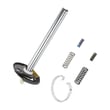
- Won’t agitate or weak agitation: worn agitator dog 80040 is common.
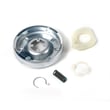
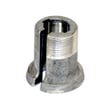
- No spin or intermittent spin: check the coupling 285753A between the motor and transmission.
- Lid-related no-start/no-spin: test the lid switch circuit (often tied to a switch assembly).
Why it matters
A true hard reset clears temporary control errors, but it will not fix a mechanical bind, a drain restriction, or a worn drive component. If the same symptom returns after a reset, checking the drain pump, coupling, and agitator drive parts prevents repeat shutdowns and poor wash performance.
Last updated: February 2026
How to identify a Kenmore washer model?
To identify a Kenmore washer model, we look for the model/serial tag on the washer cabinet. On Kenmore model 11092573210, the tag is typically on the top or back of the control panel, or on the main cabinet near the bottom edge.
Where to find the model number tag
Check these common locations first (in order):
- Behind the control panel (top or back edge)
- On the cabinet frame near the bottom, left or right side
- Around the lid opening on top-load washers
- Behind the door or in the door jamb on front-load washers
- Rear panel near the power cord entry
What the tag looks like and what to copy
The tag usually includes multiple identifiers. For parts lookup and diagrams, we use the full model number exactly as printed.
| What you see on the tag | What it’s used for | Tip |
|---|---|---|
| Model number (example: 11092573210) | Correct parts list and diagrams | Copy every digit; do not shorten it |
| Serial number | Manufacturing info | Helpful for service history |
| Type/stock numbers | Internal identifiers | Not a substitute for the model number |
Why it matters
Kenmore washers can look similar across many series, but internal components (like the drive system, drain pump, or timer) can differ. Using the exact model number helps us match the right replacement part the first time, such as the washer drain pump WP3363394 if you are troubleshooting a no-drain issue.
Quick troubleshooting tie-in (optional)
If you’re identifying the model because the washer is showing an error or acting unbalanced, our Kenmore error code resources can help narrow the cause:
- Kenmore 110 vmax top load washer error codes
- Kenmore top load washer ue and ue error codes
- Kenmore calypso top load washer error codes
Last updated: February 2026
What are the main parts of a washing machine?
The main parts of a washing machine include the water fill system, wash system, drive system, and drain system. On Kenmore washer model 11092573210, common serviceable components you will see include the motor, timer, pump, clutch, and agitator parts such as the agitator dog 80040.
Core systems and what they do
- Water inlet and fill: brings hot and cold water into the tub (often through a mixing valve).
- Wash action: moves clothes through water using an agitator or wash plate.
- Drive and spin: turns the basket for spin extraction (motor, coupling, clutch, drive block).
- Drain: pumps water out to the standpipe or laundry sink.
- Controls: timer or electronic control that sequences fill, wash, drain, and spin.
Main parts you will commonly replace
These are some of the most common “core” parts customers replace on this Kenmore washer when symptoms show up:
- Washer drain pump WP3363394 (won’t drain, humming, leaks)
- Coupling 285753A (motor runs but washer will not agitate or spin)
- Clutch 285785 (weak or slipping spin)
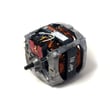
- Washer drive motor WP661600 (no agitation or spin, burning smell, intermittent operation)
- Washer timer WP661598 (cycle stalls, won’t advance)
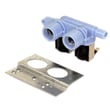
- Mixing valve 285805 (fill problems, wrong water temperature)
Quick “part to symptom” guide
| Symptom | Most likely system | Common part examples for 11092573210 |
|---|---|---|
| Won’t drain or drains slowly | Drain | Drain pump, drain hose (if restricted) |
| Won’t agitate but fills and drains | Wash/drive | Agitator dog, coupling |
| Won’t spin or spins weakly | Drive/spin | Clutch, drive block, suspension springs |
| Won’t fill or fills wrong temp | Fill | Mixing valve, inlet screens (clean) |
Why it matters
Knowing which system is failing helps you choose the right repair path and avoid replacing good parts. For example, a “won’t drain” complaint usually points to the drain pump or a blockage, while a “won’t agitate” complaint often points to agitator components or the motor coupling.
Last updated: February 2026
What is the average lifespan of a Kenmore washer?
A Kenmore washer typically lasts 10 to 15 years with normal household use and basic maintenance. For Kenmore model 11092573210, lifespan is most affected by load size, installation (leveling), and wear items such as the drive system and drain pump.
What usually determines how long it lasts
- Load habits: frequent overloading shortens the life of the drive components and suspension.
- Drain performance: slow draining makes the pump work harder and can lead to leaks.
- Spin vibration: an unlevel washer stresses the tub, springs, and drive parts.
- Water quality: hard water and sediment can contribute to valve and seal wear.
- Small failures fixed early: replacing inexpensive wear parts can prevent bigger damage.
Common wear parts that can extend service life
If your washer still fills and drains but agitation or spinning is weak, these are common fixes on many Kenmore top-load designs:
| Symptom | Common cause | Example part for model 11092573210 |
|---|---|---|
| Agitator “ratchets” or won’t move clothes well | Worn agitator dogs/cam | Agitator dog 80040 |
| Won’t agitate or spin, motor runs | Worn motor coupling | Coupling 285753A |
| Water left in tub, slow drain, leaking at pump | Failing drain pump | Washer drain pump WP3363394 |
| Spins poorly, burning smell, loud during spin | Worn clutch | Clutch 285785 |
Maintenance that helps you reach 10 to 15 years
- Keep loads balanced and avoid packing the basket tightly.
- Use the right amount of detergent; excess suds can cause poor draining and residue.
- Check and clean the drain hose path; avoid kinks and crushed sections.
- Level the washer so it does not “walk” during spin.
- Address new noises early (grinding, squealing, or repeated banging in spin).
Why it matters
Washer replacement decisions usually come down to whether the issue is a wear part (often economical) or a major tub/drive repair. Knowing the typical 10 to 15 year lifespan helps you decide when a repair like a coupling, clutch, or drain pump is the smart move.
Last updated: February 2026
What is the cubic feet capacity of a Kenmore washer model 11092573210?
The exact cubic feet capacity for Kenmore washer model 11092573210 varies by the specific design details for that series, but most Kenmore 110 top-load washers of this style are typically about 3.2 to 3.5 cu. ft., which fits medium-size loads comfortably.
How to estimate capacity (practical checks)
If you need a working estimate for load sizing and detergent use, these checks help you land on the right range:
- Tub diameter and depth: larger tubs usually land closer to 3.5 cu. ft.
- Agitator style: a tall, full-size agitator often indicates a mid-capacity tub
- Basket fill rule: load loosely to the top row of holes (not packed) for best turnover
- Cycle choice: bulky cycles often allow more water and better rollover for larger items
- Spin performance: if loads stay very wet, reduce load size and rebalance
What “3.2 vs 3.5 cu. ft.” means for real laundry
Here is a simple way to think about it for a Kenmore top-load washer like 11092573210:
| Capacity range | Best for | Typical load examples |
|---|---|---|
| ~3.2 cu. ft. | Medium everyday loads | 8 to 10 bath towels, or a mixed hamper load |
| ~3.5 cu. ft. | Medium to slightly larger loads | 10 to 12 bath towels, or a small comforter (varies by thickness) |
Why it matters
Capacity affects cleaning and wear: overloading reduces agitation and rinsing, increases vibration, and can speed up wear on drive components like the motor coupling and clutch.
Parts that commonly show stress when overloaded
If you are troubleshooting poor agitation, slipping, or noisy spin, these model-matched parts are often involved:
- Coupling 285753A (connects the drive motor to the transmission/drive system)
- Clutch 285785 (helps the basket reach and hold spin speed)
- Agitator dog 80040 (helps the agitator “grab” and move clothing)
For imbalance-related symptoms (banging, walking), we also recommend reviewing Kenmore top load washer ue and ue error codes for load and leveling guidance.
Last updated: February 2026
Who makes Kenmore replacement parts?
Kenmore is a brand name, so replacement parts for Kenmore washer model 11092573210 are typically manufactured by the original equipment manufacturer (OEM) that built the washer and its components. In practice, many Kenmore washer parts cross to major OEMs (commonly Whirlpool-built designs), so the best way to get the right part is to match by model number and the exact part listing.
How to identify the correct manufacturer for your part
Because Kenmore sourced washers from multiple OEMs over the years, the most reliable approach is to identify the part by function and then match the exact part ID used for model 11092573210.
- Use the model number 11092573210 when searching parts
- Match the part by part name and part ID, not by a guessed manufacturer
- Compare the old part (shape, mounting points, electrical connectors) to the replacement
- If multiple versions exist, match by any markings on the original part (numbers, stamps)
- Replace related wear items together when it makes sense (for example, drive components)
Common examples of OEM-style parts for this Kenmore washer
Here are a few parts listed for model 11092573210 that are commonly replaced; these are the exact identifiers you can use to ensure you are buying the correct item:
| What it affects | Example part to match | What you might notice when it fails |
|---|---|---|
| Agitation (top section movement) | Agitator dog 80040 | Agitator “slips,” poor turnover |
| Drive connection between motor and transmission | Coupling 285753A | Won’t agitate or spin, grinding noise |
| Draining | Washer drain pump WP3363394 | Won’t drain, water left in tub |
| Cycle control | Washer timer WP661598 | Stalls, won’t advance, inconsistent cycles |
Why it matters
Kenmore parts are not “one-manufacturer-only” across all models. Matching the correct part for 11092573210 prevents fit issues, repeat failures, and return hassles, especially on high-wear items like a motor coupling, drain pump, or agitator components.
Last updated: February 2026