Error Codes



How do I find the cubic feet of my Kenmore refrigerator?
For your Kenmore refrigerator model 59679242010, the most reliable way to find cubic feet is to calculate the interior volume: measure the usable inside height, width, and depth (in inches), multiply them, then divide by 1728 to convert to cubic feet.
Fast ways to find capacity
1) Measure and calculate (most accurate)
Use a tape measure and measure the usable interior space (not the outside cabinet).
- Empty shelves and bins enough to measure straight lines
- Measure height (top interior to floor of compartment)
- Measure width (left wall to right wall)
- Measure depth (back wall to inside front edge, not including door bins)
- Multiply:
H x W x D(in inches) - Divide by 1728 to get cubic feet
2) Check the rating label (quick check)
Many refrigerators list capacity on the rating label (often on a side wall, near the crisper area, or inside the fresh food section). If it lists “cu. ft.”, that is the capacity.
Example calculation
If the usable interior measures 60 in (H) x 28 in (W) x 18 in (D):
| Step | Math | Result |
|---|---|---|
| Cubic inches | 60 x 28 x 18 | 30,240 |
| Cubic feet | 30,240 ÷ 1728 | 17.5 cu. ft. |
Why it matters
Knowing cubic feet helps us match the right refrigerator size for your kitchen, compare models fairly, and choose compatible storage and maintenance parts (like a water filter) for your setup.
Related part that often comes up
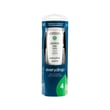
If you are also checking capacity because you are maintaining the fridge, the water filter is a common item to replace on schedule: genuine Kenmore refrigerator water filter EDR4RXD1.
Last updated: February 2026
How to tell what model Kenmore refrigerator?
To identify your Kenmore refrigerator model, look for the model and serial tag on the inside walls of the fresh food section or freezer, or on the frame just behind the door. For Kenmore model 59679242010, the tag is typically in one of these common locations.
Where to look for the model number tag
Check these spots in order (they are the most common on Kenmore bottom-mount refrigerators):
- Inside the refrigerator compartment on a side wall (often upper right or upper left)
- On the ceiling of the fresh food compartment near the light housing
- Inside the freezer compartment on a side wall or rear wall
- On the door frame area (visible when you open the refrigerator door)
- Behind or just above the toe grille (kick plate) at the bottom front
- Behind the lower crisper drawers on the back wall
What the tag looks like (and what to write down)
The label is usually a white or silver sticker or plate. Record:
- Model number (example format: 596.79242010 or 59679242010)
- Serial number
- Sometimes a type or manufacturing code
Quick check table
| What you see on the label | What it means | Why we need it |
|---|---|---|
| 596.79242010 or 59679242010 | Model number | Ensures parts match your exact refrigerator |
| Serial number | Unit-specific ID | Helps confirm production range for some parts |
Why it matters
Kenmore model numbers can look similar, but small differences change the correct parts (water filter, ice maker, door gasket, rails). Using the exact model number helps us match parts like the genuine Kenmore refrigerator water filter EDR4RXD1 without guesswork.
If the label is missing or unreadable
Use these practical options:
- Remove the crisper drawers and inspect the back wall with a flashlight
- Pull the toe grille off and look for a tag on the frame
- Check for a faint “imprint” where a sticker used to be
- If you still cannot find it, match parts by comparing your refrigerator’s features (ice maker style, dispenser type, door color) to the parts diagrams for model 59679242010
Last updated: February 2026
What are the common problems with Kenmore 59679242010 refrigerators?
Common problems we see with the Kenmore 59679242010 bottom-mount refrigerator are warm temperatures (fresh food or freezer), ice maker not making ice, water dispenser or filter flow issues, water leaks, and unusual noises. Most fixes start with airflow and temperature checks, then move to specific parts like the ice maker, door seals, or condenser fan.
Most common symptoms and what usually causes them
- Not cooling or weak cooling: dirty condenser coils, condenser fan not running, evaporator fan/airflow issues, frost buildup from a defrost problem
- Ice maker not working: freezer too warm, clogged filter, frozen fill tube, failed ice maker module
- Water leaks or puddles: clogged defrost drain, loose water line connections, cracked tubing, door not sealing
- Noisy operation: fan blade hitting ice/debris, worn fan motor, compressor start components
- Lights not working when door opens: failed door/light switch
Quick checks we recommend first (10 to 20 minutes)
- Confirm temps: set freezer near 0°F and fresh food near 37°F.
- Make sure vents inside the refrigerator are not blocked by food packages.
- Clean condenser coils and verify the condenser fan runs when the compressor is running.
- If you have a dispenser, replace the water filter if flow is slow or taste is off.
- Look for frost buildup on the freezer back wall (a strong clue of a defrost/airflow problem).
Parts that commonly solve these problems on this model
| Problem | Part that often fixes it | What it does |
|---|---|---|
| Bad taste/slow water flow, ice maker starving for water | Genuine Kenmore refrigerator water filter EDR4RXD1 | Improves flow and filtration to the dispenser and ice maker |
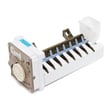
| Ice maker not producing ice (after temp and water checks) | Refrigerator ice maker assembly WPW10300024 | Cycles and harvests ice cubes |
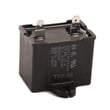
| Warm temps and compressor running hot/noisy | Refrigerator condenser fan motor W11613295 | Pulls air across condenser coils to remove heat |
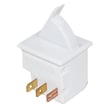
| Interior light issues | Refrigerator light switch W11396033 | Turns lights on and off with door movement |
Why it matters
Cooling, ice, and water problems often share the same root causes: restricted airflow, poor heat removal at the condenser, or low water flow through the filter. Fixing the underlying cause prevents repeat failures and helps protect food quality.
For dispenser-related issues, we also use how to replace the water filter in a Kenmore refrigerator as our go-to guidance for correct filter installation and flushing.
Last updated: February 2026
Why is my Kenmore refrigerator leaking water from the bottom?
Water leaking from the bottom of your Kenmore 59679242010 bottom-mount refrigerator is usually caused by a clogged defrost drain that overflows into the fresh food section, or a drain pan that is cracked, out of position, or overflowing. Clearing the drain and checking the pan typically stops the leak.
Most common causes to check first
- Defrost drain clogged with ice or debris: Meltwater cannot flow to the drain pan, so it spills inside the cabinet and runs down to the floor.
- Drain pan shifted or damaged: The pan under the refrigerator is meant to catch defrost water; if it is misaligned or cracked, water can miss the pan.
- Door not sealing well: Warm, humid air creates excess frost; that frost later melts and can overwhelm the drain system.
- Ice maker or water line seepage: A slow drip can travel along tubing and show up as a puddle at the front.
Quick troubleshooting steps (safe DIY)
- Unplug the refrigerator before working near fans or wiring.
- Look for water inside under the crisper drawers or on the freezer floor (a clue the defrost drain is involved).
- Clear the drain opening: remove visible debris; melt ice with warm water (a turkey baster works well).
- Check the drain pan underneath for cracks, tipping, or overflow; reseat it fully.
- Inspect door sealing with the “paper test” (paper should drag when pulled); if it slips easily, address the seal.
Parts that may be involved
| Symptom | Likely area | Example part to consider |
|---|---|---|
| Puddle after defrost cycle | Drain system / pan | (Drain pan varies by configuration) |
| Frost buildup, then leaking | Door seal | Refrigerator gasket panel (gray) W10830055 or refrigerator gasket panel (white) W11396037 |
| Water near ice maker/dispenser | Ice maker fill / leaks | Refrigerator ice maker assembly WPW10300024 |
Why it matters
Leaks can damage flooring and can also lead to ice buildup, odor, and temperature swings if the drain keeps freezing over. Fixing the root cause helps your refrigerator cool consistently and prevents repeat puddles.
For step-by-step help on door seal issues, use our guide: how to fix a fridge door seal.
Last updated: February 2026