Owner’s manual
 Error Codes


Does unplugging a refrigerator reset the ice maker?
Yes. On the Kenmore 79571603013 bottom-mount refrigerator, unplugging the unit (or switching it off at the breaker) for about 5 minutes power-cycles the controls and often resets a non-responsive ice maker after a minor glitch.
- Unplug the refrigerator or turn off the circuit breaker.
- Wait 5 minutes (10 minutes is fine if the issue is persistent).
- Restore power.
- Confirm the ice maker is switched ON (if your model has an on/off switch).
- Allow time for recovery: most ice makers need several hours to resume normal production.
A power cycle helps, but these items commonly stop ice production even when the ice maker is fine:
- Freezer temperature: target 0°F (ice makers often stall above about 10°F).
- Ice bin position: make sure the bin is fully seated.
- Ice clumps or a jam: clear stuck cubes in the mold or bin.
- Water supply: verify the shutoff valve is open and the water line is not kinked.
- Door sealing: warm air leaks can slow or stop ice production.
| What you see | What it usually means | What to do |
|---|---|---|
| No ice for a few hours | Normal restart time | Wait 12 to 24 hours for full output |
| Ice is small or hollow | Low water flow or freezing issue | Check water supply and freezer temp |
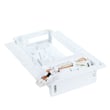
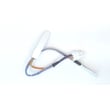
| Ice maker is silent and never cycles | Possible failed ice maker module | Consider replacing the ice maker assembly AEQ72909602 |
Resetting clears temporary control-board or sensor hiccups without replacing parts. If the problem returns quickly, the issue is usually temperature, water flow, or a failing ice maker component.
For model-specific control locations and operating steps, use the 79571603013 owner's manual.
Last updated: January 2026
How to adjust leveling feet on refrigerator?
To level your Kenmore refrigerator model 79571603013, turn the front leveling feet to raise or lower the front corners until the cabinet is stable and the doors close on their own. In most cases, clockwise raises the front and counterclockwise lowers it; confirm the direction in the 79571603013 owner's manual.
- Unplug the refrigerator or switch off power at the breaker for safety.
- Pull the unit forward enough to access the front leveling feet (or front rollers, depending on the base design).
- Use an adjustable wrench or the correct-size socket to turn the leveling feet.
- Raise the front slightly so the refrigerator tilts back a little; this helps the doors self-close.
- Recheck side-to-side level across the cabinet and adjust the left or right foot as needed.
- Push the refrigerator back into place carefully so you do not kink the water line (if equipped).
Most Kenmore bottom-mount refrigerators use standard threads:
| Goal | Typical turn direction | What you should see |
|---|---|---|
| Raise the front corner | Clockwise | Foot extends downward, front lifts |
| Lower the front corner | Counterclockwise | Foot retracts upward, front drops |
If the foot seems to “spin forever,” that is normal; the screw adjusts height and does not back out like a removable fastener.
- Refrigerator rocks after leveling: Make sure both front feet are firmly contacting the floor.
- Doors do not close by themselves: Raise the front slightly more (small adjustments make a big difference).
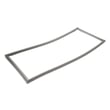
- Gaps at the door seal: Level first, then inspect the gasket; a torn gasket can cause warm air leaks (right side uses refrigerator door gasket, right ADX73550624).
- Floor is uneven: Use a thin, solid shim under the low side after the feet are adjusted.
Proper leveling reduces door-swing issues, helps the door gasket seal evenly, and supports consistent cooling by minimizing warm air leaks into the fresh food and freezer compartments.
Last updated: January 2026
What are the common problems with Kenmore Elite refrigerators?
Kenmore Elite refrigerators, including model 79571603013, most often have cooling problems, ice maker or water issues, frost buildup from defrost or door-seal leaks, and unusual noises from fans or the compressor area. Many fixes start with airflow, cleaning, and simple part checks before replacing major components.
- Not cooling or warm temperatures: dirty condenser coil, failed evaporator fan motor, control issue, or sealed-system/compressor problem
- Frost buildup or ice on the back wall: door gasket leak, door not closing fully, defrost system issue
- Water leaking or puddles: clogged/iced drain, water line connection leak, ice maker fill issues
- Ice maker not making ice: water supply problem, ice maker failure, freezer too warm
- Buzzing, clicking, or rattling: condenser fan area debris, failing compressor start components, fan blade hitting ice
- Set temperatures to normal targets (about 37°F fresh food, 0°F freezer) and give it 24 hours to stabilize.
- Clean dust from the condenser area and confirm the unit has good airflow around it.
- Check door closing and sealing; look for gaps, torn gasket sections, or doors sitting low.
- Listen for the evaporator fan in the freezer; a stalled fan often causes warm temps and odd noises.
- If the lights do not respond correctly when the door opens/closes, test the door switch.
| Symptom | Common part to check | Example part for this model |
|---|---|---|
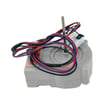
| Warm fridge/freezer, weak airflow | Evaporator fan motor | Lg refrigerator evaporator fan motor 4681JB1027C |
| Lights stay off/on, fan behavior odd | Door switch | Refrigerator door switch 6600JB1010A |
| Frost, moisture, poor sealing | Door gasket | Refrigerator door gasket, left ADX73550621 or refrigerator door gasket, right ADX73550624 |
| No ice | Ice maker assembly | Ice maker assembly (AEQ72909602) - refrigerator ice maker part by lg AEQ72909602 |
Cooling and ice-making problems often start with airflow restrictions or air leaks. Fixing a dirty condenser coil, a weak fan, or a leaking door gasket early helps protect food, reduce run time, and prevent the compressor from being overworked.
For control settings, diagnostic steps, and component locations on Kenmore 79571603013, use the 79571603013 manual. If you see an error code on the display, use the Kenmore 795 model bottom freezer refrigerator error codes guide to match the code to the most likely cause.
Last updated: January 2026