Owner’s manual
 Error Codes


Are bottom mount fridges better?
A bottom-mount refrigerator like Kenmore 59669313010 is “better” when you want everyday fresh-food items at eye level and don’t mind bending for freezer access. For most households, it improves convenience and organization, while keeping freezer storage in a deep pull-out drawer.
What you gain with a bottom-mount design
- Easier access to fresh food (produce, milk, leftovers) because the refrigerator compartment is higher.
- Better day-to-day ergonomics for cooking and meal prep since you open the fridge more than the freezer.
- Drawer-style freezer storage that holds bulky items and stacks well.
- Cleaner organization because freezer baskets and dividers reduce “lost” items.
What to watch out for
- You bend more to reach frozen foods, especially items at the bottom of the drawer.
- Needs proper clearance for door swing and airflow; the manual calls for about 1/2 inch space at the sides and top and 1 inch behind (plus extra room for a water line if equipped).
- Door alignment matters for easy closing and good sealing; the manual includes door closing and alignment steps.
Quick comparison
| Feature | Bottom-mount (this model style) | Top-freezer style |
|---|---|---|
| Fresh-food access | Best (eye level) | Good (lower shelves require bending) |
| Freezer access | Requires bending | Easier (higher) |
| Organization | Strong (drawer/baskets) | Simpler shelves |
| Best for | Frequent cooking, fresh foods | Heavy freezer use, tight budgets |
Why it matters
“Better” usually comes down to how you use the appliance. If your family is in the refrigerator compartment many times a day, bottom-mount models reduce reaching and make it easier to keep food visible, which helps reduce waste.
Helpful next steps for owners
- Confirm recommended clearances and room temperature range in the 59669313010 owner’s manual.
- If doors do not close smoothly, follow the manual’s door closing and alignment guidance.
- Keep vents unblocked and avoid overpacking so cold air can circulate.
Last updated: February 2026
How do I tell what model Kenmore fridge I have?
Your Kenmore refrigerator model number is printed on the appliance’s model and serial tag. On Kenmore model 59669313010 bottom-mount refrigerators, the tag is typically inside the fresh food compartment (often on a side wall or near the crisper area) or inside the freezer area.
Where to look first (fastest checks)
- Inside the refrigerator compartment on the left or right interior wall
- On the ceiling area inside the fresh food section near the light shield
- On the wall behind or beside the lower crisper drawers
- Inside the freezer compartment on an interior side wall
- Behind the toe grille or kickplate area at the bottom front
What the label looks like and what to write down
The tag usually lists:
- Model number (example format: 596.69313010 or 59669313010)
- Serial number (unique to your unit)
- Electrical rating (often 115V, 60 Hz, 15 or 20 amp circuit)
We recommend copying the model number exactly as shown, including any dots or extra digits, then matching it to the parts list for the most accurate fit.
Quick tips to avoid mix-ups
| What you see | What it means | What to do |
|---|---|---|
| 596.69313010 | Model number with a dot | Use the full number when searching parts |
| 59669313010 | Same model number without a dot | This is still valid for lookup |
| A long number labeled “Serial” | Serial number | Keep it for service history, not parts matching |
Why it matters
Kenmore refrigerators can look identical across multiple model numbers, but parts like a door gasket, electronic control board, or thermistor can vary by revision. Using the exact model number helps us match the correct diagrams and replacement parts the first time.
For model tag locations and handling steps (like safely turning cooling off before moving shelves or drawers), use the 59669313010 owner's manual.
Last updated: February 2026
How to reset Kenmore bottom freezer ice maker?
On Kenmore refrigerator model 59669313010, the most reliable “reset” for the ice maker is a power-cycle and ice maker OFF/ON cycle: turn the ice maker OFF, restore power, then turn the ice maker back ON so it can restart its harvest and fill sequence. See the 59669313010 owner's manual.
Quick reset steps (safe and effective)
- Turn the ice maker OFF (depending on your version, raise the wire shutoff arm to the OFF/up position or switch it OFF).
- Empty the ice bin so you can confirm new ice production.
- Turn cooling OFF at the controls (press the Minus touch pads until a dash "-" appears in both displays, if your control panel uses that style).
- Unplug the refrigerator (or switch off the dedicated breaker) for 2 to 5 minutes.
- Restore power, then set temperatures back to your normal settings.
- Turn the ice maker ON and allow 12 to 24 hours for full ice production.
If it still will not make ice
These checks solve most “no ice” complaints after a reset:
- Confirm the household water supply valve to the refrigerator is fully open.
- Make sure the freezer is cold enough; ice makers typically need about 0°F to cycle normally.
- Look for a frozen or blocked fill path; a warm freezer or airflow problem can contribute.
- Listen for the evaporator fan; poor airflow can prevent proper freezing.
- If the fan is noisy, broken, or not spinning, inspect the refrigerator evaporator fan motor WPW10128551 and the fan blade.
What “reset” means on this model
This model’s documentation focuses on turning the ice maker OFF/ON and safely powering the refrigerator down at the controls. That OFF/ON cycle plus a brief power interruption clears many control glitches and restarts the ice maker’s normal timing.
| Action | What it does | Typical result |
|---|---|---|
| Ice maker OFF then ON | Re-enables the ice maker | Restarts cycling if it was disabled |
| Cooling OFF then power-cycle | Reboots controls | Clears minor electronic lockups |
| Wait time after reset | Allows freeze and harvest | Ice returns gradually over hours |
Why it matters
A true reset prevents unnecessary part replacement and helps you confirm whether the issue is control-related (temporary) or a hardware problem (water supply, temperature, fan airflow, or an ice maker component).
Last updated: February 2026
How many cubic feet is my Kenmore refrigerator by model number?
For Kenmore model 59669313010, the most reliable way to get the exact cubic-foot capacity is to use the model’s specification information in the 59669313010 owner's manual. If you cannot locate the capacity quickly, the rating plate inside the refrigerator compartment typically lists key specs for your exact unit.
Fast ways to find your exact capacity
- Check the rating plate (usually on an interior wall of the fresh food section). Look for “Capacity” or “Total volume”.
- Use the model number 59669313010 to match the correct spec section in the 59669313010 owner's manual.
- If the label is hard to read, take a clear photo and zoom in; the capacity is often printed near electrical ratings.
- If doors are not sealing well, fix that first; temperature swings can make the refrigerator seem “too small” because food spoils faster. Use the how to fix a fridge door seal guide.
What “cubic feet” means (and why it can look different)
Cubic feet is the total interior storage volume (fresh food plus freezer). Usable space can feel smaller depending on shelves, bins, and ice maker components.
| Measurement | What it includes | What it does not tell you |
|---|---|---|
| Total capacity (cu. ft.) | Fresh food + freezer volume | How shelves/bins reduce usable space |
| Usable space | What you can practically store | The official spec number |
Why it matters
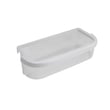
Knowing the correct cubic-foot capacity helps us match the right replacement parts and accessories for your Kenmore 59669313010 (for example, door storage like the refrigerator door bin WPW10371194 or sealing parts like a door gasket).
Last updated: February 2026
Why does my Kenmore fridge have water pooling inside the bottom?
Water pooling inside the bottom of your Kenmore 59669313010 refrigerator is usually caused by defrost water that cannot drain properly, so it overflows into the fresh food section. The most common fix is clearing the defrost drain and making sure the doors seal and close correctly.
Most common causes (and what to check first)
- Clogged defrost drain: Food debris or ice blocks the drain, so meltwater backs up.
- Drain tube issue: The tube can be restricted, kinked, or not draining to the pan.
- Door not closing fully: Warm, humid air increases frost, which creates excess defrost water.
- Dirty or sticky door gaskets: Gaskets can leak air; cleaning often helps.
- Items blocking airflow: Poor airflow can increase frost and moisture.
Quick troubleshooting steps
- Unplug the refrigerator and remove food from the bottom area.
- Look for ice or debris at the drain opening (often under the evaporator cover area).
- Melt ice with warm water (not boiling) and flush the drain with a turkey baster.
- Confirm the refrigerator is level and doors close easily (door closing issues can worsen moisture).
- Clean door gaskets with mild soap and warm water; dry fully (the manual notes gasket cleaning helps when gaskets are dirty or sticky).
For model-specific access points and panel removal guidance, follow the 59669313010 owner's manual.
Parts that commonly relate to this symptom
| Symptom you see | Likely area | Example part for this model |
|---|---|---|
| Water under crisper drawers | Defrost drain path | Refrigerator drain tube W10619951 |
| Frost buildup then water | Evaporator area airflow | Refrigerator evaporator fan motor WPW10128551 |
| Door sweating, moisture, puddles | Door seal/closure | Check gasket condition and alignment |
Why it matters
When defrost water cannot reach the drain pan, it ends up inside the cabinet. That can lead to recurring puddles, ice sheets under drawers, odors, and temperature swings from excess moisture.
If you want a step-by-step walkthrough for puddles and drain issues, use how to get rid of refrigerator puddles.
Last updated: February 2026
How to tell if a Kenmore refrigerator compressor is bad?
If your Kenmore refrigerator model 59669313010 is warm or not holding temperature, a “bad compressor” is only one possibility. We confirm compressor trouble by checking for poor cooling plus abnormal run behavior (constant running, repeated clicking, or no start) after basic power and control checks in the 59669313010 owner's manual.
Quick symptoms that point toward a compressor problem
- Refrigerator and freezer both warm even though the unit has power
- Compressor is very hot to the touch after trying to run (use caution)
- Repeated clicking every few minutes (start device overload cycling)
- Runs constantly but temperatures do not improve after 24 hours
- Unusual hissing or rattling beyond normal operating sounds
Rule out common non-compressor causes first
The manual notes that high-efficiency compressors can run longer than older models, and that new installs need time to cool. Before condemning the compressor, we check these basics:
- Verify the outlet works (test with a lamp)
- Reset a tripped breaker or replace a blown fuse
- Make sure the refrigerator control is turned on
- If recently installed or restarted, allow 24 hours to cool completely
- Confirm doors seal and close fully (warm air leaks mimic cooling failure)
Normal vs. not normal (what you hear)
| What you notice | Often normal | More concerning |
|---|---|---|
| Intermittent running | Yes | No start at all |
| Pulsating sound | Yes (fans/compressor adjusting) | Loud repeated clicking |
| Water dripping sound | Yes (defrost melt) | No cooling plus constant clicking |
When a compressor is actually “bad”
A compressor is typically the culprit when the unit has correct power, controls are on, airflow is good, and it still cannot pump refrigerant effectively. A technician confirms this with electrical checks (amperage draw, winding continuity) and sealed-system diagnosis.
Parts that may be involved in a compressor repair
If testing confirms a compressor issue, the model uses a sealed-system compressor such as the refrigerator compressor W10233960. Sealed-system work requires specialized tools and refrigerant handling.
Why it matters
Replacing a compressor is one of the highest-cost refrigerator repairs. Doing the quick power, control, and 24-hour cool-down checks first prevents unnecessary parts replacement and gets you to the right fix faster.
Last updated: February 2026
What are the most common problems with Kenmore refrigerators?
The most common issues we see on Kenmore refrigerators like model 59669313010 are cooling problems, water leaks, ice maker or dispenser trouble, moisture buildup, and unusual noises. Many of these come down to airflow (dirty coils or a failing fan), door sealing, or a control/sensor problem; use the 59669313010 owner's manual troubleshooting section to narrow it down.
Quick symptom checklist (what to look for first)
- Not cooling or warm temps: unit runs a lot, food soft, freezer not holding 0°F
- Water on floor or in fridge: puddles under crisper or near freezer, ice buildup then dripping
- Moisture or frost: condensation inside, frost on packages, doors hard to close
- Noises: buzzing, clicking, rattling, or a loud fan sound
- Lights or door sensing issues: light stays on or won’t turn on when door opens
Common causes and the parts that often fix them
| Symptom | Most common cause | Parts that commonly apply on 59669313010 |
|---|---|---|
| Warm refrigerator/freezer | Poor airflow, fan not moving air | Refrigerator evaporator fan motor WPW10128551, refrigerator evaporator fan blade WP2169142 |
| Moisture buildup inside | Door opened often, gasket dirty or not sealing | Door gasket (match color and location), clean sealing surfaces per manual |
| Water leaks/puddles | Drain system restriction or misrouted drain | Refrigerator drain tube W10619951 |
| Random temp swings or dead display | Control or sensor issue | Refrigerator electronic control board WPW10503278, thermistor/sensor |
| Interior light problems | Door switch not actuating | Refrigerator switch W11384469 or light swit W11396033 |
What we recommend doing (in order)
- Confirm basics: make sure power is solid and controls are set correctly (the manual notes a new install can take 24 hours to cool fully).
- Check door sealing: clean gaskets with mild soap and warm water; sticky or dirty gaskets can cause moisture and warm temps.
- Improve airflow: keep vents clear inside; allow proper clearance around the cabinet (typical guidance is about 1/2 inch at sides/top and 1 inch behind).
- Listen for the evaporator fan: if the freezer fan is loud, intermittent, or silent when it should run, inspect the fan motor and blade.
- Address leaks: if you see water under the crisper or freezer, inspect and clear the drain path and drain tube.
Why it matters
Cooling, sealing, and airflow problems make the compressor run longer, raise food temperatures, and create condensation that can turn into leaks or frost. Fixing the root cause early helps protect food and reduces wear on major components like the compressor.
Last updated: February 2026