Owner’s manual
 Error Codes




What are the disadvantages of a bottom freezer refrigerator?
Bottom-freezer refrigerators like the GE DFE28JSKBSS make fresh food easier to reach, but the tradeoffs are mostly in freezer access and maintenance. The most common disadvantages are more bending for frozen items, heavier drawer loads, and occasional drain or defrost-related issues that can lead to leaks or ice buildup (see the DFE28JSKBSS owner's manual).
- More bending and lifting: You reach down for frozen foods, and full freezer baskets can get heavy.
- Harder freezer organization: Deep drawers can bury smaller items under larger packages.
- Less convenient for frequent freezer use: If you use ice, frozen meals, or bulk frozen foods daily, the lower drawer can feel less efficient than a top freezer.
- Potential for water or ice issues: Bottom-freezer designs can still develop drain or defrost problems that show up as puddles or ice in/under the freezer.
- Door and drawer alignment sensitivity: If doors or the freezer drawer are slightly out of alignment, sealing and smooth operation can suffer.
| Feature | Bottom freezer | Top freezer |
|---|---|---|
| Fresh-food access | Best (eye-level shelves) | Requires more bending |
| Freezer access | More bending | Easier reach |
| Freezer organization | Deep drawers, can hide items | Shelves, easier visibility |
| Typical maintenance complaints | Leaks/ice from drain or defrost issues | Fewer drawer/slide concerns |
These disadvantages affect daily ergonomics (bending, lifting, visibility) and can influence food waste (items getting lost in deep bins). They also help you decide what to watch for first if you notice puddles, frost, or sealing problems.
- Keep heaviest frozen items (meat, bulk bags) closest to the front of the lower basket.
- Use small bins inside the drawer to separate snacks, vegetables, and breakfast items.
- If you see water on the floor, follow a leak checklist like how to get rid of refrigerator puddles.
- If doors do not close or seal evenly, use an alignment guide like how to align the doors on a french door refrigerator with adjustable rollers video.
- For model-specific features, care steps, and safety guidance, follow the DFE28JSKBSS owner's manual.
If you need replacement parts for the GE DFE28JSKBSS, we list model-matched parts by section, and you can also search by model number on Sears PartsDirect.
Last updated: February 2026
What is the most common problem with GE profile refrigerators?
The most common GE Profile refrigerator problems are ice maker and water dispenser issues (no ice, slow water flow, leaks) and cooling complaints (warm fresh food section, frost buildup, noisy fan). On the GE DFE28JSKBSS, these symptoms usually trace back to airflow, filtration, or door-sealing problems you can diagnose quickly using the DFE28JSKBSS owner's manual.
- Ice maker stops making ice or makes small/hollow cubes
- Water dispenser flow is slow or sputters
- Water leaks under the refrigerator or inside the fresh food section
- Refrigerator is warm but freezer seems closer to normal
- Buzzing, clicking, or a loud fan noise (often from the evaporator fan area)
- Confirm door closure and seals: A slightly open door or a wrinkled gasket causes warm temps, frost, and frequent fan run time.
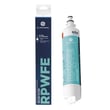
- Check the water filter: A restricted filter commonly causes slow dispensing and can affect ice production. The manual references the RPWFE water filter cartridge for these models.
- Look for airflow blockage: Overpacked shelves or blocked vents can create warm spots and uneven cooling.
- Clean condenser coils (if accessible): Dust buildup raises temperatures and stresses the sealed system.
- Reset nuisance alarms if the door was left open: Use how to reset the door alarm on a GE refrigerator.
| Problem you notice | Most likely category | Best next step |
|---|---|---|
| No ice, slow ice | Water supply or filter restriction | Replace/seat filter, verify supply valve is fully open |
| Slow water at dispenser | Filter or air in water line | Replace filter, purge air from dispenser line |
| Warm fridge, freezer OK | Airflow or evaporator fan issue | Check vents, listen for fan, reduce blockage |
| Puddles/leaks | Defrost drain or water line issue | Inspect for ice in drain area, check tubing connections |
| Beeping/door alarm | Door not sealing or left ajar | Check gasket, align doors, reset alarm |
Ice, water, and cooling problems often share the same root causes: restricted airflow, restricted water flow (filter), or a door that is not sealing. Fixing those early prevents temperature swings that spoil food and helps the refrigerator run more efficiently.
We list model-correct replacement parts by diagram for GE DFE28JSKBSS; if you are shopping by model number across categories, search by model on Sears PartsDirect.
Last updated: February 2026
How to remove bottom grille on GE refrigerator?
On the GE DFE28JSKBSS bottom-mount refrigerator, the bottom grille (base grille/toe grille) typically comes off by releasing its retaining tabs or removing a couple of screws (model dependent), then pulling the grille straight out from the front. Use the steps in the DFE28JSKBSS owner's manual for the exact fastener and clip locations.
- Unplug the refrigerator or switch off power at the breaker (safer around wiring and fans).
- If you need to pull the unit forward, pull it straight out to avoid floor damage.
- Protect the floor with cardboard or a thin panel.
- Keep a small container for screws so nothing gets lost.
- Look along the top edge and corners of the grille for screws.
- If screws are present, remove them with a Phillips screwdriver.
- Grip the grille at both ends and pull straight outward.
- If it feels stuck, check for hidden clips; press the grille inward slightly, then pull outward to release the tabs.
- Set the grille aside where it will not get stepped on or warped.
- Align the grille with the openings and mounting points.
- Insert one side first, then press along the length until the tabs snap in.
- Reinstall any screws and tighten them snugly (do not overtighten).
- Grille flexes but will not release: a screw is still installed (often at the corners).
- One side releases, the other will not: the grille is hung on a tab; push that side inward, then pull outward.
- Refrigerator is too close to the wall: pull the unit straight out a few inches for hand clearance.
| Task | Typical tool |
|---|---|
| Remove mounting screws | Phillips screwdriver |
| Release tight tabs | Plastic putty knife |
| Pull refrigerator forward | Helper (recommended) |
The bottom grille controls airflow to the condenser area. Removing it correctly prevents broken tabs and helps you access cleaning and service areas that affect cooling performance.
If you need replacement parts for your GE DFE28JSKBSS, start with the parts list for this model, or search by model number on Sears PartsDirect.
Last updated: February 2026