 Installation guide
 Owner’s manual



How do I find the cubic feet of my dryer?
For your Hotpoint HTDX100ED4WW electric dryer, cubic feet (capacity) is the inside drum volume. We find it by measuring the drum’s inside diameter and depth, then converting that cylinder volume to cubic feet; confirm any model-specific capacity listing in the HTDX100ED4WW owner's manual.
How to measure dryer capacity (cubic feet)
- Unplug the dryer and open the door.
- Measure the inside drum diameter (left-to-right across the center) in inches.
- Measure the inside drum depth (front lip to the back of the drum) in inches.
- Use this formula:
- Cubic inches = π × (diameter ÷ 2)² × depth
- Cubic feet = cubic inches ÷ 1,728
Quick example (use your measurements)
- If diameter = 24 in and depth = 20 in:
- cubic inches = 3.1416 × 12² × 20 ≈ 9,048
- cubic feet = 9,048 ÷ 1,728 ≈ 5.2 cu ft
Measurement tips that prevent bad numbers
- Measure inside the drum, not the cabinet.
- Measure to the nearest 1/4 inch.
- Ignore baffles (lifters); measure the main cylinder.
- If the drum is hard to access or damaged, check the dryer drum WE21X20562 diagram and match what you’re measuring.
Common capacity ranges (for context)
Most full-size dryers land in these ranges:
| Dryer type | Typical capacity |
|---|---|
| Compact | 3.4 to 4.4 cu ft |
| Standard/full-size | 5.0 to 7.4 cu ft |
| Extra-large | 7.5+ cu ft |
Why it matters
Capacity helps us match load size to airflow and heat. Overloading can increase dry time and heat stress on parts like the heating element, operating thermostat, and lint screen. For efficiency and maintenance habits, see how to use your clothes dryer efficiently.
If you need replacement parts while you’re measuring or servicing the dryer, order from the parts list for HTDX100ED4WW or search by model on Sears PartsDirect.
Last updated: February 2026
How do I unblock a Hotpoint dryer?
To unblock your Hotpoint HTDX100ED4WW electric dryer, we start by clearing airflow restrictions: clean the lint screen, then check the vent duct and outside exhaust hood for lint buildup or a crushed, kinked, or blocked 4-inch duct. Use the owner's manual for venting requirements and safety steps.
Quick steps to clear the most common blockage
- Unplug the dryer (electric shock prevention).
- Remove and clean the lint screen; clear lint from the filter housing opening.
- Pull the dryer forward and inspect the vent duct for crushing, kinks, or heavy lint.
- Check the outside exhaust hood; confirm the flaps move freely and there is no nesting or debris.
- Reconnect the duct securely and run a timed dry cycle to confirm strong airflow.
What “blocked” usually means on this model
Most “blockage” complaints on the HTDX100ED4WW come from restricted venting. The manual calls for venting to the outdoors and recommends 4-inch metal ducting (rigid metal preferred; UL-listed flexible metal allowed) and avoiding plastic duct.
Venting checklist (best practice)
| Item to check | What “good” looks like | What to fix |
|---|---|---|
| Duct type | 4-inch metal duct | Replace plastic or combustible duct |
| Duct path | Short, direct run | Remove unnecessary bends/length |
| Duct condition | Not crushed or collapsed | Reroute to prevent pinching |
| Exhaust hood | Flaps move freely | Clear lint, debris, or obstructions |
If airflow is good but drying is still poor
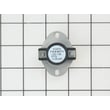
Restricted airflow can also trigger overheating protection. If the dryer runs but heat cycles off too quickly, a failed thermostat can mimic a “blocked” symptom. For this model, common related parts include the dryer high-limit thermostat WE4M137 and the dryer operating thermostat WE4M181.
Why it matters
A clear lint screen and properly vented duct help your dryer dry faster, use less energy, and reduce overheating stress on components like the heating element and thermostats.
You can order replacement parts for your HTDX100ED4WW from the parts list for this model, or search by model number on Sears PartsDirect.
Last updated: February 2026
What does F04 mean on a dryer?
On a Hotpoint HTDX100ED4WW electric dryer, an F04 code is a control fault that points to an unexpected signal in the dryer’s electronics. We treat it as an electrical or control issue first; start with a power reset and then check for heat and airflow problems that can trigger safety shutdowns (see the HTDX100ED4WW owner's manual).
What to do first (safe, quick checks)
- Unplug the dryer (or switch off the breaker) for 2 to 5 minutes, then restore power and try a cycle.
- Confirm the dryer has full power; most electric dryers need two breakers/fuses.
- Clean the lint screen and check that the exhaust airflow is strong outside.
- Make sure the vent uses 4-inch rigid metal duct and is not crushed or restricted.
- If the code returns immediately, stop the cycle and proceed to the deeper checks below.
Common causes on electric dryers like HTDX100ED4WW
F04 is most often tied to one of these conditions:
| Likely cause | What you’ll notice | What typically fixes it |
|---|---|---|
| Overheating from restricted venting | Long dry times, very hot cabinet, burning smell | Clear/shorten venting; follow the installation guide venting requirements |
| Failed safety device (high-limit or safety thermostat) | Dryer runs but heat cuts out, or stops mid-cycle | Replace the failed thermostat (commonly dryer high-limit thermostat WE4M137 or dryer safety thermostat WE4M160) |
| Heating circuit problem | No heat or weak heat | Test/replace the heater (commonly dryer heating element WE11M10001) |
| Control/timer issue | Code repeats with normal airflow and heat checks | Inspect wiring connections; replace the failed control component as needed |
Why venting and overheating matter
Your dryer is designed to exhaust moisture and lint outdoors. When airflow is restricted, temperatures rise and safety thermostats can open to protect the dryer. That protection can show up as fault codes, no-heat symptoms, or repeated shutdowns.
When parts replacement is the right next step
If airflow is correct and the code keeps returning, we focus on the heat safety circuit first because it is a common failure point.
- If the dryer overheats: start with dryer high-limit thermostat WE4M137.
- If heat drops out unpredictably: check dryer safety thermostat WE4M160.
- If there is no heat at all: test the heater and consider dryer heating element WE11M10001.
For ordering, use the parts list for HTDX100ED4WW on this page, or search by model on Sears PartsDirect.
Last updated: February 2026





