 Installation guide
 Owner’s manual
 Error Codes


What is the life expectancy of a Cabrio washer?
A Whirlpool Cabrio-style top-load washer typically lasts 11 years with normal household use and basic maintenance. For your Whirlpool WTW8500DW5, keeping it level, using the right detergent, and replacing wear items on schedule helps you reach that expected lifespan; see the owner's manual.
Most Cabrio-style Whirlpool top-load washers land in the same general range, but real-world life depends on usage and care.
- Loads per week (more cycles equals more wear on the drive system and suspension)
- Overloading (stresses the basket, clutch, and drive components)
- Detergent choice (excess suds can cause performance issues)
- Installation quality (an unlevel washer increases vibration and part wear)
- Preventive maintenance (hoses, cleaning, and quick fixes for small leaks)
Your WTW8500DW5 manual calls out a key interval that directly impacts reliability.
| Item | What to do | When |
|---|---|---|
| Water inlet hoses | Inspect for bulges, kinks, cuts, wear, leaks | Periodically |
| Water inlet hoses | Replace to reduce risk of hose failure | Every 5 years |
| Washer placement | Keep on a level floor; avoid carpet installs | At install and after moves |
| Detergent | Use HE detergent; do not exceed dispenser max line | Every load |
These symptoms often show up as parts wear out; addressing them early can extend service life.
- Loud grinding or slipping during agitation or spin (drive or clutch wear)
- Excessive shaking or banging (suspension wear or unlevel installation)
- Slow draining or standing water (pump or drain restriction)
- Intermittent lid locking or cycle stopping (lid lock issues)
- Long fill times or no fill (water supply or inlet valve problems)
Planning around an 11-year life expectancy helps you decide when to invest in repairs versus replacement. If the washer is close to that age and needs multiple major components (drive, control, basket), costs can add up quickly.
For model-specific maintenance and care steps, use the WTW8500DW5 installation guide. For replacement parts and diagrams for your WTW8500DW5, shop the parts list for this model or search by model number on Sears PartsDirect.
Last updated: February 2026
Is 4.5 cu ft a large capacity washer?
Yes. A 4.5 cu. ft. washer is considered large capacity; it handles bulky items (like a comforter) and bigger mixed loads with fewer cycles. For your Whirlpool WTW8500DW5, use the cycle and load-size guidance in the WTW8500DW5 owner's manual to avoid overloading.
Most large-capacity top-load washers in the 4.5 cu. ft. range are designed for:
- Larger mixed loads (everyday clothes plus towels)
- Bulky items (comforters, blankets, jackets)
- Fewer loads per week compared with smaller tubs
- Better wash action when items can move freely (not packed tight)
Even with a large tub, performance depends on loading correctly:
- Load items loosely; don’t press them down.
- Keep the load balanced; mix large and small items.
- For bulky items, wash 1 large item at a time when possible.
- Use the correct cycle for the fabric and soil level.
- If the washer struggles to spin or drains slowly, reduce load size and check the drain path.
| Washer capacity | Typical use | Common mistake to avoid |
|---|---|---|
| 3.5 to 4.4 cu. ft. | Medium to medium-large loads | Overfilling with towels |
| 4.5+ cu. ft. (large) | Bulky items and larger family loads | Packing items tightly |
| 5.0+ cu. ft. (extra-large) | Very large loads, bulky bedding | Using too much detergent |
A large-capacity washer like the WTW8500DW5 saves time and water by reducing the number of loads, but only when the load can tumble and circulate. Overloading leads to poor cleaning, out-of-balance spinning, and extra wear on drive and suspension components.
If you need replacement parts for your Whirlpool WTW8500DW5 (for example, a draining or spinning issue), you can start with the parts list for this model or search by model number on Sears PartsDirect.
Last updated: February 2026
What is the most common problem with Whirlpool washers?
For Whirlpool top-load washers like model WTW8500DW5, the most common problems we see are drain and spin issues, water leaks, and no-start/lock problems. These often trace back to a clogged drain path, a failing drain pump, a lid lock that will not engage, or a water inlet valve that is not filling correctly.
- Washer will not drain or leaves clothes wet: drain hose kinked, standpipe issue, or a failing drain pump
- Washer will not spin or stops mid-cycle: lid not locking, unbalanced load, drive/clutch wear
- Washer will not fill or fills slowly: restricted inlet screens, low water pressure, inlet valve problem
- Water on the floor: loose hose connections, cracked hose, drain hose backing up
- Loud banging or walking: washer not level, overloaded basket, worn suspension components
- Confirm power and safety basics: plug into a grounded 3-prong outlet (no extension cord).
- Check the drain setup: make sure the drain hose is not kinked and is properly routed into the standpipe or laundry tub.
- Reduce load size and rebalance: bulky items can stop spin and trigger out-of-balance behavior.
- Turn off water when away: helps prevent flooding from pressure surges (covered in the owner's manual).
If the basic checks do not solve it, these model-matched parts are frequent solutions:
| Problem you notice | Common fix | Example part for this model |
|---|---|---|
| Not draining / no spin after drain step | Replace drain pump | Washer drain pump W10876600 |
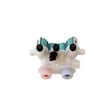
| Will not fill or fills very slowly | Replace inlet valve | Washer water inlet valve W11165546 |
| Won’t start or stops because lid won’t lock | Replace lid lock | Washer lid lock assembly W10810403 |
Drain, fill, and lid-lock problems can look like “the washer is dead,” but they are often single-component failures that stop the cycle for safety. Catching the symptom early helps prevent repeat shutdowns, wet loads, and unnecessary wear on the drive system.
For installation-related issues (leveling, drain hose routing, and required tools), use the installation guide. You can also search parts by model on Sears PartsDirect.
Last updated: February 2026





