Owner’s manual
 Error Codes



How do I tell what model Kenmore fridge I have?
To tell what model Kenmore refrigerator you have, find the model and serial tag on the cabinet (not on a removable drawer). On Kenmore model 79572039111 bottom-mount refrigerators, it is typically inside the fresh food section on a side wall or ceiling, or inside the freezer on an inner wall; confirm the exact location in the 79572039111 owner's manual.
Where to look for the model number tag
Check these common spots first (use a flashlight and look for a sticker or metal plate):
- Inside the refrigerator compartment on the left or right side wall
- On the ceiling of the refrigerator compartment near the light housing
- Inside the freezer compartment on a side wall or back wall
- Behind the lower kick plate (toe grille) at the front bottom
- On the cabinet frame near a door hinge area (with the door open)
What to write down (and why)
Record the full model number and serial number exactly as shown. Kenmore model numbers often include a long string of digits; one missing digit can lead to the wrong parts (water filter, door switch, ice maker) or the wrong service instructions.
| Label item | What it’s used for | Example format |
|---|---|---|
| Model number | Matching parts and diagrams | 79572039111 |
| Serial number | Production date and revisions | Letters + numbers |
| Brand | Cross-referencing manuals | Kenmore |
Tips to avoid common mistakes
- Use the number from the refrigerator cabinet tag, not a number printed on a drawer or shelf
- Include every digit; do not shorten the model number
- If the tag is worn, take a photo and zoom in to confirm characters
- If you are shopping for a filter, match the model number first, then the filter part (for example, genuine Kenmore refrigerator water filter 9690 AGF80300801)
Why it matters
Kenmore refrigerators share similar styling across many series, but parts like the electronic control board, door switch, and water inlet valve can vary by model. Using the exact model number prevents ordering the wrong replacement part.
Last updated: February 2026
How many cubic feet is my Kenmore refrigerator model 79572039111?
The exact cubic feet (total capacity) for Kenmore refrigerator model 79572039111 is listed on the model’s rating label and in the 79572039111 owner's manual. Most Kenmore 795 (LG-built) bottom-mount refrigerators are commonly in the 20 to 22 cu. ft. range.
How to find the exact cubic feet for model 79572039111
Check these two places first; they are the most reliable for your specific unit:
- Owner’s manual: Look for “Specifications” or “Capacity” in the 79572039111 owner's manual.
- Rating label: Usually inside the fresh food compartment on a side wall, near the crisper area, or near the door opening.
- Product data sheet (if included with paperwork): Often lists “Total capacity” and sometimes “Refrigerator” and “Freezer” capacities separately.
- Model tag vs. serial tag: Use the tag that shows the full model number 79572039111.
What “cubic feet” means (and why numbers can look different)
Capacity is the total internal storage volume. Some documents list:
- Total capacity (refrigerator + freezer)
- Refrigerator capacity only
- Freezer capacity only
| Capacity listing | What it includes | Where you’ll see it |
|---|---|---|
| Total capacity | Fresh food + freezer | Manual/spec sheet, rating label |
| Refrigerator capacity | Upper compartment only | Manual/spec sheet |
| Freezer capacity | Bottom drawer only | Manual/spec sheet |
Why it matters
Knowing the correct cubic feet helps when comparing replacement refrigerators, choosing storage accessories, and confirming you are using the right parts and filters for your exact configuration.
Last updated: February 2026
How to read Kenmore model numbers?
Kenmore model numbers read left to right: the first 3 digits are the manufacturer prefix, and the remaining digits identify the exact design and revision. For Kenmore refrigerator model 79572039111, the 795 prefix is the key code we use to match the correct parts and service information.
Where to find the model number on a refrigerator
Look for the rating label in one of these common spots:
- Inside the fresh food compartment on a side wall
- On the door frame when you open the refrigerator door
- Behind the crisper drawers on a side wall
- On the ceiling of the refrigerator compartment near the lights
- On the back exterior panel (less common)
For label-location notes and model-specific details, check the 79572039111 owner's manual.
How to break down a Kenmore model number
Most Kenmore model numbers follow this practical structure for parts lookup:
- Prefix (first 3 digits): manufacturer code (most important)
- Middle digits: platform or base design series
- Ending digits: feature set, color, or production revision
Example using your model
| Section | Example | Meaning |
|---|---|---|
| Manufacturer prefix | 795 | Identifies the manufacturing source used for parts matching |
| Model identifier | 72039111 | Narrows to the exact bottom-mount refrigerator configuration |
Why it matters when ordering parts
Using the full model number prevents fit and wiring mismatches, especially on water and ice components.
- Water filters and housings vary by design
- Ice maker assemblies can differ by revision
- Control boards must match the exact configuration
- Door bins, rails, and drawers are often model-specific
If you are working on the water system, the how to replace the water filter in a Kenmore refrigerator guide helps you identify the filter style and install it correctly.
Last updated: February 2026
How to tell if a Kenmore refrigerator compressor is bad?
On Kenmore model 79572039111, a bad compressor usually shows up as poor or no cooling even though the refrigerator seems to be running, repeated clicking or buzzing from the compressor area, or the unit running almost nonstop without reaching temperature. Confirm the basics first, then move to compressor-specific checks.
Quick symptoms that point to the compressor
- Fresh food and freezer both warm (not just one section)
- Compressor tries to start, then clicks off (often every few minutes)
- Compressor is very hot to the touch after repeated start attempts
- You hear a hum, then a click (start attempt fails)
- No compressor sound at all while interior lights and fans still work
Rule out common look-alikes first (fast checks)
Before blaming the compressor, we check these because they cause the same “not cooling” complaint:
- Make sure the condenser area is not packed with dust and pet hair
- Verify the condenser fan runs when the compressor is running
- Listen for the evaporator fan in the freezer; no airflow can mimic a sealed-system issue
- Check door gaskets for gaps and heavy frost buildup inside
- Confirm temperature settings and allow 24 hours after changes
What to check next (in order)
| What you observe | Most likely cause | What we do next |
|---|---|---|
| Clicks every few minutes, little or no cooling | Compressor start device or overload | Inspect/replace the overload device if applicable; then retest |
| Compressor runs, fans run, still not cold | Sealed system problem (compressor weak, refrigerant issue, restriction) | Technician diagnosis with pressures and temperatures |
| No compressor sound, control panel works | Control or wiring issue | Verify power to compressor circuit and control outputs |
Compressor-specific confirmation (best practice)
A technician confirms compressor condition with electrical and sealed-system tests:
- Measure compressor amperage draw during start and run
- Check winding continuity and insulation to ground
- Verify start components are working correctly
- Evaluate frost pattern and system pressures (sealed system)
If the compressor is confirmed failed, the replacement for this model is the refrigerator compressor TCA38091801. For model-specific operating details and normal sounds, use the 79572039111 owner's manual.
Why it matters
Replacing a compressor is a major repair. Ruling out airflow problems, a failed fan motor, or a start/overload issue prevents unnecessary parts costs and gets cooling restored faster.
Last updated: February 2026
Is it worth replacing a compressor on a refrigerator?
Yes, replacing the compressor on a Kenmore refrigerator model 79572039111 is worth it when the refrigerator is in otherwise good condition and the total repair cost is clearly less than replacing the unit. If the refrigerator is older and has multiple issues, replacement is usually the better value.
Quick decision checklist
We use these practical factors to decide whether a compressor job makes sense:
- Age of the refrigerator: under ~8 years usually favors repair; over ~10 years usually favors replacement
- Total repair cost vs. replacement cost: if repair is over ~50% of a comparable new refrigerator, replacement is typically smarter
- Overall condition: worn door gaskets, cracked liners, noisy fans, or recurring cooling problems push toward replacement
- Warranty/coverage: any parts or labor coverage can swing the decision toward repair
- Food protection and downtime: compressor replacement can take time; plan for food storage
For model-specific safety, access, and service notes, follow the 79572039111 owner's manual.
Typical costs and what they include
A compressor replacement is a sealed-system repair; it is labor-intensive and requires specialized tools.
| Item | What it covers | Why it matters |
|---|---|---|
| Compressor part | The compressor itself | Main component cost (often the biggest line item) |
| Labor | Recovering refrigerant, brazing, evacuation, recharge | Skilled work drives total price |
| Related parts | Filter drier, process tube, sometimes start device | Helps prevent repeat failures |
If you are pricing the part for this model, the refrigerator compressor TCA38091801 is the listed compressor assembly.
When we recommend replacing the compressor
Compressor replacement is usually the right call when:
- The refrigerator is cooling well historically and the failure is sudden
- The cabinet, doors, and drawers are in good shape
- You have no signs of a refrigerant leak (oil residue, repeated loss of cooling after prior sealed-system work)
- You want to keep the same fit and finish (built-in space constraints)
When we recommend replacing the refrigerator instead
Replacement is usually the better value when:
- The refrigerator is 10+ years old
- You have other expensive symptoms (warm freezer, frost issues, fan noise, control problems)
- The repair quote is close to the cost of a new unit
- You have had prior sealed-system repairs
Why it matters
A compressor is the heart of the cooling system. Replacing it can restore normal temperatures and prevent food spoilage, but it is one of the highest-cost refrigerator repairs, so comparing age, condition, and total cost protects your budget.
Last updated: February 2026
What is the average lifespan of a Kenmore refrigerator?
Most Kenmore refrigerators, including bottom-mount models like 79572039111, last 10 to 15 years with normal use. With consistent maintenance (airflow, clean coils, good door seals), it’s common to reach the upper end of that range before major repairs become more frequent.
Typical lifespan ranges (what we see most often)
| Appliance type | Typical lifespan | What usually ends it first |
|---|---|---|
| Kenmore refrigerator (most styles) | 10 to 15 years | Sealed system wear, control issues, cooling fan failures |
| Bottom-mount refrigerator | 10 to 15 years | Evaporator fan, defrost/drain problems, compressor strain |
What helps your refrigerator reach 15 years
- Vacuum or brush the condenser area regularly so the compressor runs cooler.
- Keep door gaskets clean and sealing tightly to prevent constant run time.
- Set stable temps (about 37°F fresh food and 0°F freezer) and avoid frequent changes.
- Don’t overpack; good airflow prevents warm spots and frost buildup.
- Replace water filters on schedule to protect the water system and ice maker.
For model-specific care and cleaning intervals, follow the 79572039111 owner's manual.
Signs your Kenmore is nearing end-of-life
- Compressor runs almost constantly but temperatures still drift warm.
- Repeated frost buildup or water leaks from defrost drain icing.
- Loud fan noise or intermittent cooling (often tied to the evaporator fan).
- Multiple repairs needed within a short period (for example, ice maker plus cooling issues).
Why it matters
Knowing the expected lifespan helps you decide whether to repair or replace. On a 10 to 15 year old refrigerator, a lower-cost fix (like a door switch or water filter) often makes sense, while high-cost sealed system repairs can be harder to justify.
Last updated: February 2026
Why is my Kenmore refrigerator leaking underneath?
On Kenmore refrigerator model 79572039111, water leaking underneath is usually caused by a defrost drain that is clogged or frozen, or by water overflowing the drain pan. Start by clearing the drain path and checking for cracked drain components; then inspect the water supply parts if the leak continues.
Quick checks that fix most leaks
- Unplug the refrigerator before inspecting or clearing ice.
- Look for a sheet of ice on the freezer floor or water under the crisper drawers (common with a blocked defrost drain).
- Flush the defrost drain with warm water (a turkey baster works well) until it flows freely.
- Check the drain pan underneath for cracks, misalignment, or overflow.
- Inspect the water filter area for drips after dispensing water.
- Verify the refrigerator is level front-to-back and side-to-side; poor leveling can cause water to miss the drain pan.
Common leak sources and what you will see
| Leak source | Typical symptom | What to do first |
|---|---|---|
| Defrost drain clogged/frozen | Water under drawers; ice in bottom of freezer | Thaw and flush the drain; clear debris |
| Drain tube restricted | Water returns after a day or two | Inspect/replace the refrigerator drain tube 5251JA3003D |
| Water filter not seated | Drips near filter housing | Reseat filter; replace if damaged |
| Water line or fitting leaking | Puddle near back/bottom | Inspect tubing and connections |
Parts that commonly solve “leaking underneath”
If you find the leak is coming from the drain or water system, these model-matched parts are common fixes:
- Refrigerator drain tube 5251JA3003D if the drain line is split, kinked, or won’t stay clear
- Refrigerator water tubing MJU62070602 if a supply line or internal tube is cracked or rubbing
- Lg refrigerator water inlet valve AJU72992601 if the valve seeps or drips even when not dispensing
- Refrigerator water filter bypass ABN73019101 for testing (bypass the filter housing to isolate a filter-related leak)
Why it matters
Water under the refrigerator can damage flooring and also lead to ice buildup that blocks airflow in the freezer. Fixing the drain path early helps the defrost system work correctly and prevents repeat puddles.
Model-specific help
Use the 79572039111 owner's manual to locate the defrost drain access points, drain pan location, and any cleaning steps recommended for your exact Kenmore bottom-mount design.
Last updated: February 2026
Why is my refrigerator not getting cold at the bottom?
When a Kenmore bottom-mount refrigerator like model 79572039111 is warm at the bottom, the most common causes are restricted airflow or poor heat removal, often from dirty condenser coils, a weak fan, or frost and ice buildup. Start with cleaning and airflow checks before replacing parts.
Quick checks we recommend first
- Set fresh food to about 37°F and freezer to about 0°F, then wait 24 hours to judge results.
- Make sure vents inside the refrigerator are not blocked by food packages.
- Clean dust and pet hair from the condenser area (unplug first).
- Confirm the doors close fully and the gaskets seal all the way around.
- Listen for fans: you should typically hear a fan running when the compressor is running.
Most likely causes (and what to do)
Dirty condenser coils or blocked condenser airflow
Dust on the condenser makes it hard to dump heat, so the refrigerator section can warm up.
- Vacuum coils and the grille area.
- If the condenser fan is not running (on models that use one), cooling performance drops.
Evaporator fan not moving cold air
If the evaporator fan is weak or stopped, cold air does not circulate well to the refrigerator compartment.
- If you hear rattling, squealing, or no fan sound with the compressor running, inspect the fan.
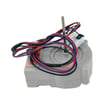
- Consider the refrigerator evaporator fan motor 4681JB1027C if diagnostics point to a failed fan motor.
Frost or ice blocking airflow (defrost issue)
A heavy frost layer on the evaporator can block airflow to the bottom of the refrigerator.
- Check for frost buildup on the freezer back wall.
- A full manual defrost (unplug, doors open, towels down) can restore airflow temporarily.
Symptom-to-cause guide
| What you notice | Most common cause | Best next step |
|---|---|---|
| Freezer cold, fridge bottom warm | Airflow restriction or evaporator fan issue | Clear vents; check fan operation |
| Both sections warm | Condenser coils, condenser fan, or sealed system | Clean coils; verify fans; service if needed |
| Water/ice buildup, warm spots | Defrost drain or defrost problem | Inspect for frost; clear drain path |
Why it matters
Bottom-area warming usually means cold air is not circulating correctly or the system cannot shed heat efficiently. Fixing airflow and coil cleanliness often restores normal temperatures and reduces compressor run time.
Helpful references
- Use the 79572039111 owner's manual for temperature settings, vent locations, and cleaning guidance.
- For fan troubleshooting steps, follow how to fix your evaporator cooling fan.
Last updated: February 2026