Owner’s manual
 Error Codes



How many cubic feet is my Kenmore Elite refrigerator?
For Kenmore model 10658143801 (side-by-side refrigerator), the exact cubic-foot capacity is listed on the model’s rating information and in the specifications section of the 10658143801 owner's manual. Use that spec to match shelves, bins, and storage expectations to your refrigerator’s true size.
How to find the cubic feet on your refrigerator
Check these common places first:
- The model and serial tag inside the fresh food compartment (often on a side wall)
- The specifications section in the 10658143801 owner's manual
- The product description label inside the refrigerator compartment (varies by production run)
- Your original purchase paperwork (sometimes lists capacity)
Typical capacity range for Kenmore side-by-side refrigerators
Most Kenmore side-by-side refrigerators fall into a fairly consistent range. Use this as a quick reality check while you confirm the exact spec for 10658143801.
| Refrigerator style | Typical capacity range (cu. ft.) | Best for |
|---|---|---|
| Side-by-side | 20 to 27 | Narrow door swing, easy freezer access |
| French door | 25 to 30+ | Wide shelves, large fresh-food storage |
Why cubic feet matters
Capacity affects how the refrigerator performs in real life:
- Helps you set realistic expectations for shelf and bin space
- Guides food organization (especially freezer vs fresh food balance)
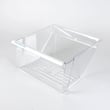
- Supports correct replacement choices for storage parts like the refrigerator shelf WPW10276348 or refrigerator crisper pan WPW10159659
Quick tip if you are comparing to an “Elite” listing
“Kenmore Elite” is a branding label used across multiple refrigerator styles and sizes. The most accurate match is always the capacity tied to your exact model number 10658143801 in the manual specs.
Last updated: January 2026
How wide is a Kenmore side-by-side refrigerator?
Most Kenmore side-by-side refrigerators measure about 33 to 36 inches wide. For Kenmore model 10658143801, use the exact width and door-clearance dimensions listed in the 10658143801 owner's manual so your cabinet opening and door swing clearance match the refrigerator you own.
Typical width ranges (what you should plan for)
These are the measurements that affect fit in a kitchen cutout:
- Cabinet width (box only, no handles): typically 33 to 36 in.
- Overall width (doors closed): typically about 33 to 36 in.
- Width with handles (if handles protrude): typically 34 to 38 in.
- Door swing clearance: often needs 1 to 3 in. beyond the overall width
- Side clearance for airflow/leveling: typically 1/8 to 1/2 in. per side
| What you are measuring | What it includes | Typical side-by-side range |
|---|---|---|
| Cabinet width | Main cabinet only | 33 to 36 in. |
| Width with handles | Cabinet plus handle projection | 34 to 38 in. |
| Opening width to target | Cutout plus clearance | Width + 1/4 to 1 in. |
How we recommend measuring (quick checklist)
Measure your refrigerator and your space before moving the unit:
- Measure the widest point across the front with doors closed
- Measure again including handles (if they stick out)
- Check door swing so bins and the ice bucket can clear walls
- Measure the cabinet opening at the front and back (walls are not always square)
- Confirm you can pull the unit out for service, filter changes, and cleaning
Why it matters
If the refrigerator is even slightly wider than the opening, it can prevent proper leveling, restrict airflow, and make it harder to remove shelves, the ice bin, or the water filter.
Last updated: January 2026
What is the code er 1f on a Kenmore Elite refrigerator?
On Kenmore model 10658143801, the ER 1F (or ER IF) code points to a problem with the freezer evaporator fan (ice fan) circuit, commonly caused by a failed fan motor, ice buildup blocking the fan, or a control issue. Use the 10658143801 owner's manual to confirm the display behavior and access steps.
What to check first (fast, no parts)
- Power reset: Unplug the refrigerator (or turn off the breaker) for 5 minutes, then restore power.
- Listen for the fan: With the freezer door switch held closed, you should typically hear the evaporator fan running.
- Look for frost or ice: Heavy frost on the rear freezer panel often means airflow is restricted and the fan may be hitting ice.
- Check door sealing: A leaking gasket can drive frost buildup and fan errors.
- Confirm temperatures: Target about 0°F in the freezer and 37°F in the fresh food section.
Common causes and likely fixes
| What you notice | Most likely cause | Typical fix |
|---|---|---|
| Loud buzzing or clicking from freezer | Fan blade hitting ice | Defrost the freezer, clear ice, improve door seal |
| No fan sound, warm freezer | Failed evaporator fan motor | Replace the evaporator fan motor |
| Fan runs but code returns | Wiring/connector issue | Inspect harness connections, repair damaged wiring |
| Intermittent error, random behavior | Control board issue | Diagnose control and fan circuit together |
Parts that are often involved
If the fan motor is not running (or is noisy), the evaporator fan system is the first place we focus.
- Refrigerator evaporator fan motor WP2315549 (moves cold air through the freezer and into the fresh food section)
- Refrigerator evaporator fan blade WP2169142 (can crack or slip and cause noise or poor airflow)
Why it matters
That fan is what distributes cold air. When it fails or gets blocked by ice, temperatures rise, ice production drops, and the refrigerator can run longer than normal, which stresses components.
Helpful DIY guidance
Last updated: January 2026