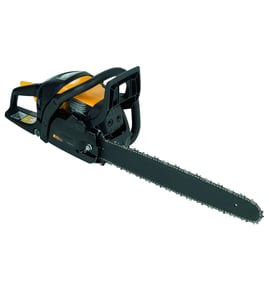

How many cc's is a McCulloch MAC chainsaw?
Engine size (cc) depends on the exact Mcculloch model and engine family, not just the “MAC” name. For your Mcculloch model MAC, we match the correct engine displacement by using the full model identification on the saw (often on the starter housing or crankcase) and then cross-referencing parts by model on Sears PartsDirect.
Use these quick checks on the chainsaw itself; they identify the exact engine version tied to the cc rating:
- Look for the full model and type code on the ID label (not just “MAC”).
- Check the engine tag for a displacement marking (often shown as “cc” or “cm³”).
- Note the serial number range; some production runs use different engines.
- Confirm whether it is a 2-cycle gas saw (most Mcculloch MAC-SERIES saws are).
- Match what you find to the parts breakdown for the exact model identification.
Most homeowner gas chainsaws fall into a few common displacement bands. This helps you sanity-check what you find on the label.
| Typical cc range | Common use | What you will notice |
|---|---|---|
| 30 to 40 cc | Light trimming, small limbs | Lighter weight, shorter bars common |
| 40 to 50 cc | General firewood, storm cleanup | Good balance of power and weight |
| 50 to 60 cc | Heavier cutting, larger rounds | More torque, usually louder and heavier |
The cc rating affects which carburetor settings, fuel line sizes, air filter style, and ignition components your saw uses. Matching parts by the exact model identification prevents hard-starting, rough running, and poor cutting performance.
These issues often get mistaken for “wrong cc” when the real cause is fuel or ignition related:
- Drain old fuel and refill with fresh, properly mixed 2-cycle fuel.
- Check the spark plug condition and gap.
- Inspect fuel lines for cracking or air leaks.
- Clean the air filter and verify the choke is operating.
For step-by-step troubleshooting, use tips for a hard to start chainsaw.
Last updated: February 2026
How do I know what model McCulloch chainsaw I have?
To identify your Mcculloch chainsaw model, we look for the model identification stamp or tag on the saw body. On many Mcculloch saws, the model is stamped into the crankcase area (often on the underside), and those stamped numbers are what you use to match the correct parts list for your saw.
Check these common locations on Mcculloch chainsaws:
- Underside of the crankcase or engine housing (look for stamped characters)
- Near the starter housing or recoil cover
- Around the handle frame or rear handle area
- On a small ID plate or decal (if it has not worn off)
When you find the stamp or tag, record the details exactly as shown:
- Model number (letters and numbers)
- Type or series number (if shown)
- Product number or spec number (if shown)
- Any suffix after the model (for example, a dash and extra digits)
| What you find | Why it matters |
|---|---|
| Model number | Gets you to the correct illustrated parts breakdown |
| Suffix/spec number | Separates similar saws that use different carburetors, fuel lines, or ignition parts |
| Serial number | Helps confirm production run when parts changed mid-series |
Chainsaws that look identical can use different parts (carburetor settings, fuel line routing, bar and chain fit, ignition modules). Using the exact model identification prevents ordering the wrong components and saves time during troubleshooting.
Use these practical checks to narrow it down:
- Compare your bar length and chain pitch/gauge to what the parts list expects
- Note whether it is a gas saw and whether it uses a primer bulb
- Inspect the carburetor and air filter style (common differentiators)
- Use our chainsaw DIY resources to match symptoms to likely systems (fuel, spark, compression)
For repair and identification help while you track down the correct model details, use the chainsaw category landing page. For ordering once you have the model information, search by the exact stamped model number on Sears PartsDirect.
Last updated: February 2026
What happened to McCulloch chainsaws?
Mcculloch chainsaws did not disappear; the Mcculloch name continued under new ownership after the original company changed hands. Today, “Mcculloch” is primarily a consumer outdoor power equipment brand, and parts support typically depends on the exact model identification and the current brand owner’s product line.
Even when a brand changes ownership, the biggest practical issue is parts identification. For the Mcculloch MAC chainsaw, match parts by the model and the specific component (carburetor, fuel lines, ignition, bar and chain, clutch, oiling system) rather than by brand history.
- Use the model number MAC when searching parts diagrams and listings
- Confirm the engine family and serial tag details before ordering
- Expect common wear items to be the first replacements (spark plug, air filter, fuel filter)
- Treat fuel system issues as the most common “won’t start” cause (old fuel, clogged carburetor, cracked fuel lines)
- Prioritize safety parts and adjustments (chain brake function, chain tension, bar condition)
Most consumer gas chainsaws remain serviceable because many components are standard across platforms.
| System | Typical service items | Common symptom when failing |
|---|---|---|
| Fuel delivery | Fuel lines, fuel filter, carburetor | Hard starting, surging, stalls |
| Ignition | Spark plug, ignition module | No start, intermittent spark |
| Cutting system | Chain, guide bar, sprocket | Poor cutting, vibration |
| Oiling | Oil pickup, oil pump, oil line | Dry chain, smoking bar |
Brand ownership changes can affect which exact parts are stocked under a given name, but your repair success still comes down to matching the correct part to the correct model and symptom. That prevents wrong orders and repeat failures.
- Chainsaw category landing page
- Tips for a hard to start chainsaw
- What are the most common replacement parts for chainsaws
If you do not see the part you need listed for this model, we recommend searching by model number and part description on Sears PartsDirect.
Last updated: February 2026
Are McCulloch chainsaws good quality?
Yes. Mcculloch chainsaws, including the Mcculloch MAC chainsaw, are built for solid homeowner-level cutting performance with a focus on usable power, manageable weight, and practical ergonomics. Overall quality depends most on routine maintenance (fuel system, chain condition, and bar lubrication) and correct setup for the job.
Quality shows up in how consistently the saw starts, cuts, and holds adjustment over time. For most gas chainsaws, these are the biggest indicators:
- Starts reliably hot and cold (no excessive priming or repeated pulls)
- Idles smoothly and accelerates without bogging
- Oiler keeps the bar and chain properly lubricated
- Chain stays sharp and tensioned without frequent readjustment
- Anti-vibration and handle layout reduce fatigue during longer cuts
Most “quality” complaints come from fuel, air, or cutting-attachment issues, not the engine itself. We recommend these habits:
- Use fresh, properly mixed fuel (and empty the tank for long storage)
- Clean or replace the air filter regularly
- Keep the chain sharp and set to the correct tension
- Confirm bar oil is flowing before cutting
- Inspect fuel lines and the fuel filter for cracking or leaks
| Symptom | Most common cause | What to check first |
|---|---|---|
| Won’t start | Fuel delivery or spark | Fresh fuel mix, spark plug condition |
| Runs rough | Dirty carburetor or air restriction | Air filter, carburetor settings |
| Leaks gas | Cracked fuel line or loose connection | Fuel lines, tank grommet |
| Cuts slowly | Dull chain or wrong depth gauges | Chain sharpness, file guide use |
A chainsaw can feel “low quality” if it is hard to start, runs rough, or won’t oil the bar. Fixing those basics restores cutting speed, reduces wear on the clutch and bar, and helps prevent overheating.
For model-specific replacement parts and diagrams for your Mcculloch MAC chainsaw, start with the parts list for this model; you can also search by model number on Sears PartsDirect.
Last updated: February 2026
How old is McCulloch chainsaw?
Mcculloch chainsaws have been around since the 1940s; the Mcculloch company began in 1943 and produced its first chainsaw shortly after that. For your Mcculloch model MAC (MAC 4600 11-600465-07), the exact age depends on the specific production year of your unit.
We use the same practical checks on most gas chainsaws to narrow down the build timeframe:
- Look for a data plate or sticker on the starter housing, rear handle, or near the fuel tank
- Write down any serial number, date code, or type/variant marking
- Compare your saw’s features (primer bulb style, choke lever layout, chain brake design) to parts diagrams and common configurations
- Check whether the saw uses older-style carburetor adjustment screws (often indicates an older design)
- Note any emissions labeling (later models often have more prominent compliance labels)
Because the model number alone does not reliably encode the manufacturing year, we recommend using the identification markings on the saw.
| What you have | What it tells you | What to do next |
|---|---|---|
| Serial number or date code | Often the most accurate age clue | Record it exactly, including letters |
| Only model number (MAC) | Identifies the model family, not the build date | Use physical labels and feature clues |
| No readable labels | Age estimate only | Compare visible components and layouts |
Knowing the approximate age helps us match the right carburetor, fuel lines, ignition parts, and bar and chain setup, and it also guides maintenance decisions (fuel system cleaning, replacing brittle lines, and checking crank seals).
If you are asking about age because the saw is hard to start or runs poorly, these guides help you diagnose the most common causes:
You can also search your model and diagrams to match components and order replacements through Sears PartsDirect.
Last updated: February 2026