


How do I tell what model dishwasher I have?
To identify your Kenmore undercounter dishwasher model, open the door and look for the rating label on the inside edge of the tub or door frame. For model 66517795791, the label lists the model number and serial number you need for parts and service.
Where to look for the rating label
Check these common spots first (in order):
- Inside the door, along the left or right inner edge
- On the tub frame just behind the door seal
- Along the top edge of the door opening (under the counter lip)
- On the side wall of the tub near the front
What to write down (and why)
Record both numbers exactly as shown:
- Model number (used to match parts diagrams and compatible replacement parts)
- Serial number (used to identify production run details and version changes)
- Brand (Kenmore) and type (undercounter dishwasher), if listed
Why it matters
Kenmore dishwashers can look similar across multiple model series, but internal parts like the inlet valve, door latch, and spray arm hardware can differ. Using the exact model number helps you avoid ordering the wrong part.
Quick guide: model number vs. serial number
| Item on label | What it tells us | When you need it |
|---|---|---|
| Model number | Which parts fit your dishwasher | Ordering parts, looking up diagrams |
| Serial number | When and where it was built | Confirming version changes |
If the label is hard to read
Try these steps to make it legible:
- Wipe gently with a damp cloth and a drop of dish soap
- Use a flashlight at an angle to reduce glare
- Take a close-up photo and zoom in
- Copy the characters carefully (watch for 0 vs O, 5 vs S)
If you are ordering common wear items once you have the model number, parts like the dishwasher door latch WP3380854 or inlet valve W10844024 are examples of model-matched components you can verify against your parts list.
Last updated: February 2026
How to reset Kenmore 66517795791 dishwasher?
To reset your Kenmore 66517795791 dishwasher, we use a simple control reset that cancels the current cycle and clears many “buttons not responding” situations. The most reliable reset is to cancel and drain, then restore power for a full control reboot.
Quick reset steps (most common)
- Press Cancel/Drain once and close the door.
- Wait 1 to 2 minutes for the dishwasher to drain and stop.
- If the keypad is still unresponsive, turn power OFF at the breaker for 5 minutes.
- Turn power back ON and wait 30 seconds.
- Start a new cycle and confirm the wash motor and fill begin normally.
If the buttons still do not work
A “dead” or partially working keypad is often caused by a door not fully latching, moisture in the console area, or a control that is not getting stable power.
- Open and firmly re-close the door; make sure it clicks shut.
- Check for a stuck key; press each button once to confirm it releases.
- Run a drain reset again after drying the console area.
- If the door will not latch consistently, inspect the latch mechanism.
- If the unit fills but stops, heating or temperature sensing issues can also interrupt cycles.
Parts that commonly relate to reset and control symptoms
| Symptom you see | What to check | Part on this model page |
|---|---|---|
| Door won’t start cycle or buttons seem “ignored” | Door fully latched | Dishwasher door latch WP3380854 |
| Dishwasher won’t fill after reset | Water supply and inlet valve | Inlet valve W10844024 |
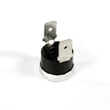
| Cycle stops mid-cycle or acts erratic | Temperature sensing and heating circuit | Thermostat WP661566 |
Why it matters
A proper reset clears a stuck cycle and forces the control to restart its normal sequence (drain, fill, wash). If the dishwasher immediately fails again after a reset, that points to a repeatable issue such as a door latch problem, fill problem, or a heating/temperature fault.
Last updated: February 2026
What are common problems with Kenmore dishwashers?
Common problems on Kenmore undercounter dishwashers like model 66517795791 are no-start issues, poor cleaning, not draining, leaks, and weak drying. These usually trace back to a door-latch problem, restricted water fill, clogged spray paths, or a failing heat or pump component.
Most common symptoms and what they usually mean
- Won’t start or stops mid-cycle: door not latching, latch switch not closing, timer/control issue
- Dishes still dirty: low water fill, blocked spray arm holes, worn seals letting pressure leak off
- Water won’t drain: kinked/clogged drain hose, drain path blockage, pump/impeller issue
- Leaking: loose clamps, worn seals, tub corner baffle/deflector not sealing
- Not drying well: heater circuit issue, thermostat issue, heater mounting/seal leak
Quick checks we recommend first (fast, no parts)
- Confirm the door closes firmly and the latch “clicks.”
- Run hot water at the sink for 30 to 60 seconds before starting a cycle (helps fill temperature).
- Check the bottom of the tub for debris around the sump area.
- Inspect the drain hose routing for kinks and make sure it has a high loop.
- Spin the spray arm by hand to confirm it moves freely.
Parts that commonly fix these problems on model 66517795791
| Problem | Likely part to check | What it affects |
|---|---|---|
| Won’t start | Dishwasher door latch WP3380854 | Door switch signal to run |
| Not filling or fills slowly | Inlet valve W10844024 | Water entering the tub |
| Not draining | Dishwasher drain hose WP3374077 | Drain flow out of the dishwasher |
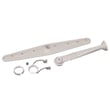
| Poor wash pressure or leaks at spray arm | Dishwasher lower spray arm seal WP3376846 | Spray pressure and sealing |
| Weak drying or water not heating | Thermostat WP661566 | Heater control and temperature sensing |
Why it matters
These symptoms often overlap. For example, a slow fill can look like a wash problem (dirty dishes) and a heat problem (poor drying) because the dishwasher never gets enough hot water to wash and heat properly. Checking fill, spray, and drain basics first prevents replacing the wrong part.
Last updated: February 2026
Why is water standing in the bottom of my Kenmore dishwasher?
Water standing in the bottom of your Kenmore 66517795791 dishwasher almost always points to a drain problem: a blocked filter area, a kinked or clogged drain hose, or a drain component that is not moving water out fast enough. Clearing debris and checking the drain path usually fixes it.
Quick checks we recommend first
- Cancel the cycle and run a drain (if your control has a Cancel/Drain function).
- Remove the lower rack and look for food, glass, labels, or bones around the sump area.
- Check the sink drain and garbage disposer connection (a clogged sink drain can slow dishwasher draining).
- Inspect the drain hose under the sink for kinks, crushing, or a low spot that traps water.
- Make sure the drain hose has a high loop up under the counter to help prevent backflow.
Parts that commonly cause standing water
If the drain path is clear but water still remains, these model-related parts are common suspects:
| Symptom | Most likely cause | What to check next |
|---|---|---|
| Hums but does not drain | Drain pump jammed or failing | Check for debris in the pump area; consider replacing the pump motor |
| Drains slowly | Partial clog or restricted hose | Remove hose and flush; verify disposer inlet is clear |
| Overfills then stops | Float stuck or switch issue | Lift and clean around the float; verify it moves freely |
| Water backs up after draining | Backflow from sink/disposer | Confirm high loop and clear sink/disposer drain |
Helpful parts to consider for Kenmore 66517795791:
- Dishwasher drain hose WP3374077 (cracked, kinked, or internally clogged hose can restrict draining)
- Dishwasher float assembly WP3376397 (a stuck float can interrupt normal operation)
- Pump motor W10428773 (if the unit will not evacuate water even with a clear drain path)
Why it matters
Standing water can lead to odors, poor wash performance, and re-depositing debris on dishes. Fixing the drain path also helps protect the circulation system and heating performance over time.
Safety and troubleshooting tips
- Turn off power at the breaker before checking wiring or removing panels.
- Shut off the water supply if you disconnect hoses.
- If you need to test electrical components, use a meter and follow safe practices; how to use a multimeter to test electrical parts video is a good starting point.
Last updated: February 2026







