Owner’s manual
 Error Codes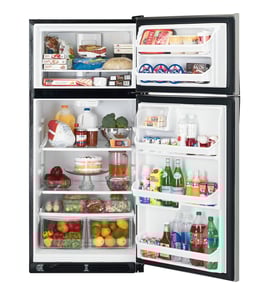



What is a fridge with freezer on top called?
A fridge with the freezer on top is called a top-freezer refrigerator, also commonly called a top-mount refrigerator. Your Kenmore 10671182100 is this style: the freezer compartment sits above the fresh-food section, typically with a separate door for each.
Common names you will see
- Top-freezer refrigerator
- Top-mount refrigerator
- Freezer-on-top refrigerator
- Top freezer (shortened name)
How to confirm the style on your Kenmore 10671182100
The easiest way to confirm the configuration and door layout for your exact unit is to check the diagrams and feature descriptions in the 10671182100 owner's manual.
Here is a quick visual checklist:
- Freezer compartment is the upper door
- Refrigerator compartment is the lower door
- Side-swing doors (not a pull-out freezer drawer)
- Airflow moves between freezer and refrigerator through internal vents
Top-freezer vs other common refrigerator styles
| Style name | Freezer location | Typical door layout |
|---|---|---|
| Top-freezer (top-mount) | Top | 2 side-swing doors |
| Bottom-freezer | Bottom | Upper door + lower drawer/door |
| Side-by-side | Left side | 2 tall vertical doors |
| French door | Bottom | 2 upper doors + lower freezer drawer |
Why it matters
Knowing the style helps when you are shopping for Kenmore 106 model parts, comparing door gaskets, or troubleshooting cooling and airflow issues. On top-mount designs, blocked vents between compartments can cause temperature and moisture problems, so correct loading and airflow are important.
Last updated: January 2026
What is the upper part of a fridge called?
On a Kenmore 10671182100 top-mount refrigerator, the upper part is the freezer compartment. It’s the section designed to keep foods frozen and it also supplies cold air that circulates down into the fresh food (refrigerator) compartment.
What the top (freezer) section does
The freezer compartment is more than just storage for frozen food; it’s a key part of the cooling system.
- Produces and stores frozen foods at the coldest temperatures
- Sends cold air through vents to help cool the refrigerator section
- Helps manage moisture and odors between compartments when airflow is correct
- Often houses the ice maker on models equipped for automatic ice
Airflow basics (why the freezer matters)
Your refrigerator depends on airflow between the freezer and refrigerator sections. When vents are blocked, temperatures can rise and moisture problems can show up.
| If you notice this | Common cause | What to do |
|---|---|---|
| Fridge warm, freezer cold | Refrigerator air vent blocked | Move packages away from vents |
| Frost buildup or wet spots | Restricted airflow, door not sealing | Check vents and door gaskets |
| Odors moving between sections | Shared air circulation | Clean both sections, cover foods |
Quick tips to keep both sections cooling correctly
- Keep food packages from touching or covering freezer vents
- Leave space around items so air can circulate
- Keep doors closed as much as possible to maintain stable temperatures
- Clean spills promptly to reduce odor transfer between compartments
- Follow the vent and temperature guidance in the 10671182100 owner's manual
Why it matters
Because cold air originates in the freezer and circulates to the refrigerator section, anything that disrupts freezer airflow (overpacking, blocked vents, poor door sealing) can cause cooling complaints in the fresh food compartment.
Last updated: January 2026
What size is Kenmore refrigerator model 10671182100?
Kenmore top-mount refrigerator model 10671182100 is a full-size, standard-depth refrigerator; most units in this style are about 30 to 33 inches wide, 65 to 69 inches tall, and 31 to 34 inches deep (not counting the door swing clearance). For exact dimensions, use the 10671182100 owner's manual.
How to get the exact size for your 10671182100
We recommend confirming three measurements: width, height, and depth (plus door clearance).
- Width: measure the cabinet side-to-side at the widest point
- Height: floor to top of cabinet (include hinge cover if present)
- Depth: front of cabinet to back (note: handles can add extra depth)
- Door swing: allow extra space so doors open fully
- Back clearance: leave room for airflow and any water line (if equipped)
Installation clearance guidelines (important)
Your manual calls for ventilation space around the refrigerator. Use these minimum clearances as your baseline:
- 1/2 inch on each side
- 1/2 inch at the top
- At least 2 inches on the hinge side when installed next to a fixed wall (so the door can swing open)
- Extra space at the back if you have an ice maker water line
| What you are sizing for | What to measure | Why it matters |
|---|---|---|
| Fit in the opening | Cabinet width, height, depth | Prevents binding, rubbing, and vibration |
| Door operation | Door swing clearance | Lets bins and shelves clear the wall |
| Cooling performance | Side/top/back clearance | Helps airflow and stable temperatures |
Why it matters
A refrigerator that is too tight in the opening can run hotter, cool less evenly, and be harder to level and align. Proper clearance also helps prevent door seal issues and makes service access easier.
Last updated: January 2026