Owner’s manual
 Error Codes



How to raise a refrigerator off the floor?
To raise a Kenmore 79579433218 top-mount refrigerator, we adjust the two front leveling screws (leveling legs) so the cabinet sits slightly higher in front and is stable. Turn the leveling screws clockwise to raise and counterclockwise to lower, then confirm both doors close easily.
How to raise and level the Kenmore 79579433218
- Unplug the refrigerator if you will be working near wiring or moving it far from the wall.
- Pull the refrigerator straight out to protect the floor and avoid stressing the power cord.
- Use a flat-head screwdriver in the front leveling screw slots.
- Turn clockwise to raise that side; turn counterclockwise to lower.
- Adjust both sides in small, equal increments to keep the cabinet square.
- Recheck door closing; a slight backward tilt helps doors self-close.
For the model-specific leveling procedure, see the 79579433218 use & care manual.
If you need more height than the leveling screws allow
On the 79579433218, the built-in leveling system is intended for leveling and minor height changes. If you need a larger lift (for example, thick carpet transitions), use a rigid, fully supported platform that does not block airflow.
| Option | Best for | Key cautions |
|---|---|---|
| Adjust leveling screws | Small height changes and door closing | Do not over-tilt; keep stable |
| Solid platform/base | Larger lift (1 to 3 inches) | Must support full footprint; keep vents clear |
| Appliance rollers | Frequent moving for cleaning | Can increase vibration; re-level after moving |
Parts that matter (when leveling is difficult)
If a front leg is stripped, bent, or will not turn smoothly, replacing the leg is often the correct fix.
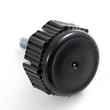
- Refrigerator leveling leg 4779JA3001E: supports the front of the cabinet and provides height/level adjustment.
- Check for debris under the front edge that can prevent the leg from contacting the floor.
- Confirm the refrigerator is not rocking after adjustment.
Why it matters
Proper height and leveling help the doors seal correctly, reduce vibration noise, and keep airflow and cooling performance consistent. A refrigerator that leans forward can cause doors to drift open and create temperature swings.
Last updated: January 2026
How to tell cubic feet of Kenmore refrigerator by model number?
For Kenmore model 79579433218, the cubic-foot capacity is not reliably determined from the model number alone. Kenmore model numbers identify a product series and features, but capacity is typically confirmed from the rating label, product specs, or by calculating interior volume using measurements; see the 79579433218 use & care manual.
Best ways to confirm capacity for model 79579433218
1) Check the rating label (fastest)
Look for the model and serial label inside the fresh-food compartment (often on the side wall or ceiling area). On many refrigerators, the label or nearby documentation lists capacity in cubic feet.
2) Use the model’s documentation
The 79579433218 use & care manual covers multiple related models (795.7940* and 795.7943*). If capacity is listed, it may be shown by variant, so match your exact label (including any color code) to the correct spec.
3) Measure and calculate cubic feet (works for any refrigerator)
Use this method when you cannot confirm capacity from labeling.
- Empty the compartment you’re measuring (refrigerator and freezer can be calculated separately).
- Measure usable interior height, width, and depth in inches (do not include door bins).
- Multiply:
H × W × Dto get cubic inches. - Divide by 1728 to convert to cubic feet.
- Repeat for freezer; add the two results for total capacity.
Quick reference: calculation example
| What you measure | Formula | Result |
|---|---|---|
| Interior volume | H × W × D (inches) | cubic inches |
| Convert to cu. ft. | cubic inches ÷ 1728 | cubic feet |
Why “a digit in the model number” is not dependable
Some brands and product lines use patterns that look like they encode size, but for Kenmore 795-series refrigerators, the model number is not a consistent, customer-decodable capacity code. Using the label, specs, or measurement avoids ordering the wrong shelves, bins, or door gaskets.
Related parts fit tip (why capacity matters)
If you’re shopping parts for this model, confirm the exact model from the label first so you get the right fit for items like a door bin or gasket.
- Door storage can vary by revision and door style.
- Shelf dimensions can differ even within the same series.
- Gasket profiles can vary by door design.
Example part for this model: lg refrigerator door bin MAN62570801.
Last updated: January 2026
What is the average lifespan of 79579433218?
The average lifespan of a Kenmore top-mount refrigerator like model 79579433218 is about 13 years with normal use and basic maintenance (clean condenser area, good door seals, and stable temperatures). Keeping airflow and defrost performance healthy helps it reach that mark.
Typical lifespan and what affects it
Most top-mount refrigerators land in a fairly tight range; the biggest differences come from maintenance and operating conditions.
- Typical lifespan: 13 years
- Heavy use or hot/dirty environments: shorter lifespan
- Good cleaning and correct temperatures: longer lifespan
- Door seal condition: strongly affects compressor run time
- Ice maker and water system upkeep: prevents leaks and icing issues
Quick maintenance checklist (best ROI)
Use these habits to reduce wear on the compressor, evaporator fan, and defrost system.
- Keep refrigerator at 37°F and freezer at 0°F
- Make sure doors close fully; avoid overloading door bins
- Clean dust from the condenser area periodically
- Replace the water filter on schedule (many systems are every 6 months)
- Fix warm spots or heavy frost early (often airflow or defrost related)
Common “end-of-life” symptoms vs. fixable issues
| Symptom | Often fixable? | Common area to check |
|---|---|---|
| Not cooling, compressor runs constantly | Sometimes | Dirty condenser area, door gasket, airflow |
| Clicking, won’t start cooling | Sometimes | Start components, control issues |
| Frost buildup, warm fridge section | Yes | Defrost heater, air damper, evaporator fan |
| Water leaking inside or under unit | Yes | Drain issues, water fittings/valve |
Why it matters
A refrigerator that runs longer and harder than it should (from air leaks, blocked airflow, or dust buildup) puts extra hours on the sealed system. Small fixes like replacing a worn gasket can meaningfully reduce run time and extend service life.
For model-specific care and maintenance intervals, follow the 79579433218 owner's manual.
Last updated: March 2026