Owner’s manual
 Error Codes

How do I tell what model Kenmore dryer I have?
Your Kenmore dryer’s model number is printed on the appliance identification plate; on Kenmore model 41769042991, it’s located on the left side of the door opening. Once you have the full model number, we can match the correct parts, wiring, and troubleshooting steps.
Look for a sticker or metal plate in these common spots:
- Left side of the door opening (most common for Kenmore 417-style dryers)
- Inside the door opening on the cabinet frame
- Back panel of the dryer
- Behind the lint screen housing (on some designs)
For the exact location and how it’s labeled, use the 41769042991 owner’s manual.
Record both numbers exactly as shown:
- Model number (example format: 417.XXXXXXXX)
- Serial number (helps confirm production run and compatible revisions)
- Date of purchase (useful for service history and reference)
| What you see | What it tells us | Why it matters |
|---|---|---|
| Model starts with 417. | Kenmore 417 platform | Helps narrow down the correct parts diagrams and service info |
| Full model number (all digits) | Exact configuration | Prevents ordering the wrong belt, switch, or thermostat |
| Serial number | Build sequence | Helps confirm compatible updates |
Kenmore dryers can look similar across series, but parts like a drum belt, door switch, or thermal limiter can vary by model. Using the full model number helps us match the right replacement part the first time.
If you’re diagnosing a display or flashing-code issue, the Kenmore 417 model dryer error codes guide is the fastest way to translate the code into likely causes.
Last updated: February 2026
How much does it cost to replace a heating element in a Kenmore dryer?
For Kenmore dryer model 41769042991, replacing the heating element typically costs $100 to $350 total when you include parts and professional labor. If you do the repair yourself, the part cost is commonly $20 to $150, depending on whether you replace just the element or a complete heater assembly.
- DIY part only: $20 to $150
- Service call and labor: $80 to $250
- Total installed (most common range): $100 to $350
- Higher totals happen when airflow problems also damaged thermostats or wiring
| Scenario | What you pay for | Typical total |
|---|---|---|
| DIY replacement | Heating element assembly only | $20 to $150 |
| Pro replacement | Part + labor | $100 to $350 |
| Overheating repair | Element + safety thermostats + vent cleaning | $150 to $450 |
On model 41769042991, a “no heat” or “weak heat” repair often includes one or more safety temperature parts along with the heater.
- Frigidaire dryer heating element assembly 131553900
- Thermostat 134120900 (thermal limiter)
- Kelvinator dryer high-limit thermostat 3204267
A failed heating element is often a symptom of restricted airflow (lint buildup, crushed vent, blocked exterior hood). Fixing the heater without correcting airflow can cause repeat failures and longer dry times.
- Clean the lint screen and housing thoroughly.
- Inspect the vent run for kinks, crushing, or heavy lint.
- Confirm the dryer tumbles normally and the blower is moving air.
- Use the wiring diagram and access steps in the 41769042991 owner’s manual to safely test components.
Last updated: February 2026
What is the average lifespan of 41769042991?
The average lifespan of a Kenmore dryer like model 41769042991 is about 13 years with normal household use and basic maintenance. Keeping airflow strong (lint screen and venting) and fixing wear items early helps the dryer reach that full service life.
- Vent restriction (long run, crushed flex duct, clogged hood) raises heat and shortens component life
- Lint screen habits; a clean, properly seated screen improves airflow every load
- Load size; overloading strains the belt, drum support, and motor
- Heat stress; repeated overheating wears thermostats and the heating system
- Wear parts; replacing noisy or slipping parts early prevents bigger damage
| Component | What you notice when it wears | Typical timing |
|---|---|---|
| Drum belt | Drum stops turning, squeal, burning rubber smell | 5 to 10 years |
| Drum bearing/support | Rumbling, scraping, thumping | 7 to 12 years |
| Heating system controls | No heat, overheating, cycling issues | 8 to 15 years |
| Door latch/switches | Won’t start, door won’t stay closed | 8 to 15 years |
- Clean the lint screen before every load
- Check the vent for strong airflow and clean it regularly
- Avoid overloading; dry similar fabrics together
- Stop the cycle when items are slightly damp to prevent overdrying
- Address new noises quickly; they often point to belt or bearing wear
If your dryer is otherwise in good shape, replacing a few wear items can restore reliable operation:
- Belt 134503600 (drum drive belt)
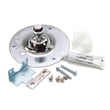
- Dryer drum bearing kit 5303281153 (drum support components)
- Frigidaire dryer heating element assembly 131553900 (electric heat source)
A dryer that runs hot or struggles to move air dries slower, uses more energy, and wears out safety thermostats and heating components faster. Following the care and cleaning guidance in the owner's manual helps protect the drum, heater, and controls.
Last updated: March 2026