Installation guide
 Owner’s manual
 Error Codes

How to hard reset Kenmore washer?
To hard reset your Kenmore washer model 11022102311, we recommend a simple power reset first: unplug the washer (or switch off the breaker) for 1 minute, then restore power and start a cycle. This clears minor control glitches without changing normal cycle operation.
Hard reset steps (power reset)
- Press START/PAUSE/Unlock Lid to stop the cycle.
- Wait until the washer fully stops moving and the lid unlocks.
- Unplug the power cord (or turn off the circuit breaker) for 60 seconds.
- Plug back in (or turn breaker on).
- Select a cycle and press START.
If the washer seems “stuck” after the reset
Some behaviors are normal on this model and can look like a problem:
- During Sensing, the basket may spin in short pulses and you may hear a hum.
- Water may take 2 to 3 minutes to begin filling.
- Opening the lid during Sensing can cause the sensing process to start over when you restart.
Quick checks that prevent repeat issues
- Keep the lid closed during Sensing.
- Avoid tightly packing loads; redistribute items if the washer pauses.
- Use the correct cycle and spin speed for the load.
- Confirm the outlet has power; reset a tripped breaker if needed.
When a “reset” does not fix it (common part-related causes)
If the washer will not start, will not unlock, or stops mid-cycle, the issue is often a safety interlock or drive component rather than the control needing a reset.
| Symptom | What to check first | Parts that commonly relate |
|---|---|---|
| Won’t start or lid won’t lock/unlock | Lid must be closed; wait for movement to stop | Washer lid lock assembly W10404050 |
| Won’t spin or clothes stay wet | Load balance, drain path, cycle selection | Drive system components (belt, pulley) |
Why it matters
A hard reset clears temporary control memory, but it does not correct mechanical problems (like a failing lid lock, belt, or gear case). Using the normal stop and restart steps also prevents the washer from restarting the sensing phase unnecessarily.
For model-specific operating details and control behavior, use the 11022102311 owner’s manual.
Last updated: February 2026
What is the average lifespan of a Kenmore washer?
A Kenmore washer typically lasts 10 to 15 years. For your Kenmore 11022102311 washer, consistent maintenance (especially hose replacement, proper detergent use, and avoiding overloads) helps you reach the high end of that range; neglected wear items can shorten it. See the 11022102311 use and care guide for model-specific care routines.
What affects washer lifespan most
- Load size and balance: frequent overloading strains the drive system and suspension.
- Water quality: sediment can stress the water inlet valve and internal passages.
- Detergent habits: this model is designed for HE (high efficiency) detergent; overdosing can cause residue and odor.
- Hose condition: worn inlet hoses are a common failure point.
- Spin vibration: persistent out-of-balance spinning accelerates wear on the tub support and dampers.
Maintenance that adds years (best practices)
We recommend these habits for the Kenmore 11022102311:
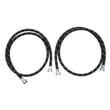
- Replace inlet hoses every 5 years and inspect for bulges, kinks, cuts, wear, or leaks.
- Use HE detergent only and follow the detergent maker’s dosing instructions.
- Run occasional warm or hot cycles (not only cold) to help reduce buildup.
- Keep the lid closed when starting; the washer will not start or fill with the lid open.
- If you pause mid-cycle, wait for the basket to stop before expecting the lid to unlock.
Quick schedule
| Task | How often | Why it matters |
|---|---|---|
| Inspect inlet hoses | Monthly | Prevents sudden leaks and water damage |
| Replace inlet hoses | Every 5 years | Reduces risk of hose failure |
| Review detergent amount | Every load | Prevents residue, odor, and poor cleaning |
| Level the washer | As needed | Reduces vibration and component wear |
Parts that commonly wear first
These are typical wear points on many Kenmore top-load washers; replacing them when symptoms appear can extend service life:
- Washer drive belt WPW10006384 (slipping, squealing, weak spin/agitation)
- Washer lid lock assembly W10404050 (won’t start, lid won’t lock/unlock correctly)
- Washer water inlet valve assembly WPW10683603 (slow fill, no fill, hot/cold fill issues)
Why it matters
A washer usually reaches end-of-life from cumulative wear (drive, suspension, leaks, or control issues), not from one single failure. Staying ahead of hoses, detergent residue, and vibration is the simplest way to keep the Kenmore 11022102311 running reliably for a full 10 to 15 years.
Last updated: February 2026
How can I tell how old my Kenmore washer is?
You can tell how old your Kenmore washer model 11022102311 is by decoding the serial number on the washer’s ID tag. The serial format varies by the manufacturer that built the unit, but the serial always contains a date code you can translate into a month and year.
Where to find the serial number on model 11022102311
Check these common locations first:
- Under the lid on the top rim of the cabinet opening
- On the back of the washer cabinet
- On the rear of the control console area
- On the inside wall of the cabinet near the tub opening
For diagrams and label-location notes specific to this washer family, use the 11022102311 owner’s manual.
How to decode the serial number (what to look for)
Once you have the serial number, look for a date code pattern:
- A leading digit or letter that represents the year
- One or two characters that represent the month (sometimes 01-12, sometimes A-L)
- The remaining characters that identify the production sequence
Quick decode checklist
- Write down the full serial number exactly as shown
- Identify whether the date code is numeric, alpha, or mixed
- Translate the month and year using the correct Kenmore-built-by chart
- Confirm the result by checking if it matches the washer’s design era (controls, lid style, cycle labeling)
Common examples (patterns you may see)
These examples show the kinds of formats you might encounter; your washer’s exact format depends on who manufactured it for Kenmore.
| What you see in the serial | What it usually means | What you get |
|---|---|---|
| First digit looks like a year code | Year indicator | Year of manufacture |
| Next two digits are 01-12 | Month indicator | Month of manufacture |
| Month shown as A-L | Letter-month code | Month of manufacture |
Why it matters
Knowing the manufacture date helps us match the right replacement parts and revisions for your washer, especially for wear items like a washer drive belt WPW10006384 or a washer lid lock assembly W10404050. It also helps you plan maintenance and compare repair cost versus replacement.
Last updated: February 2026
How many cubic feet is a Kenmore Model 11022102311 washer?
The exact tub capacity (cubic feet) for Kenmore washer model 11022102311 is listed in the product specifications section of the documentation; most Kenmore 110-series top-load washers of this design are typically about 3.2 to 3.6 cu. ft. Confirm the exact number in the 11022102311 owner's manual.
How to find the capacity in the documentation
Look for these common labels in the specs/features pages:
- “Capacity” or “Washer capacity”
- “Basket volume” or “Tub capacity”
- “Model specifications”
- “Dimensions and capacity”
- A spec table near electrical and installation details
If you are using the installation paperwork, check the 11022102311 installation guide for any “dimensions/specifications” section; some versions list capacity, but the owner’s manual is the most reliable place.
Typical capacity range (what to expect)
For Kenmore 110-series top-load washers similar to model 11022102311, capacity usually falls into this range:
| Washer type | Typical capacity range |
|---|---|
| Standard top-load (agitator) | 3.0 to 3.6 cu. ft. |
| Large-capacity top-load | 3.8 to 4.3 cu. ft. |
Why it matters
Capacity affects how much laundry you can wash per load and how you should load the basket. Overloading can reduce cleaning performance and contribute to out-of-balance spinning, noise, and extra wear on drive components.
Quick tips for loading based on capacity
- Load loosely; do not pack items down.
- Keep bulky items (blankets, jackets) balanced around the basket.
- If the washer struggles to spin, reduce load size and redistribute.
- Use the correct cycle and water level (if selectable) for the load.
- If agitation seems weak or inconsistent, inspect common wear items like the agitator dog 80040.
Last updated: February 2026
Is it worth repairing a Kenmore washing machine?
For a Kenmore washer like model 11022102311, repairing it is worth it when the fix restores safe, reliable washing for less than replacing the machine, especially for common wear parts (belt, lid lock, suspension) that typically solve no-spin, no-agitate, or out-of-balance problems.
Quick way we decide: repair vs. replace
We use these practical checkpoints before buying a new washer:
- Repair it when the problem is a common wear item (belt, lid lock, actuator, suspension) and the tub and cabinet are in good shape.
- Repair it when symptoms are isolated (won’t spin, won’t start, noisy in spin) and the washer otherwise fills and drains normally.
- Replace it when there is major structural damage (severely rusted cabinet, cracked outer tub) or repeated failures across multiple systems.
- Replace it when the repair requires multiple high-cost assemblies at once (for example, gear case plus additional major components).
- Repair it when you can confirm the issue with the troubleshooting steps in the 11022102311 owner's manual.
Typical repair cost tiers (parts-only)
These examples use common parts for this model family to show how repairs usually stack up.
| Repair type | Common symptom | Example part | Typical value |
|---|---|---|---|
| Low cost | Won’t start or won’t lock | Lid lock | Usually worth repairing |
| Medium cost | Shaking, banging, off-balance | Suspension/damper | Usually worth repairing |
| Higher cost | No agitation/spin, grinding | Gear case/drive system | Compare to replacement |
Parts that often make a repair worthwhile
On Kenmore top-load washers, these parts frequently solve the most common complaints:
- Washer drive belt WPW10006384 for slipping, weak spin, or no agitation
- Washer lid lock assembly W10404050 when the washer will not start or the lid will not lock
- Damper assembly W10780045 for excessive vibration or out-of-balance shutdowns
- Washer brake actuator W11481722 for spin and stopping issues
- Washer gear case W11454741 for loud grinding, no drive, or internal mechanical failure
Why it matters
A targeted repair keeps your 11022102311 running safely and avoids replacing a washer for a single worn component. The manual also notes key safety and operation limits (for example, the washer will not start or fill with the lid open), which helps prevent misdiagnosis. See the installation guide for setup checks that can mimic failures (leveling, drain setup, hose routing).
Last updated: February 2026
Is Kenmore Elite high end?
Yes. Kenmore Elite is Kenmore’s higher-end line, typically offering upgraded features, quieter operation, and more premium styling than standard Kenmore models; the exact “high-end” level depends on the specific Elite model and its feature set. For model-specific operation details, use the 11022102311 owner's manual.
What “high end” usually means for Kenmore Elite
Kenmore Elite models are positioned above base and mid-tier Kenmore appliances. In washers, that usually translates to better wash performance options, more cycle choices, and convenience features.
Common Elite upgrades include:
- More cycle and temperature options (better fabric care flexibility)
- Higher spin performance (better water extraction, shorter dry times)
- Improved controls and displays (easier cycle selection)
- Better noise and vibration control (more stable spinning)
- More robust components in key areas (drive and suspension systems)
How to judge if an Elite washer is “high end” in practice
We recommend comparing the features you will actually use, plus repair part costs and availability for your exact model.
| What to compare | What to look for | Why it matters |
|---|---|---|
| Wash system | Agitator vs. impeller design, cycle options | Cleaning performance and fabric wear |
| Spin performance | Faster final spin, better balance control | Less water left in clothes |
| Serviceability | Common wear parts available | Lower downtime and easier repairs |
| Controls | Simple knobs vs. electronic control panel | Ease of use and diagnostics |
Why it matters
“High end” is most meaningful when it matches your needs: if you want more cycle control, better spin-out, and a quieter laundry area, Elite models are usually a strong step up within the Kenmore lineup.
Model-specific tip for Kenmore 11022102311
Your Kenmore 11022102311 is a top-load washer. If you are evaluating long-term ownership, it helps to know that wear items like the drive belt and lid lock can affect day-to-day satisfaction. For example, a worn belt can cause weak agitation or spin; a failing lid lock can prevent starting.
Helpful parts often involved in these symptoms:
Last updated: February 2026
How to identify a Kenmore washer model?
Your Kenmore washer model number is printed on the appliance ID label; on Kenmore model 11022102311, it’s typically found under the lid opening on the top panel area, and it can also be on the rear panel. Once you have the full number, we can match the correct washer parts and diagrams.
Where to look on a Kenmore washer
Check these common model-number locations first:
- Under the lid, around the tub opening or underside of the top panel (most top-load Kenmore 110 models)
- On the back of the cabinet near the power cord entry
- Along the rear panel edge or lower back area
- Inside the console area (behind the control panel) on some versions
For diagrams and label-location notes specific to your washer, use the 11022102311 owner’s manual.
What the model number looks like (and why it matters)
Kenmore washer model numbers often start with 110 and are usually 11 digits (like 11022102311). Using the exact model number helps us avoid look-alike parts that do not fit, especially for items like a lid lock, drive belt, or water inlet valve.
Quick check table
| What you see on the label | What it usually means | What to do next |
|---|---|---|
| 110XXXXXXXX | Kenmore-built/Whirlpool-built style numbering | Use the full 11-digit model to pick parts |
| Extra letters after the number | Revision/series info | Record everything exactly as shown |
| Only a partial number | Incomplete ID | Recheck under lid and rear panel |
Tips to record it correctly
- Write the model number exactly as printed (all digits)
- Take a clear photo of the label for reference
- If the label is worn, try a flashlight at an angle to read embossed print
- Keep the model number with your installation paperwork from the installation guide
Why it matters
Kenmore washers can share similar cabinets and controls across multiple series; the exact model number ensures the right fit for critical parts like the washer lid lock assembly W10404050 and prevents ordering the wrong replacement.
Last updated: February 2026