Installation guide
 Owner’s manual


How do I tell what model my Kenmore dryer is?
Your Kenmore dryer’s model number is printed on the model and serial number label on the appliance. For Kenmore model 11069732800, use that exact model number when ordering parts or checking electrical and venting requirements in the 11069732800 owner's manual.
Where to find the model number label
We most often see the label in one of these spots:
- Inside the dryer door opening (on the door frame)
- On the back panel of the dryer cabinet
- Near the lint screen housing (depending on the design)
- On the inside edge of the front panel (less common)
What to write down (and why)
The manual recommends recording key details so you can get the right help and the right parts.
- Model number (example: 11069732800)
- Serial number (identifies the production run)
- Purchase date (useful for service history)
Why it matters
Kenmore model numbers can look similar, but small differences change the correct parts list (heating system, timer or control style, door switch style, and drum support components).
Quick ID checklist
Use this checklist to confirm you have the correct number before you shop:
- Copy the model number exactly as printed (no extra spaces)
- Use all digits (Kenmore 110 models are typically long numeric strings)
- Match the model number on the label to the one you search for parts
- Keep a photo of the label for reference
Model number vs. serial number
| Item | What it tells you | Used for |
|---|---|---|
| Model number | The exact dryer design | Parts lookup, manuals, wiring and venting specs |
| Serial number | When and where it was built | Service identification, production details |
Last updated: February 2026
How to take off the front panel of a Kenmore dryer?
To remove the front panel on Kenmore dryer model 11069732800, we disconnect power first, then release the top, remove the front-panel mounting screws (often inside the door opening and along the top edge), and lift the panel up and off while supporting any wiring.
Safety first (before you touch any screws)
- Unplug the dryer or disconnect power at the breaker (the manual warns to disconnect power before servicing).
- If you have a gas version of this platform, close the gas shutoff valve before moving or servicing.
- Wear cut-resistant gloves; cabinet edges can be sharp.
- Keep screws organized by location so reassembly is straightforward.
For model-specific diagrams and fastener locations, use the 11069732800 owner's manual.
Front panel removal steps (typical for this Kenmore style)
- Disconnect power.
- Open the top panel:
- Insert a putty knife a few inches in from each front corner to release the spring clips.
- Lift the top and support it.
- Remove the lint screen (if top-mounted) and any housing screws that secure the top to the front bulkhead.
- Remove front panel screws:
- Look inside the door opening for screws that tie the front panel to the cabinet.
- Remove any screws along the top edge of the front panel (under the raised top).
- Disconnect wiring as needed:
- If the door switch harness is attached to the front panel, unplug it (note orientation).
- Lift the front panel up and off the lower retaining tabs/clips, then pull it forward.
What you can access once the front is off
Common service items behind the front panel include:
- Drum support rollers (often the source of thumping or squealing)
- Belt and idler pulley system
- Blower housing area and lint path
- Door switch and harness routing
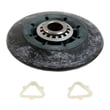
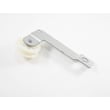
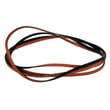
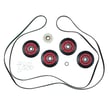
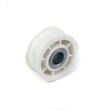
If you are opening the cabinet to address noise or poor tumbling, the dryer repair kit 4392067 is a common bundle used for wear items on many Kenmore 110-style dryers.
Quick reference: what to remove vs. what it affects
| What you remove | Why you remove it | What it exposes |
|---|---|---|
| Top panel clips/screws | Frees cabinet access | Front panel fasteners |
| Door-opening screws | Releases front panel | Drum and belt area |
| Door switch connector | Prevents wire damage | Allows panel to lift off |
Why it matters
Removing the front panel correctly prevents broken plastic tabs, pinched wiring, and air leaks that can worsen drying performance. It also gives you safe access to the drum support, belt path, and lint duct areas.
Last updated: February 2026
What is the average lifespan of 11069732800?
The average lifespan of a Kenmore dryer like model 11069732800 is about 13 years with normal use and routine maintenance. Keeping airflow strong (clean lint, correct venting) and replacing wear parts promptly helps you reach that lifespan.
What affects lifespan most
- Venting and airflow: restricted exhaust overheats components and shortens life.
- Lint control: lint buildup stresses the heater, motor, and thermostats.
- Load size: frequent overloading wears the drum support system and drive parts.
- Heat settings and cycle choice: high heat all the time increases thermal stress.
- Preventive maintenance: simple cleaning reduces breakdowns.
Maintenance that extends life (high impact)
Use the venting and care guidance in the installation guide and operating tips in the owner's manual. Focus on these basics:
- Clean the lint screen before every load.
- Check the outside vent hood for strong airflow.
- Use clamps on vent joints and avoid screws that protrude into the duct.
- Keep flexible metal vent fully extended and supported.
- Vacuum lint from the lint screen housing periodically.
Common wear parts and what they do
These parts often determine whether an older dryer keeps running smoothly:
| Symptom | Likely wear area | Example part for this model |
|---|---|---|
| Squealing, thumping, poor tumbling | Drum support and belt path | Dryer repair kit 4392067 |
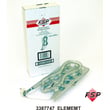
| No heat or weak heat | Heating circuit | Dryer heating element WP3387747 |
| Runs but drum will not turn | Drive system | Drive motor 279787 |
Why it matters
A dryer that takes longer to dry usually has an airflow or heating issue; both increase operating temperature and can shorten the life of the heating element, thermostats, and motor. Correct venting and timely part replacement protect the dryer and your laundry results.
Last updated: March 2026